
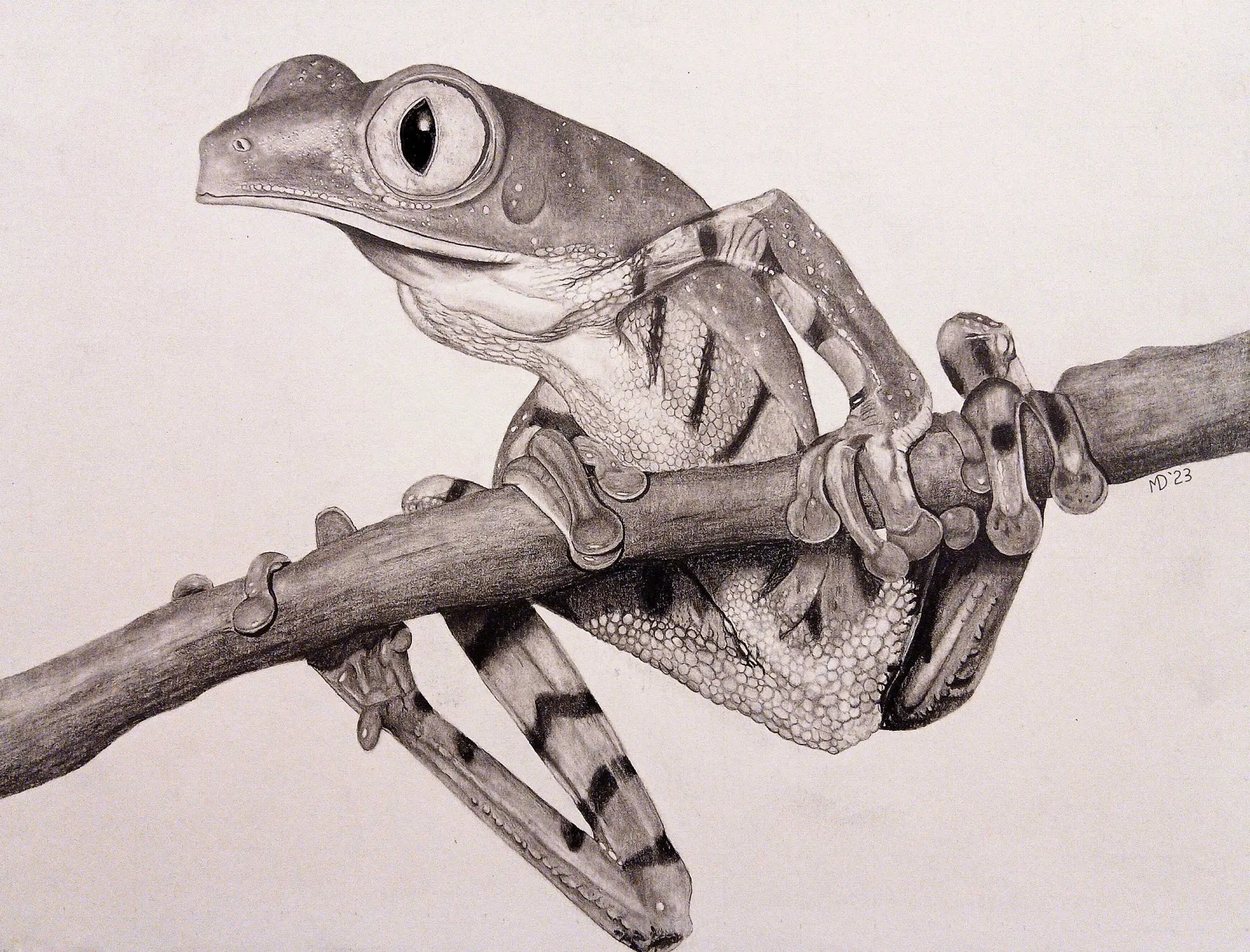
About the Tiger-striped Leaf Frog Drawing
I have always loved treefrogs. Their large eyes, delicate toe pads, remarkable colors, and ability to move almost effortlessly through vegetation made them some of the animals that first drew me toward amphibians. I have never seen a Tiger-striped Leaf Frog (Callimedusa tomopterna) in the wild, but some species become fascinating long before there is an opportunity to encounter them in the wild.
I was immediately drawn to this frog’s unusual proportions—its enormous eye, elongated limbs, expanded toe pads, and almost angular way of gripping the branch. It looks recognizably like a frog, yet also slightly fantastical, as though it were designed for a rainforest fairy tale.
Tiger-striped Leaf Frogs are nocturnal, arboreal inhabitants of the Amazon Basin and surrounding regions of northern South America. During the day, they rest quietly among foliage, where their green upper surfaces help them disappear. At night, they emerge to climb and hunt through the vegetation.
Their most dramatic colors are partly concealed while they are resting. The flanks and long limbs carry bold orange-and-dark markings that become visible when the frog moves, creating the tiger-striped appearance reflected in the common name. The effect combines camouflage with sudden flashes of color.
Like other leaf frogs, they stick their eggs on vegetation above water rather than directly in it. After hatching, the tadpoles drop into the pool below and continue their development there.
Leaf frogs also move differently from many familiar treefrogs. Rather than relying entirely on long leaps, they often climb carefully, extending one limb at a time and wrapping their fingers and toes around stems and branches. That deliberate movement gives them an almost hand-over-hand quality and reinforces the impression of a tiny creature cautiously navigating its own elevated world.
In Forest Pixie, graphite replaces the frog’s vivid coloration with pattern, texture, and form. The dark bars across the long limbs, broad adhesive toe pads, prominent eye, and delicate grip give the animal an appearance that is both biologically specialized and slightly magical.
The title reflects that combination. Poised quietly on the branch, the frog seems like a small, watchful inhabitant of the forest—delicate, strange, and almost too fanciful to be real.
Forest Pixie is a graphite-pencil wildlife drawing of a Tiger-striped Leaf Frog (Callimedusa tomopterna) by Michael E. Dorcas for Tantilla Art.