
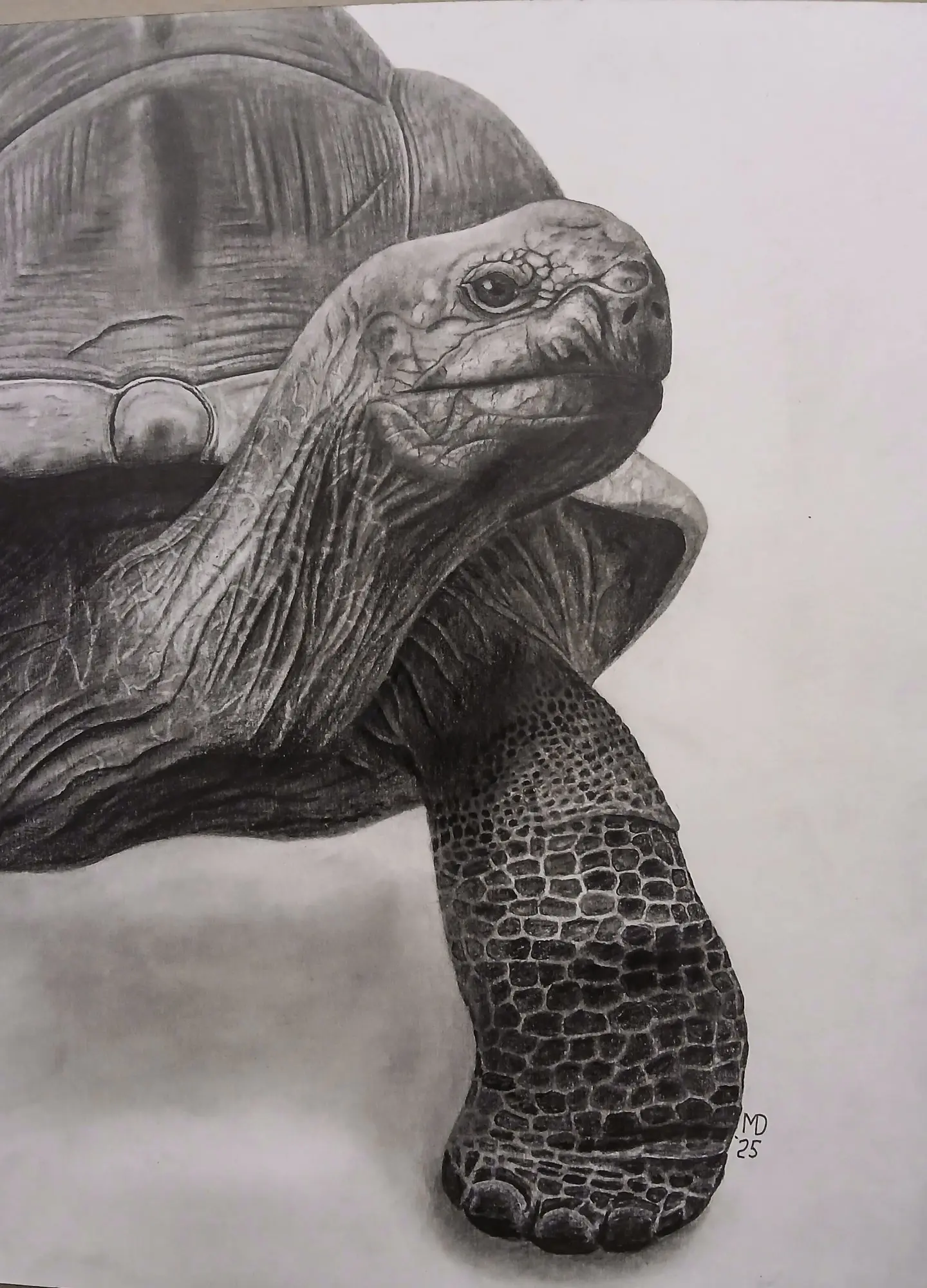
About the Aldabra Giant Tortoise Drawing
I have never seen Aldabra Giant Tortoises (Aldabrachelys gigantea) in the wild, but I came to know them well as a teenage zoo volunteer. When I was fifteen and working at the Fort Worth Zoo, one of my tasks was refilling their food pans with piles of vegetables. Before I could do that, however, I sometimes had to persuade these immense animals to move. They liked to sit directly on their empty pans.
I remember pushing against a tortoise that seemed roughly as movable as a boulder while it regarded me with complete calm and quiet indifference. I could push with all the strength I had, and the tortoise appeared neither impressed nor especially concerned. It seemed perfectly willing to wait until I solved the problem.
Those early encounters gave me a lasting appreciation for Aldabra Giant Tortoises. They are among the largest tortoises in the world, with the biggest males weighing several hundred pounds, and they can live for well over a century. Their great age gives them an almost ancient presence. A large adult may have outlived generations of keepers and witnessed changes extending far beyond a human lifetime.
The species is native to Aldabra Atoll in the Seychelles, a remote group of coral islands in the western Indian Ocean. Giant tortoises once occurred on many islands throughout the region, but sailors and settlers killed them in enormous numbers for food. Their ability to survive for long periods without fresh water made them tragically convenient living provisions aboard ships. The isolation of Aldabra allowed its tortoises to escape the complete destruction suffered by many related island populations.
On Aldabra, the tortoises are not merely inhabitants of the landscape; they help create it. By grazing, browsing, trampling vegetation, dispersing seeds, and opening pathways through dense growth, they function as ecosystem engineers. Their constant feeding produces areas of short, closely cropped vegetation known as “tortoise turf,” a distinctive plant community shaped by generations of grazing.
They are primarily herbivorous, eating grasses, leaves, stems, and fruit, but even these apparently placid vegetarians can be surprising. In 2021, researchers published the first video evidence of an Aldabra Giant Tortoise deliberately hunting another animal. On Frégate Island in the Seychelles, a female tortoise slowly pursued a fallen tern chick along a log, killed it, and ate it. The entire hunt unfolded at tortoise speed, but it was unmistakably intentional.
That observation challenged the familiar image of giant tortoises as strict plant eaters. Like the box turtles I kept as a child, these animals are more behaviorally flexible than their slow movements and calm expressions might suggest. An animal can appear almost monumentally passive while still responding opportunistically to whatever its environment provides.
Their ecological importance has also made Aldabra tortoises valuable in restoration projects. On some islands where native giant tortoises were exterminated, conservationists have introduced Aldabra tortoises to restore lost functions such as grazing, seed dispersal, and vegetation control. Few animals illustrate more clearly how the disappearance of a single species can alter an entire island ecosystem.
In Aldabra, I focused on the animal’s weight, texture, and quiet presence. The close composition emphasizes the massive foreleg, deeply folded neck, weathered head, and direct gaze, while the immense shell rises behind the tortoise and frames the portrait. Graphite allowed me to explore the contrast between the hard geometry of the scales and shell and the softer folds around the neck and face.
The expression reminds me of the tortoises I encountered at the Fort Worth Zoo: attentive enough to know I was there, but completely confident that whatever problem I was trying to solve was mine rather than theirs.
Aldabra is a graphite-pencil wildlife drawing of an Aldabra Giant Tortoise (Aldabrachelys gigantea) by Michael E. Dorcas for Tantilla Art.