
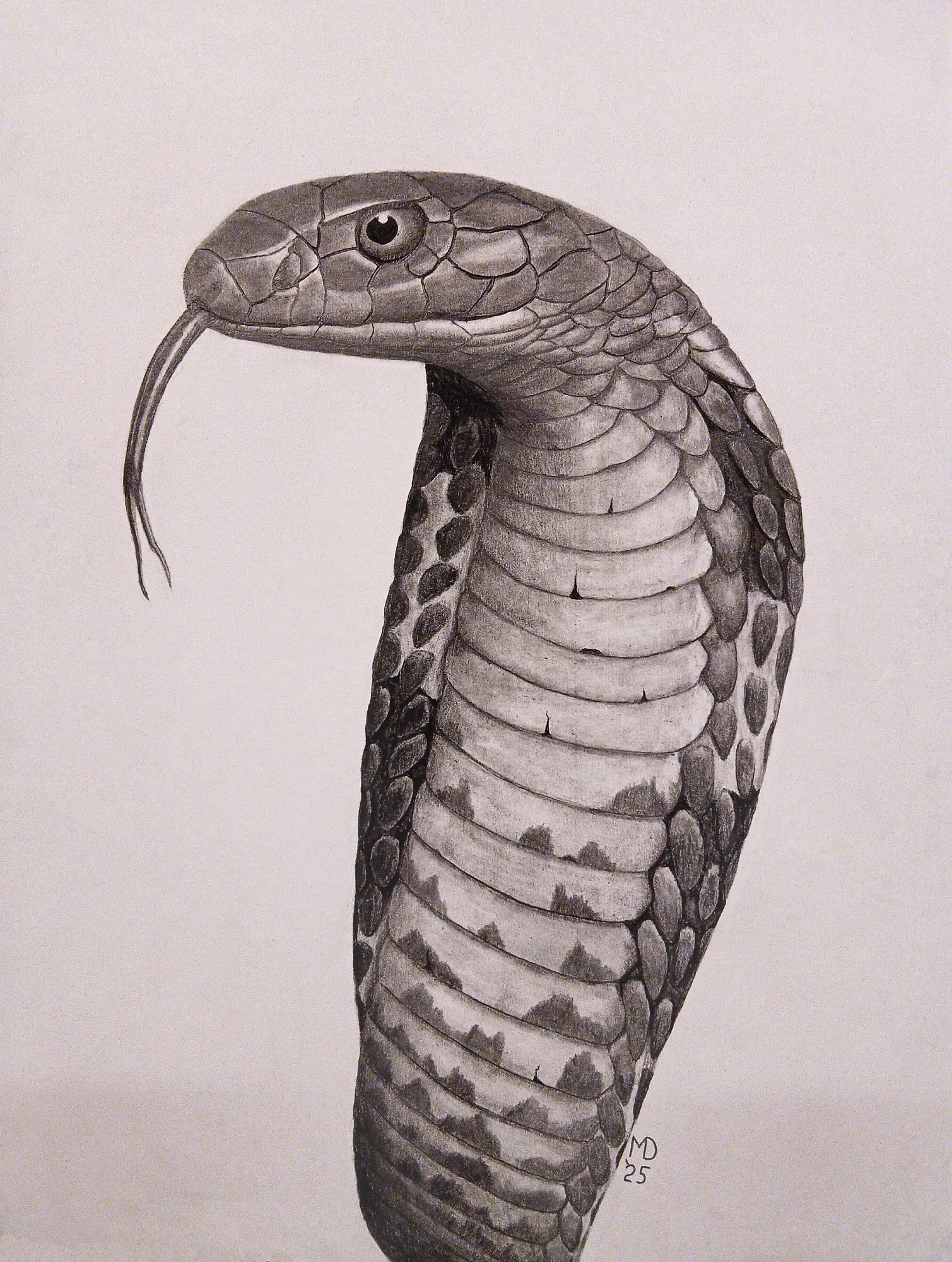
About the King Cobra Drawing
I have never encountered a King Cobra in the wild, although I searched for them in both Borneo and Cambodia. My closest and most memorable experience came much earlier, when I was fifteen and volunteering behind the scenes at the Fort Worth Zoo Reptile House.
Seeing a King Cobra at close range was very different from looking through the public viewing glass. The snake raised its head and looked directly at me, watching me intently. It did not seem frantic or indiscriminately aggressive. It appeared calm, alert, and fully conscious of my presence—as though it were not merely responding to movement but examining the person standing in front of it.
People who work regularly with King Cobras often describe that same impression. Zookeepers and herpetologists tell stories of individuals learning daily routines, anticipating when doors will open, responding differently to familiar and unfamiliar people, and seeming to study whatever is happening around them. Controlled comparisons of intelligence among snake species remain limited, so it would be difficult to prove that King Cobras are more intelligent than other snakes. Nevertheless, experienced keepers repeatedly describe them as unusually attentive and responsive animals.
That reputation may be influenced partly by their exceptional vision. King Cobras are active during the day and frequently raise the head and neck to survey their surroundings. They can lift the front of the body well above the ground, sometimes without spreading the hood, allowing them to see across grass, shrubs, and other low vegetation. When one turns its head and fixes its eyes on a person, the experience feels much more deliberate than the unfocused stare people often imagine when they think of snakes.
They are also the longest venomous snakes in the world. Adults commonly reach ten to twelve feet, and exceptional individuals may approach eighteen feet. Despite that size, they can move rapidly through forests, swim well, climb into vegetation, and lift a substantial portion of the body into an upright defensive posture. A large King Cobra does not merely appear long; it can meet a standing person at an unnervingly personal height.
The name Ophiophagus means “snake eater,” and other snakes form most of the diet. King Cobras hunt rat snakes, pythons, kraits, other cobras, and occasionally smaller members of their own kind. Pursuing such prey requires more than simply overwhelming a helpless animal. The cobra must locate and subdue another flexible, alert predator that may bite, constrict, escape into a narrow refuge, or possess dangerous venom of its own.
King Cobras also produce one of the strangest sounds made by any snake. Instead of the familiar high hiss, a threatened animal may emit a deep, low-frequency sound often described as a growl. Specialized chambers connected with the trachea act as resonators, lowering the frequency of the sound. Heard at close range from a large, upright snake, it has considerably more weight than an ordinary hiss.
Their reproductive behavior is even more remarkable. The female King Cobra is the only snake known to deliberately construct a substantial nest for her eggs. Using loops of her body, she gathers leaves, twigs, and other vegetation into a mound, then deposits her eggs within a protected chamber.
The nest is more than a pile of debris. As the plant material decomposes, it produces heat. Measurements of natural King Cobra nests found that temperatures inside averaged approximately three degrees Celsius warmer than the surrounding environment and fluctuated less dramatically. The female’s construction therefore creates a relatively warm and stable incubator from materials available on the forest floor.
Females commonly remain at or near the nest during much of incubation and may vigorously confront animals that approach. A snake known primarily for eating other snakes thus performs one of the most elaborate forms of reproductive care documented among them. The contrast is striking: a highly dangerous predator using its body not to capture prey, but to build and defend a nursery.
Even the name “King Cobra” now represents more diversity than scientists once recognized. For many years, King Cobras from India through Southeast Asia and Indonesia were treated as a single widespread species, Ophiophagus hannah. A recent taxonomic revision recognized four species. Under that arrangement, the King Cobras I searched for in Cambodia remain within Ophiophagus hannah, while those in Borneo are classified as the Sunda King Cobra, Ophiophagus bungarus.
Because the snake portrayed in this drawing is not intended to represent a securely documented geographic form, I identify it more cautiously as Ophiophagus sp. That uncertainty seems appropriate for an animal whose outward familiarity concealed evolutionary divisions that researchers recognized only recently.
King Cobras possess extremely potent venom and can inject a large quantity in a bite, but they do not normally seek confrontations with people. Their first response is often to escape. The raised body, expanded hood, fixed stare, and low growl are warnings intended to make an approaching threat stop. The display appears commanding because the snake is communicating as clearly as it can.
In Aware, I wanted to portray the quality I remember from that first close encounter at the Fort Worth Zoo. The drawing does not show the snake lunging, striking, or opening its mouth. Instead, the raised head, expanded hood, forward-facing posture, and steady eye create the impression of an animal that has noticed the viewer and is now considering what to do.
The title reflects that moment of mutual observation. I was looking closely at the King Cobra, but the experience was unsettling because the cobra seemed to be looking just as closely at me.
Aware is a graphite-pencil wildlife drawing of a King Cobra (Ophiophagus sp.) by Michael E. Dorcas for Tantilla Art.