
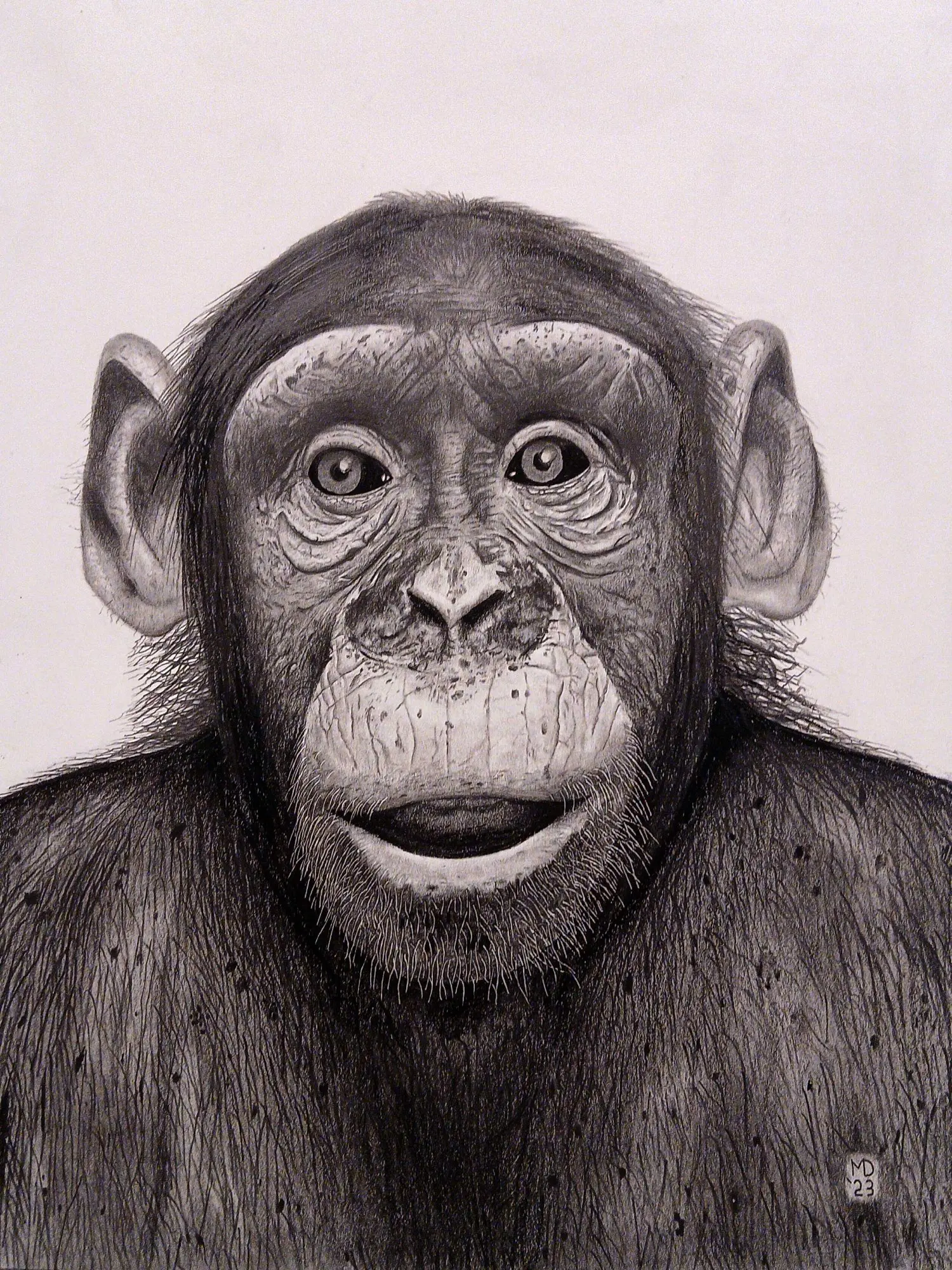
About the Chimpanzee Drawing
I have never seen Chimpanzees (Pan troglodytes) in the wild, but I hope to return to Africa one day to observe them in their natural habitats. Even without that firsthand experience, Chimpanzees have always fascinated me because of their intelligence, individuality, expressive faces, and complex social lives. In Jane’s Amigo, I wanted the direct gaze and closely framed portrait to create an immediate, almost personal encounter between the animal and the viewer.
The title honors Jane Goodall, whose pioneering studies at Gombe transformed our understanding of wild Chimpanzees. Her long-term observations revealed that they make and use tools, including modified stems used to extract termites. She also documented hunting, meat eating, strong family relationships, individual personalities, political alliances, and behaviors passed between generations through observation and learning.
Chimpanzee society is built around constantly changing relationships. Individuals travel in temporary parties that split apart and reunite within a larger community. They groom friends, form coalitions, compete for status, reconcile after conflicts, console distressed companions, and remember who has supported—or opposed—them in the past.
Goodall’s research also revealed a more troubling side of Chimpanzee society. Territorial patrols can lead to coordinated attacks and lethal aggression between neighboring communities. The prolonged conflict at Gombe, sometimes called the Chimpanzee War, demonstrated that their social lives include not only cooperation and affection, but rivalry, violence, and competition for territory.
That combination of familiarity and danger is one reason Chimpanzees make especially inappropriate pets. A young chimpanzee can appear irresistibly humanlike—playful, affectionate, curious, and small enough to be carried. That stage does not last. The animal grows into an adult wild ape with immense physical power, strong opinions, complex emotional needs, long canine teeth, and no natural place within a human household.
A pet Chimpanzee is not a domesticated animal. Domestication results from selective breeding across many generations; hand-raising a wild species does not reproduce that process. Removing an infant from its mother may make the youngster dependent on people, but it does not remove the adult behaviors, instincts, and social needs produced by millions of years of evolution.
The separation itself can be devastating. In the wild, infants remain closely dependent on their mothers for years while learning how to travel, feed, communicate, form relationships, and behave within Chimpanzee society. Infants entering the pet trade may be taken after their mothers and other adults are killed. When human-raised animals later become too strong to manage, sanctuaries may inherit adults that have never learned how to interact normally with their own species.
Popular accounts sometimes claim that a Chimpanzee is five or even ten times stronger than a human. Controlled research suggests that the difference is smaller: Chimpanzee muscle produces roughly 1.35 times the dynamic force and power of human muscle of comparable size. That still creates a formidable animal, especially when combined with powerful arms and shoulders, an extraordinary grip, explosive acceleration, and large canine teeth.
Humans also tend to restrain themselves during ordinary conflicts. An agitated Chimpanzee does not necessarily follow those rules. It may bite, grab, pull, and continue an attack with a speed and intensity that a person cannot match. Familiarity is no guarantee of safety; an adult may seriously injure someone it has known for years.
The best-known American example occurred in Connecticut in 2009. Travis, a fourteen-year-old male Chimpanzee raised and kept as a household pet, suddenly attacked Charla Nash, a woman who knew him well. She survived catastrophic injuries and later received a face transplant. Travis was shot by police. The tragedy became a powerful demonstration that affection, training, and years of apparently manageable behavior cannot transform an adult Chimpanzee into a safe domestic companion.
That does not make Chimpanzees monsters. Aggression is one part of a much broader behavioral repertoire that also includes attachment, play, cooperation, empathy, curiosity, and care. The real mistake is placing a wild ape in circumstances that cannot meet its needs and then expecting it to behave like either a human family member or a conventional pet.
Humans and Chimpanzees share about 98.8 percent of their DNA across directly comparable regions of the genome, although the precise percentage depends on how the comparison is made. That close evolutionary relationship is reflected in behaviors and expressions that can appear strikingly familiar, yet Chimpanzees remain wild animals with their own ecological and social worlds.
As forests are fragmented and farms expand into Chimpanzee habitat, the boundaries between those worlds increasingly overlap. Chimpanzees may forage in cultivated fields, damage crops, or occasionally become involved in dangerous encounters with people. Retaliation can then threaten the animals, while local families bear real economic and safety costs. Successful conservation therefore requires protecting habitat while also helping neighboring communities coexist safely with Chimpanzees.
Through this graphite portrait, I wanted to capture an individual presence rather than simply represent a species. The open expression may seem familiar, but the animal looking back at us remains unmistakably wild. The gaze invites connection without suggesting ownership.
The word Amigo reflects friendship in the sense Jane Goodall has spent her life encouraging: recognition, respect, advocacy, and kinship without possession. To care about a Chimpanzee is not to make it human or bring it into our homes. It is to allow it to remain fully a Chimpanzee.
Jane’s Amigo is a graphite-pencil wildlife drawing of a Chimpanzee (Pan troglodytes) by Michael E. Dorcas for Tantilla Art.