
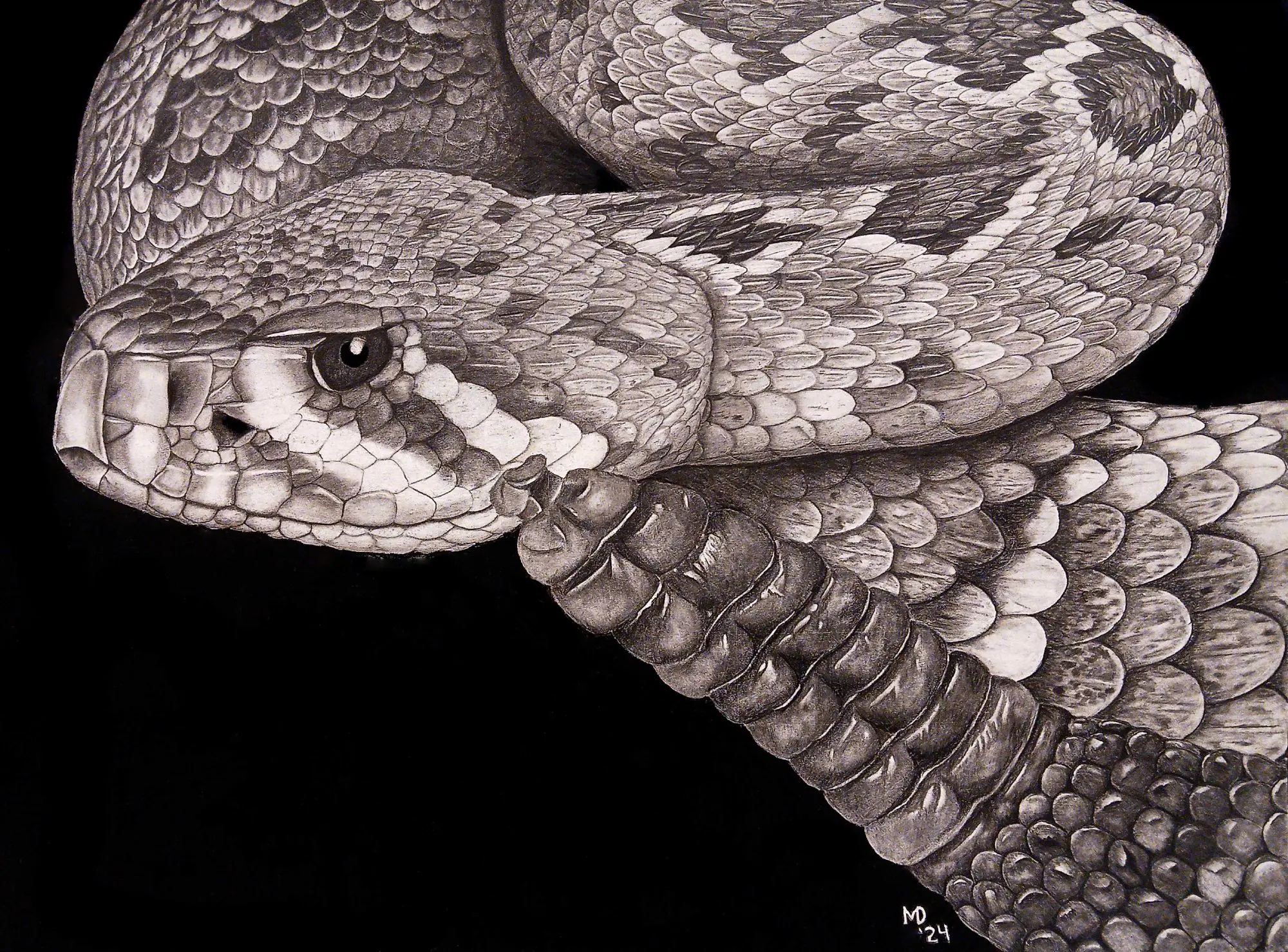
About the Eastern Diamondback Rattlesnake Drawing
I have spent considerable time studying Eastern Diamondback Rattlesnakes (Crotalus adamanteus), including radiotracking animals in the field and examining how temperature and body size influence their metabolism and energy requirements. Working with them reinforced how different these snakes are from the aggressive caricature often presented by people who have never observed them closely.
Eastern Diamondbacks are the largest rattlesnakes in the world. Their immense size, broad heads, prominent rattles, and dark diamond-shaped markings give them an unmistakable presence. Yet much of their lives is built not around aggression or constant activity, but around patience, camouflage, and extraordinary efficiency.
They are primarily ambush predators. A snake may select a promising location beside a rodent trail, coil quietly, and wait for hours or days for prey to pass within range. Heat-sensitive facial pits help it detect warm-bodied animals, even in darkness. After striking a mammal, the snake commonly releases it rather than struggling with potentially dangerous prey, then follows its chemical trail after the venom has taken effect.
That motionless hunting strategy is possible because rattlesnakes require remarkably little energy compared with birds and mammals of similar size. In research with Bill Hopkins and John Roe, I measured oxygen consumption in Eastern Diamondbacks ranging from less than two pounds to nearly eleven pounds at temperatures from 5 to 35°C.
As expected, metabolic rate increased with both body size and temperature. At about 25°C, however, our model predicted that a large snake could meet its basic annual maintenance costs with only a little more than two prey items, each equal to approximately 30 percent of the snake’s body mass. That calculation did not include the additional energy required for movement, digestion, growth, or reproduction, but it still illustrates the extraordinary economy of a large ectothermic predator. An animal that appears massive and formidable can sustain its resting body on surprisingly little food.
Radiotracking revealed another side of their lives. Eastern Diamondbacks are not confined to a single burrow or small patch of woods. They move through large areas containing upland pine forests, wetlands, palmetto thickets, forest edges, and underground refuges. What appears to us as separate habitat patches may be parts of one connected seasonal landscape to a snake.
They are especially associated with the fire-maintained ecosystems of the southeastern Coastal Plain. Historically, frequent fires kept longleaf-pine forests open and supported wiregrass, herbaceous plants, Gopher Tortoises, small mammals, and many other animals. When fire is suppressed, hardwoods and dense shrubs invade, altering the open structure on which much of that community depends.
Gopher Tortoise burrows are particularly important refuges. Eastern Diamondbacks use them for shelter from temperature extremes, fire, predators, and severe weather. One burrow may be used at different times by tortoises, indigo snakes, rattlesnakes, frogs, insects, and many other animals. Protecting the snake therefore means protecting not only an individual species but also the larger ecological community to which it belongs.
Eastern Diamondbacks have a “slow” life history. They require years to mature, and females invest heavily in reproduction rather than producing young every year. Population stability therefore depends disproportionately on the continued survival of mature females. Killing one large adult may remove not merely a snake but many years of accumulated survival and future reproductive potential.
That biology made traditional rattlesnake roundups especially damaging. For decades, hunters collected large numbers of Eastern Diamondbacks for prizes, public spectacle, meat, and skins. Snakes were often driven from Gopher Tortoise burrows by introducing gasoline fumes through a hose—a practice capable of harming the tortoise and the many other animals sharing the burrow.
Historical roundup records documented declining numbers and forced hunters to travel progressively farther to find snakes. In some areas, even roundup organizers and experienced hunters acknowledged that local rattlesnakes had become increasingly scarce. Removing large adults year after year placed direct pressure on a species poorly equipped to replace them rapidly.
Fortunately, attitudes have begun to change. The former roundup at Claxton, Georgia, became the Claxton Rattlesnake and Wildlife Festival in 2012, replacing wild-snake collecting and killing with education and conservation. Whigham, once the last Georgia roundup still collecting Eastern Diamondbacks, adopted a no-kill format in 2022. Its current event displays snakes through conservation organizations and emphasizes education rather than bringing in newly captured animals.
That transformation matters. A community event can still celebrate local history, attract visitors, and support the town without requiring the destruction of the animal at its center. Not every rattlesnake event elsewhere has abandoned wild collection, but the success of the Georgia festivals demonstrates that celebration can replace exploitation.
I have often told people that Eastern Diamondbacks are part of our natural heritage in much the same way that grizzly bears are in Yellowstone. Both are powerful animals capable of seriously injuring a person, and both require caution and respect. But potential danger does not make either animal unnecessary or unworthy of protection. Their continued presence tells us that some part of the wild landscape remains intact.
The rattle itself embodies that relationship. It is not an instrument of attack but an unusually considerate warning. Rather than relying only on camouflage and allowing a person or large animal to come dangerously close, the snake announces its presence and offers an opportunity to stop and move away. A rattling diamondback is not looking for a fight; it is trying to prevent one.
In King of Diamonds, I wanted to portray power without exaggerating aggression. The close composition and dark background concentrate attention on the heavy coils, sharply keeled scales, diamond-shaped patterning, watchful eye, broad head, and prominent rattle. The snake is still and fully composed, but its size and presence are unmistakable.
The title reflects its position as the largest and most imposing member of the rattlesnake family, but also its place within a distinctive American landscape. The Eastern Diamondback is not a monster invading our world. It is an ancient predator shaped by the rhythms of the southeastern Coastal Plain—a king whose remaining domain has steadily grown smaller.
King of Diamonds is a graphite-pencil wildlife drawing of an Eastern Diamondback Rattlesnake (Crotalus adamanteus) by Michael E. Dorcas for Tantilla Art. Reference photograph courtesy of W. W. Lamar.