
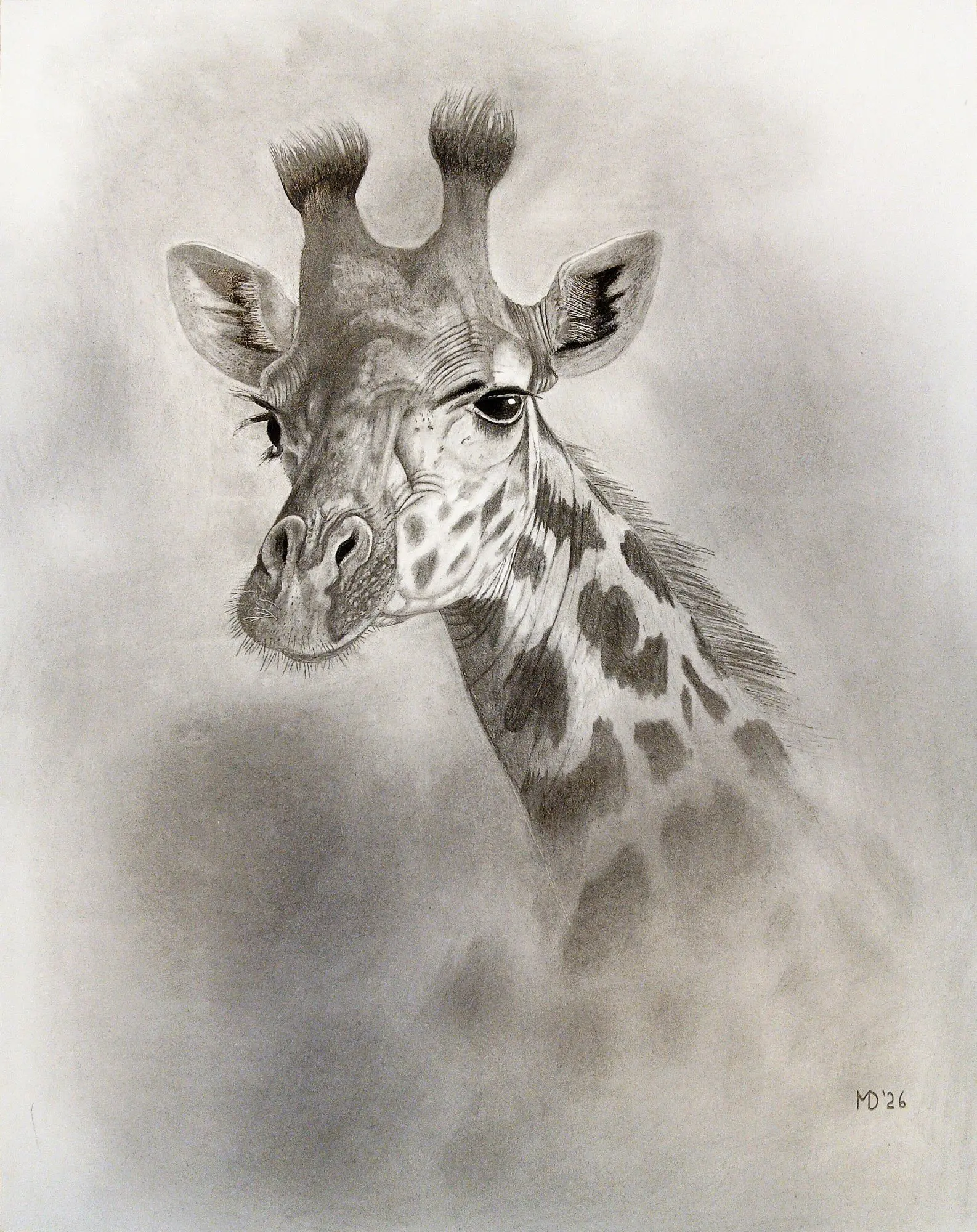
About the Maasai Giraffe Drawing
I never expected to be nearly knocked out by a giraffe.
In 2005, while visiting Kenya with my family, we stopped at a giraffe sanctuary outside Nairobi where visitors could feed the animals from a raised, covered platform. My six-year-old son was holding out food to a giraffe that had extended its head into the platform. As I leaned in beside him, the giraffe suddenly swung its enormous head, and the two of us collided headfirst. The impact left me stunned. I like to think that I nearly knocked the giraffe out as well, although somehow I doubt it.
That visit was part of my first experience seeing Maasai Giraffes (Giraffa tippelskirchi) in Kenya. In the open landscapes of southern Kenya, their height, patterned coats, and unhurried movement seemed inseparable from the land itself. Seeing them there helped make Africa feel real to me—not only through its wildlife, but through the landscapes and people connected to it.
A giraffe may appear almost impossibly constructed. It is the tallest land animal in the world, yet its elongated neck contains only seven cervical vertebrae—the same number found in humans and most other mammals. Each vertebra is simply stretched to extraordinary proportions.
When I taught animal physiology, giraffes provided one of my favorite examples of the challenges imposed by body form. Their hearts must generate exceptionally high blood pressure to push blood upward through the long neck to the brain. Pressure near the heart can be approximately twice that of a human, supported by a powerful heart, thick-walled arteries, and carefully controlled resistance within the blood vessels.
The challenge reverses when a giraffe spreads its front legs and lowers its head to drink. Gravity then favors a potentially dangerous rush of blood toward the brain. Coordinated changes in heart rate, vascular resistance, venous pressure, and the pressures surrounding the brain help keep cerebral blood flow within safe limits. When the giraffe raises its head again—sometimes through a vertical distance of five or six meters—it must maintain enough blood flow to avoid losing consciousness. What looks like a simple drink of water is actually a remarkable physiological performance.
Their height also allows giraffes to reach foliage unavailable to most other browsing animals and gives them an exceptional view of the surrounding landscape. A long, muscular tongue and mobile lips help them select leaves among thorns, while their patterned coats break up the body’s outline in the shifting light beneath trees. No two giraffes have exactly the same pattern of markings.
Their calm appearance can be deceptive. Adult males compete by swinging their necks and heavy heads in powerful contests known as necking—the same basic movement that nearly flattened me on that platform. A well-placed kick can also seriously injure or kill a lion, making an attack on a healthy adult giraffe a dangerous undertaking.
Maasai Giraffes occur primarily in Kenya and Tanzania. Their numbers declined substantially because of habitat loss and fragmentation, illegal hunting, and expanding human development. Encouraging increases have occurred in some protected populations, but their long-term survival still depends on preserving large, connected landscapes through which they can move.
In Long View, I wanted to reflect the giraffe’s elegance and quiet power while preserving the calm, watchful quality of the animal itself. The title refers most obviously to its extraordinary height and ability to see across the landscape, but it also suggests the evolutionary history embodied in its unusual anatomy and the long-term perspective required for its conservation.
The softly fading body and background keep attention on the face, eyes, and distinctive markings, allowing the portrait to emerge gradually from the graphite. Rather than emphasizing the animal’s full height, I concentrated on the intelligence and presence visible in its expression—along with the formidable head that I learned, quite literally, to respect.
Long View is a graphite-pencil wildlife drawing of a Maasai Giraffe (Giraffa tippelskirchi) by Michael E. Dorcas for Tantilla Art.
Exhibition: Selected for the 2026 Exhibizone Kingdom Animalia exhibition.