
About the Green Iguana Drawing
I have known Green Iguanas (Iguana iguana) since childhood, when I kept them as pets, but I later came to know them in a very different way through fieldwork in the tropics. I have observed and captured many of these large lizards in Guatemala, Costa Rica, and Panama, where they belong naturally among rivers, forests, and tropical vegetation.
The bright-green juveniles commonly sold as pets can be misleading. They begin as attractive little lizards that seem easy to accommodate, but adult males may exceed five feet in total length and become immensely strong. Their claws can tear skin, their jaws can deliver a serious bite, and their long muscular tails function as powerful defensive whips. A pet that once fit easily in a child’s hands can eventually require a room-sized enclosure and years of specialized care.
In the wild, Green Iguanas are superb climbers and are frequently found high in trees overhanging rivers. When threatened, they may leap from a branch and plunge into the water below, sometimes from considerable heights. Their laterally compressed tails propel them through the water, allowing them to swim away and remain submerged until danger has passed.
Although adults are primarily herbivorous, eating leaves, flowers, shoots, and fruit, that diet creates physiological challenges. Plant material can contain high concentrations of minerals, particularly potassium, that the kidneys alone cannot eliminate efficiently without losing too much water. Green Iguanas possess specialized nasal glands that remove excess salts from the blood. They expel the concentrated fluid by sneezing, sometimes leaving a pale crust around the nostrils. The behavior can look like a respiratory problem in a captive iguana, but it is part of the animal’s normal regulation of its internal chemistry.
Their digestive systems are equally specialized. A large fermentation chamber in the hindgut contains microorganisms that help break down tough plant material and release nutrients the iguana could not obtain on its own. The lizard and its intestinal community function together, allowing a reptile to live largely on leaves.
One of their strangest features is a light-sensitive organ on top of the head known as the parietal, or “third,” eye. It cannot form a detailed image like the paired eyes, but it detects changes in brightness and shadows passing overhead. For an animal basking openly on a branch, that warning may provide valuable notice of an approaching hawk or other predator.
Green Iguanas are also more socially complex than their often impassive expressions suggest. Males use head-bobs, body postures, color, and the extension of the dewlap to communicate with rivals and potential mates. Females may gather in communal nesting areas and excavate extensive burrow systems in which they deposit their eggs. After emerging, hatchlings may remain together, move through the landscape in groups, and associate with young from other clutches—behavior that challenged the old assumption that young reptiles are entirely solitary from birth.
I have also encountered Green Iguanas in Florida, where they have become established as an invasive species. Their arrival was directly connected to people. They were first documented around Miami in the early 1960s, and a pet dealer reportedly released more than 300 in 1964. Escaped and deliberately released pets contributed further to populations that now occupy much of southern Florida.
Their appetite for foliage, flowers, and fruit makes them particularly noticeable—and often unwelcome—in gardens and landscaped areas. They consume orchids, hibiscus, vegetables, mangos, berries, and many other cultivated plants. Their effects can extend beyond ornamental gardens: feeding by iguanas on nickerbean, an important host plant for the endangered Miami Blue butterfly, may have contributed to the butterfly’s disappearance from one site in the Florida Keys.
The damage is not limited to what they eat. Female iguanas excavate nesting chambers, and other individuals use burrows for shelter. Where populations are dense, these burrows can undermine sidewalks, canal banks, foundations, dams, and seawalls. South Florida’s canal network also provides the iguanas with ideal habitat and convenient corridors through which to expand.
Their tropical origin becomes obvious during unusually cold Florida weather. When temperatures fall sharply, iguanas resting in trees may become stiff and temporarily immobilized, lose their grip, and fall to the ground. They often appear dead but may revive quickly as they warm—creating the peculiar South Florida hazard of large lizards unexpectedly dropping from trees.
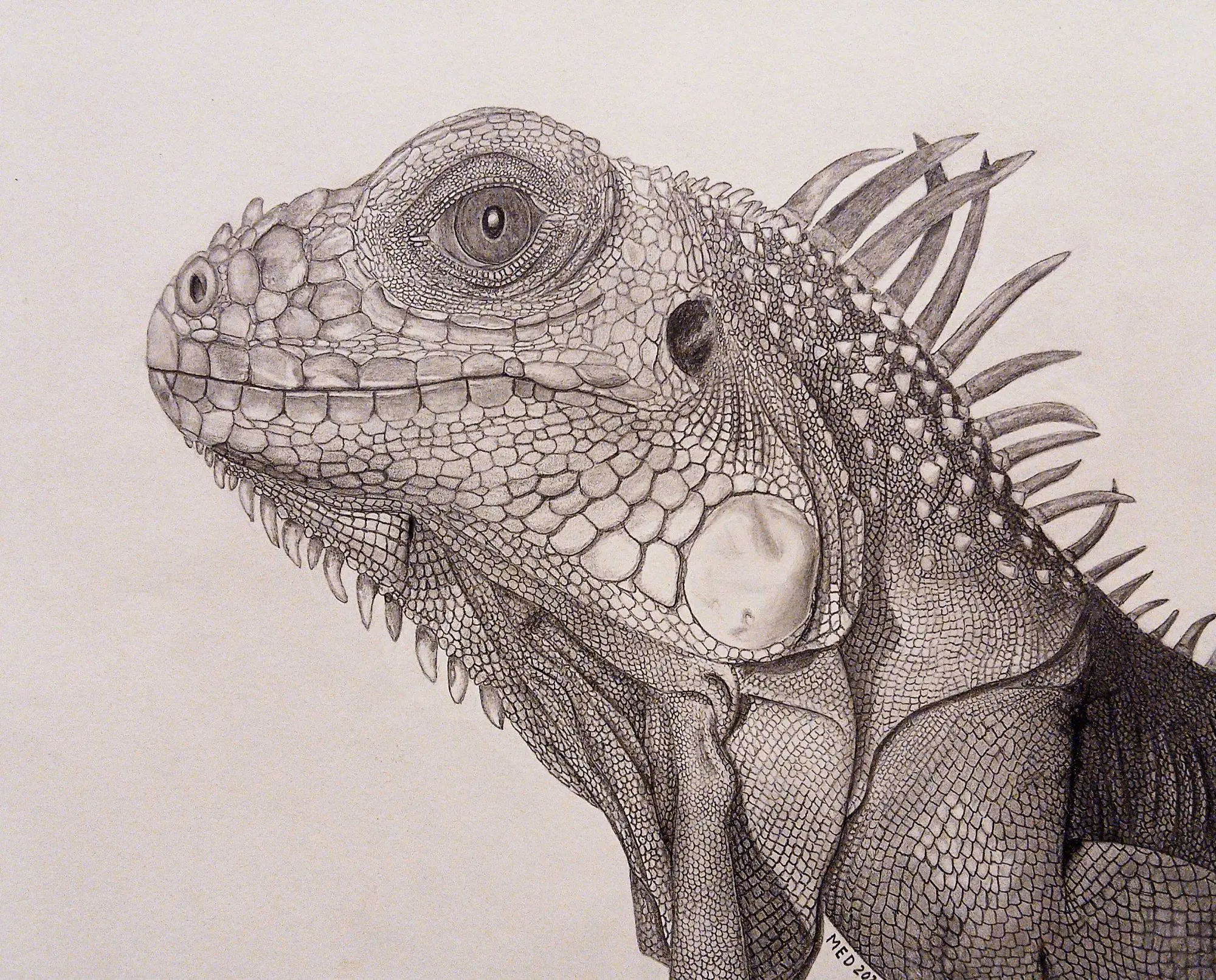
What attracted me to this portrait, however, was not the animal’s color or invasive history, but its extraordinary surface. The enlarged cheek scale, overlapping facial scales, granular skin, dewlap, and dorsal spines create a complex landscape of shapes and textures. Even the scales themselves vary dramatically in size, form, and arrangement across different parts of the head.
In Scales, I made those intricate details the central subject rather than simply portraying the lizard as a whole. Graphite removes the distraction of the Green Iguana’s natural color and emphasizes the geometry, texture, and almost armored construction of its face.
Scales is an 8 × 10-inch graphite-pencil wildlife drawing of a Green Iguana (Iguana iguana) by Michael E. Dorcas for Tantilla Art. Reference photograph courtesy of W. W. Lamar.