
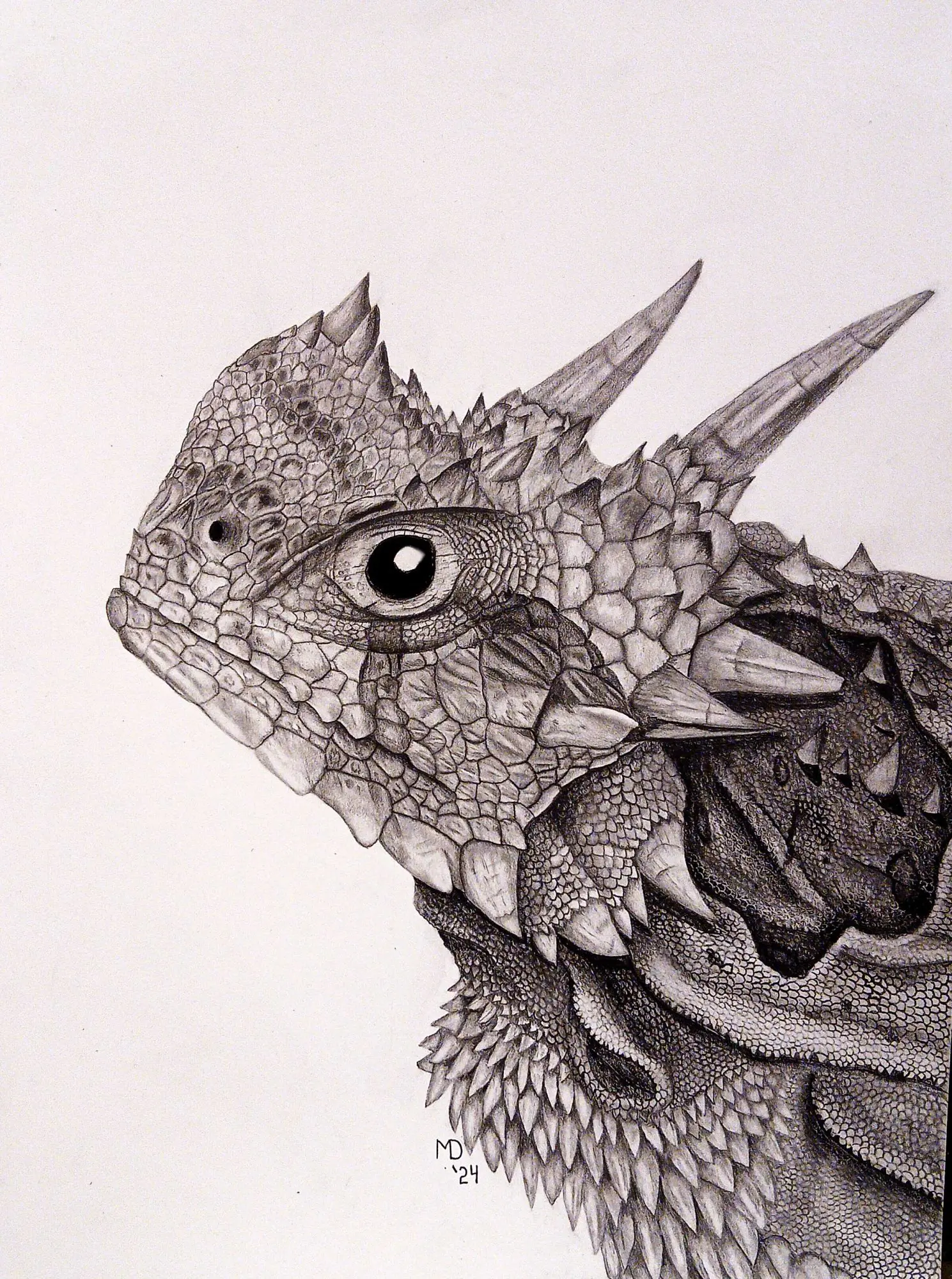
About the Texas Horned Lizard Drawing
I grew up in Texas finding Texas Horned Lizards (Phrynosoma cornutum) regularly, even in my own backyard. Their broad bodies, crown of horns, stillness, and extraordinary camouflage made them some of the most memorable reptiles of my childhood. They looked almost mythical—part tiny dragon, part living piece of the ground itself. By the time I was about twenty, however, they had essentially vanished from the area where I lived.
That disappearance has saddened many Texans of my generation because the little lizard once seemed almost inseparable from the landscape. Their decline likely resulted from a combination of factors, including habitat loss and fragmentation, pesticide use, declines in native harvester ants, the spread of red imported fire ants, and probably collection for the pet trade. The species is now listed as threatened in Texas, and in many places the familiar “horny toad” of childhood memory has become an animal people speak of nostalgically rather than one they still expect to see.
For all their odd appearance, Texas Horned Lizards are highly specialized animals. Much of their diet consists of ants, especially harvester ants, which they gather with quick flicks of the tongue. A horned lizard may consume astonishing numbers of ants in a single day. Their squat body, short legs, and spiny outline are not built for speed, but for a life of basking, waiting, and blending almost perfectly into dry, open ground.
Their defenses are as remarkable as their appearance. When threatened, a horned lizard may flatten its body to cast less shadow, sit absolutely still, or suddenly inflate itself to appear larger and more difficult to swallow. And then there is the famous last resort: some horned lizards, including the Texas Horned Lizard, can squirt blood from the corners of their eyes. The blood comes from ruptured sinuses around the eyes and appears to be especially effective against canid predators such as dogs, coyotes, and foxes. It is one of the strangest and most unforgettable antipredator defenses in the reptile world—so strange, in fact, that it almost sounds invented until you see the literature on it.
The horns themselves contribute to the animal’s unmistakable “royal” appearance, but they are also part of its defense. A predator trying to swallow a horned lizard encounters a body armored with spikes and a head ringed with projecting horns. This small reptile survives not by running from danger, but by becoming difficult, unpleasant, and memorable to attack.
One especially interesting twist in the story of this species is that Texas Horned Lizards have also been introduced outside their native range. Populations established through the pet trade have persisted on several sandy barrier islands in South Carolina, where they appear to be thriving in suitable open habitats. Research on those introduced populations has shown that they survive despite reduced genetic diversity and despite feeding largely on ants other than the harvester ants so important in much of the native range. That does not lessen the importance of conserving the species in Texas, but it is a fascinating reminder that animals sometimes prove more adaptable than we expect.
In Texas Royalty, I wanted to celebrate both the almost regal appearance of this small but iconic lizard and the sense of loss that comes from remembering when it was still common. The close composition and graphite detail emphasize the large, watchful eye, overlapping scales, intricate textures, and crown-like horns that give the animal its unmistakable form.
The title reflects more than geography. To me, the Texas Horned Lizard has always seemed like a kind of native aristocrat of the dry country—fierce-looking, ancient, and instantly recognizable, yet also vulnerable in ways most people never appreciate. It is one of the signature animals of Texas, and one of the reptiles I most associate with childhood wonder.
Texas Royalty is a graphite-pencil wildlife drawing of a Texas Horned Lizard (Phrynosoma cornutum) by Michael E. Dorcas for Tantilla Art.