
About the Texas Rat Snake Drawing
About the Texas Rat Snake Drawing
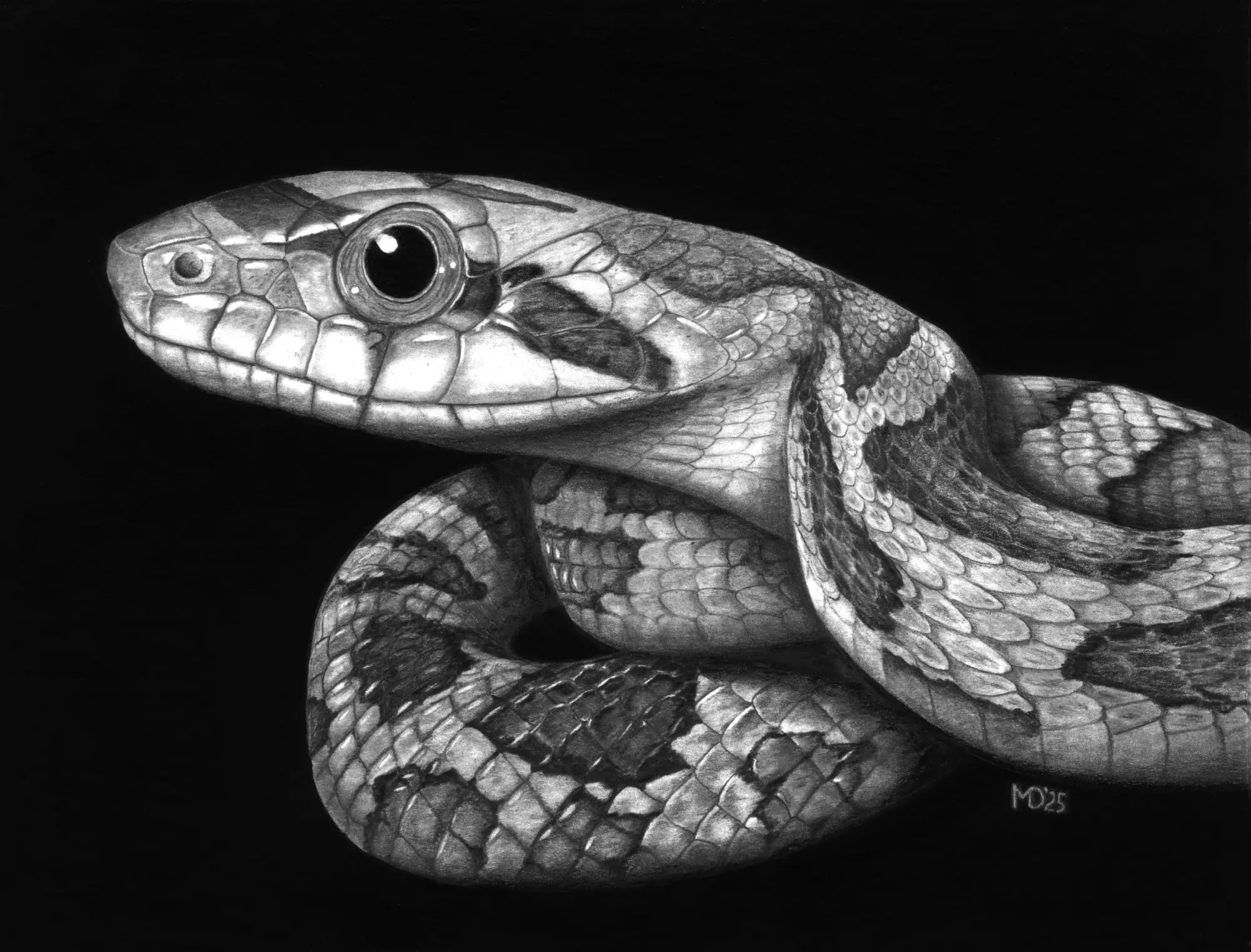
I have encountered rat snakes in many settings over the years, but juveniles have always struck me as especially beautiful. Their bold patterning, large reflective eyes, and slender proportions give them an appearance quite different from that of many adults. Drawn from a photograph by my good friend and fellow herpetologist Bill Lamar, Texas Climber focuses on a young Texas Rat Snake (Pantherophis obsoletus) before age and growth have muted some of that intricate juvenile pattern.
Rat snakes have accumulated a colorful collection of regional names across their broad range. Depending on where a person grew up, the same general group may be known as black snakes, chicken snakes, oak snakes, pilot snakes, or Texas rat snakes. These names often say something meaningful about the animals: their coloration, the habitats where people encountered them, or their habit of entering barns and climbing into birds’ nests. In many ways, those vernacular names preserve more of a snake’s relationship with people and the landscape than a scientific name alone ever could.
The scientific classification has changed repeatedly as researchers have studied geographic variation and genetics. What was once treated as one widespread species with several named subspecies—including black, gray, yellow, and Texas rat snakes—is now generally divided among several species. Under the current arrangement, the Texas Rat Snake is included within the Western Ratsnake, Pantherophis obsoletus. The animals around Davidson, North Carolina, that we historically called Black Rat Snakes are now generally classified as Central Ratsnakes, Pantherophis alleghaniensis. The boundaries are not perfectly abrupt because neighboring lineages interbreed where their ranges meet. The snakes, of course, continue climbing trees, hunting rodents, and moving through the landscape without the slightest concern about what we call them.
Across this broader group, adult coloration varies dramatically with geography. Some animals are yellowish, bright orange, tan, or brown with prominent darker blotches, while others become gray or nearly black. Juveniles generally begin life with dark brown or gray blotches against a much lighter background. That pattern provides camouflage, but it also causes young rat snakes to be mistaken for copperheads and killed. The resemblance is superficial: rat snakes are nonvenomous constrictors and pose little danger to people.
Juveniles eat treefrogs, lizards, small rodents, and other appropriately sized prey. As they grow, mammals become increasingly important, but birds and their eggs can also form a substantial part of the diet. Rat snakes actively search tree cavities, limbs, rafters, nest boxes, and other places where prey may be hidden. Their ability to reach sites that appear inaccessible helps make them effective predators.
They are exceptional climbers throughout their lives. They can ascend tree trunks, move along narrow branches, disappear into openings beneath roofs, and even scale rough brick walls by pressing their bodies against small irregularities in the surface. That ability gives them access not only to bird nests but also to mice and rats living in barns, sheds, attics, and agricultural buildings.
Farmers who understand rat snakes often welcome them in barns because a large snake can consume substantial numbers of rodents without poison, traps, or machinery. The relationship is not entirely uncomplicated—eggs or young poultry may occasionally be taken—but killing the resident “chicken snake” can remove one of the barn’s most effective forms of natural rodent control.
When I was a professor, my students and I used radiotelemetry to follow rat snakes in the Davidson area. One individual provided an especially memorable demonstration of how well these animals can know their surroundings. Each year, it overwintered down a stump hole in the middle of a wooded area. After emerging in spring, it traveled north across the landscape to private property, where it spent much of the summer in and around a barn.
As autumn approached, the snake left the barn, retraced its route south, and returned to the same stump hole in the woods. We documented that annual journey for three years. The snake was not simply wandering until it happened upon suitable shelter. It was moving between two specific destinations—an established summer foraging area and a dependable winter refuge—and finding both repeatedly.
Experiences like that challenge the common perception of snakes as creatures moving almost blindly through the world. Whatever combination of chemical, visual, and other environmental cues that rat snake used, it possessed an intimate working knowledge of its home range. A stump hole that appeared insignificant to us was a critical destination to the snake, remembered and revisited across years.
That fidelity also illustrates why apparently ordinary landscape features matter. A wooded patch, an old stump, a hedgerow, or a barn may each provide a different seasonal resource. The snake’s survival depends not only on those individual places but also on its ability to travel safely between them across roads, lawns, farms, and developed property.
In Texas Climber, the surrounding habitat has been removed completely. The deep black background places all the attention on the reflective eye, overlapping coils, patterned head, and intricate textures of the scales. The pose suggests a snake alert to its surroundings and ready to continue upward, while the title reflects one of the defining abilities of rat snakes throughout their lives.
The drawing also captures a stage that many people fail to recognize. The boldly patterned juvenile may look very different from the large rat snake later encountered in a tree or barn, but it already possesses the climbing ability, predatory instincts, and capacity to learn its surroundings that will define its adult life.
Texas Climber is a graphite-pencil wildlife drawing of a juvenile Texas Rat Snake (Pantherophis obsoletus) by Michael E. Dorcas for Tantilla Art. Reference photograph courtesy of W. W. Lamar.