
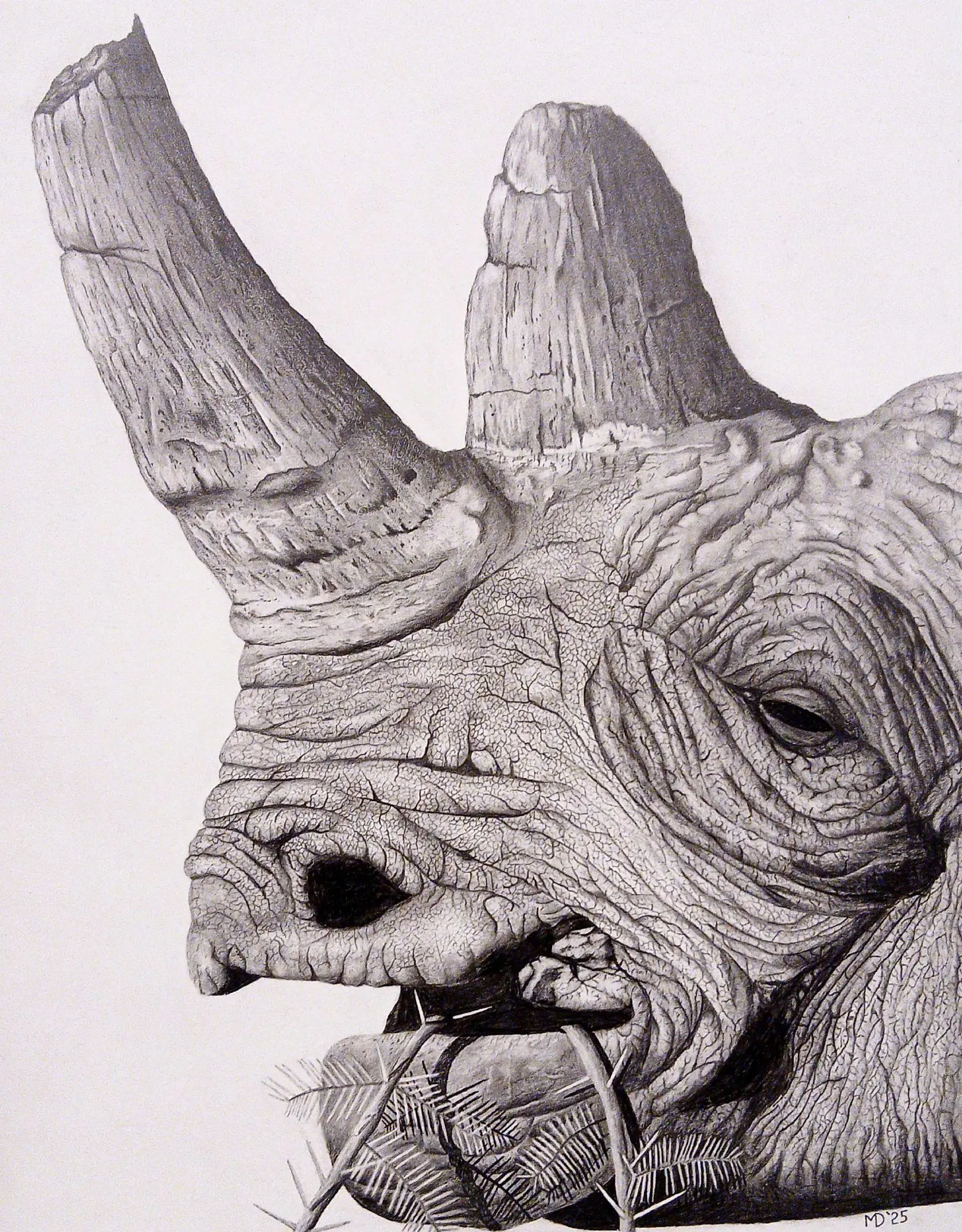
About the Black Rhinoceros Drawing
After seeing rhinoceroses in zoos for much of my life, encountering free-ranging Black Rhinoceroses (Diceros bicornis) in Africa was unforgettable. A zoo can reveal an animal’s anatomy, scale, and behavior, but seeing a rhinoceros moving through its own landscape produces a very different impression. It is not simply a large animal on display. It belongs to the place in a way that feels ancient.
I first saw Black Rhinoceroses with my family in the wild at Lake Nakuru National Park in Kenya’s Rift Valley. Lake Nakuru is widely known for its birdlife, especially its flamingos, but it is also one of Kenya’s most important rhinoceros sanctuaries. Seeing a wild Black Rhinoceros there—massive, watchful, and surrounded by the landscape in which it had evolved—was one of those experiences that no zoo encounter could duplicate.
I later saw them elsewhere in East Africa, including Ngorongoro Crater in Tanzania. The crater is one of the extraordinary wildlife landscapes of the world, a vast volcanic basin containing an exceptional concentration of large animals. Even among elephants, buffalo, lions, wildebeest, and other conspicuous wildlife, the appearance of a Black Rhinoceros carried a special significance. It was not merely another animal sighting. It was an encounter with one of the relatively few survivors of a species that had been driven close to extinction.
Despite their name, Black Rhinoceroses are not actually black; their color varies with the soil and mud covering their skin. They are also called hook-lipped rhinoceroses because of the pointed, flexible upper lip they use to grasp leaves, twigs, and branches. Unlike the broad-mouthed White Rhinoceros, which spends much of its time grazing, the Black Rhinoceros is primarily a browser, moving through shrublands and savannas in search of woody vegetation.
Adult males are usually solitary, while females may be accompanied by their calves and can associate more loosely with other rhinos. Reproduction is slow. After a pregnancy lasting approximately fifteen to sixteen months, a female normally produces a single calf and may not give birth again for several years. That slow pace makes every breeding adult important and prevents populations from recovering quickly when animals are lost.
Black Rhinoceroses can appear ponderous, but they are surprisingly quick and intensely alert. An animal that feels threatened, startled, or uncertain may charge rather than wait to determine another animal’s intentions. At close range, the mass, acceleration, and horns of a rhino make such an encounter potentially lethal.
A healthy adult Black Rhinoceros has little to fear from natural predators. Its size, thick skin, speed, and horns provide formidable protection. Yet those same horns have made the species extraordinarily vulnerable to humans.
Rhino horn consists primarily of keratin, the same basic protein found in human hair and fingernails. Nevertheless, it has commanded enormous prices through illegal markets, where it has been promoted for supposed medicinal uses, carved into luxury objects, and purchased as a symbol of status and wealth. One of the most imposing mammals on Earth has therefore been slaughtered for a substance with no greater magical properties than our own fingernails.
The resulting collapse was catastrophic. Between 1970 and the early 1990s, the world’s Black Rhinoceros population fell by approximately 96 percent—from roughly 65,000 animals to about 2,300. Entire populations disappeared, and the Western Black Rhinoceros was ultimately declared extinct. Intensive protection, translocation, breeding, and anti-poaching efforts have since helped the surviving populations increase to roughly 6,800 animals, but the species remains classified as Critically Endangered.
At the height of the poaching crisis in South Africa, the people killing rhinos were not always opportunistic hunters slipping into reserves with old rifles. Organized criminal networks used high-powered weapons, silencers, night-vision equipment, veterinary tranquilizers, and even helicopters. Once a rhino was down, its horn could be hacked or sawn from its face and removed with horrifying speed.
Kruger National Park, which I visited with Whit Gibbons in 2012, became one of the principal battlegrounds in this conflict. Protecting rhinos there and elsewhere has required armed patrols, aircraft, tracking dogs, surveillance technology, intelligence networks, and cooperation among wildlife authorities and police. Rangers and poachers have exchanged gunfire, and people on both sides have been killed. In some countries and protected areas, anti-poaching forces have operated under controversial shoot-to-kill or shoot-on-sight policies. Rhinoceros conservation has consequently become not only a biological challenge but also a dangerous struggle involving poverty, corruption, organized crime, international trafficking, and difficult questions about law enforcement and human rights.
One particularly grim incident was widely reported in 2018, when suspected rhino poachers entered Sibuya Game Reserve in South Africa’s Eastern Cape. At least two, and possibly three, were apparently attacked and largely eaten by a pride of lions. An axe and other equipment found with the remains supported the conclusion that the men had entered the reserve to kill rhinos.
Conservationists have been forced to adopt measures that would once have seemed almost unimaginable. Some rhinos are now deliberately dehorned under veterinary supervision so that they will present less of a target. The procedure does not permanently remove the horn—it grows back and must be cut again—and even a remaining stump may still attract poachers. Nevertheless, research in the Greater Kruger region has shown that dehorning can greatly reduce poaching. It is a disturbing compromise: removing part of an animal’s natural appearance in the hope that doing so will allow the animal to remain alive.
The broken horn in Survivor is therefore central to the drawing. A rhino’s horn may be damaged naturally through fighting, wear, or accident, but today any shortened or broken horn also carries unavoidable associations with poaching, dehorning, and survival under intense human pressure. The animal in the drawing is scarred and weathered, but it remains upright, alert, and formidable.
I concentrated on the rough hide, deep folds of skin, damaged horn, heavy head, and watchful eye. Graphite allowed me to explore those textures while stripping away the distractions of color. The result is not intended simply as a portrait of physical power. It is a portrait of endurance.
The title Survivor refers both to the individual animal and to the species itself. The Black Rhinoceros survived one of the most severe population collapses experienced by any large mammal, but its future remains dependent on extraordinary protection. Its continued existence is a conservation achievement, although it is also an indictment of a world in which an animal of such strength must be guarded from humans every day of its life.
Survivor is a graphite-pencil wildlife drawing of a Black Rhinoceros (Diceros bicornis) by Michael E. Dorcas for Tantilla Art.