
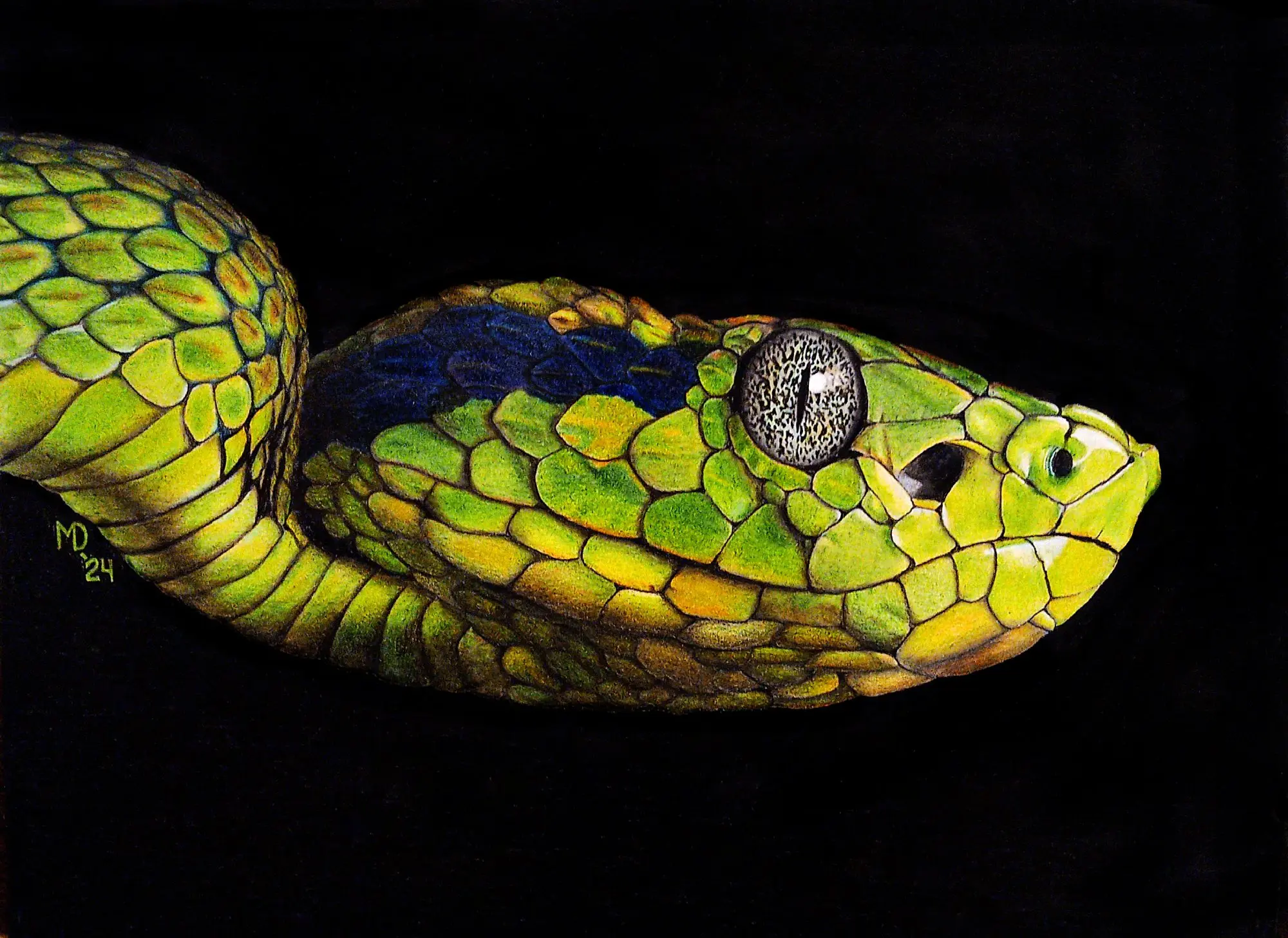
About the Yellow-blotched Palm Pitviper drawing
Palm pitvipers are among the most visually compelling snakes in the world. Their vivid colors, angular heads, vertical pupils, and habit of resting almost invisibly among leaves give them an appearance that is both beautiful and slightly unreal.
I have spent time in Costa Rica and Guatemala searching for reptiles and amphibians, including palm pitvipers, but I have never encountered a Yellow-blotched Palm Pitviper (Bothriechis aurifer) in the wild. The species occurs primarily in the humid mountain forests of southern Mexico and Guatemala. Maybe one day….
Palm pitvipers are slender, highly arboreal snakes equipped with strongly prehensile tails that can wrap securely around branches. This allows them to remain anchored while resting, climbing, or striking at prey from vegetation. Their predominantly green coloration blends remarkably well with leaves, mosses, and filtered forest light, while the heat-sensitive pits between their eyes and nostrils help them detect warm-blooded prey even under dim conditions.
They are primarily ambush predators. A snake may remain nearly motionless on a branch, waiting for a frog, lizard, small mammal, bird, or other prey animal to approach within striking distance. Some members of the genus have even been documented capturing hummingbirds—an extraordinary reminder that an apparently motionless snake can strike quickly enough to seize one of the most agile birds in the world.
Young palm pitvipers may have brightly colored tail tips that they move as a lure, attracting frogs or lizards close enough to capture. As the snakes grow, birds and small mammals become increasingly important prey for some species. Their entire bodies are adapted to hunting in a three-dimensional world of branches, vines, leaves, and suspended prey.
The Yellow-blotched Palm Pitviper is especially striking. Its green body is marked with yellow blotches edged in black, creating a pattern that can appear brilliant at close range yet disappear surprisingly well within dense vegetation. The patterned eye, dark facial markings, and sharply defined head add to the animal’s intense, watchful appearance.
Like other pitvipers, it is venomous and should be treated with caution, but it is not an animal that seeks conflict with people. Its stillness and camouflage are primarily hunting and defensive strategies. Unfortunately, those same qualities can bring snakes and people into accidental contact when vegetation is cleared or agricultural workers reach into foliage without seeing the animal.
The species occupies a relatively restricted range in fragmented montane and cloud-forest habitats. Forest loss and degradation threaten both the snake and the complex communities of amphibians, birds, mammals, and other organisms on which it depends. Its conservation is therefore inseparable from protecting the remaining highland forests of Mexico and Guatemala.
In Stealth, I wanted the snake to seem as though it were gradually revealing itself from darkness. The black background removes the surrounding forest but recreates something of the experience of suddenly recognizing a camouflaged animal that had been present all along. The vivid green and yellow scales, patterned eye, and angular head emerge first, while much of the body remains concealed.
The title reflects the way these snakes survive and hunt—not through pursuit, but through stillness, camouflage, patience, and an explosive strike delivered at precisely the right moment.
Stealth is a colored-pencil wildlife drawing of a Yellow-blotched Palm Pitviper (Bothriechis aurifer) by Michael E. Dorcas for Tantilla Art.