
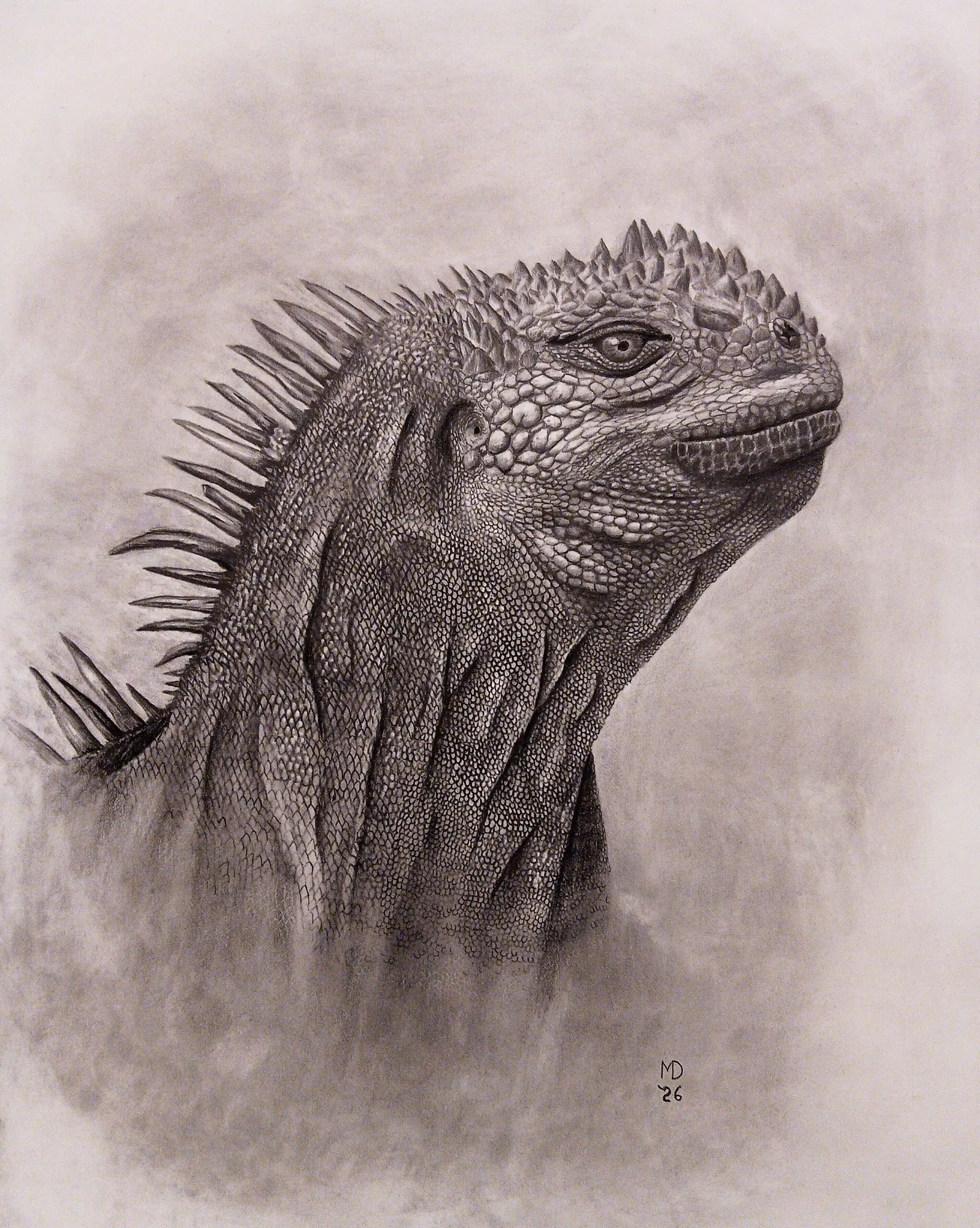
About the Marine Iguana Drawing
When I traveled to the Galápagos Islands in 2010, I was simply hoping to see a Marine Iguana (Amblyrhynchus cristatus). I had read about these extraordinary lizards for years and imagined that finding one would be a rare and memorable event. Instead, they were everywhere—even resting on the dock as we boarded the boat. While walking around, we sometimes had to be careful not to trip over them. I was thrilled to see them, though perhaps a little disappointed that an animal I had regarded as almost mythical could appear so ordinary in its own world.
Marine Iguanas are found nowhere outside the Galápagos and are the only living lizards that regularly forage in the sea. Their flattened tails propel them through the water, while long claws help them cling to submerged rocks as waves and currents move around them. They scrape algae from rocks along the shore and beneath the surface, occupying an ecological role unlike that of any other modern lizard.
Feeding in the ocean creates a serious problem: every mouthful of marine algae also contains a considerable amount of salt. The kidneys of a reptile cannot eliminate that salt efficiently without losing too much water, so Marine Iguanas rely on large specialized glands near the nasal passages. These glands remove concentrated sodium and chloride from the blood, and the iguanas then expel the salty fluid through their nostrils with forceful snorts or sneezes. The pale crust often visible around the head and snout is dried salt—a visible trace of the physiology that makes life beside the sea possible.
Their daily lives also involve an extraordinary thermal balancing act. Marine Iguanas are ectothermic (i.e., “cold-blooded”), depending largely on external heat rather than generating enough metabolic heat to maintain a high body temperature. Before entering the ocean, they bask on dark volcanic rocks and absorb solar radiation until their bodies approach temperatures near 37°C. They then plunge into seawater that may be more than ten degrees colder.
Once submerged, the challenge is to remain warm and active long enough to feed. Marine Iguanas cool much more slowly than a passive object of similar size would be expected to cool. Their heart rate drops during cooling, and blood vessels near the body surface constrict, reducing the amount of warm blood exposed to the colder skin and seawater. Warmed blood is concentrated more deeply within the body, slowing the loss of valuable heat.
The physiological response changes when the iguana returns to land. As it lies on sun-warmed lava, its heart beats much faster at a given body temperature than it did while cooling. Peripheral blood vessels dilate, allowing more blood to flow near the skin, absorb heat, and carry it rapidly into the body’s core. Marine Iguanas can consequently warm approximately twice as quickly as they cool. The same animal at the same body temperature may therefore have a very different heart rate depending on whether it is gaining heat or losing it.
Submergence adds another cardiovascular adjustment. During an extended dive, the heart rate gradually slows, conserving oxygen while the animal remains underwater. In early experiments, submerged Marine Iguanas reduced their heart rates to a fraction of their pre-dive levels; once they surfaced, the heart rate increased almost immediately. These animals are not merely tolerating cold water while holding their breath. Their circulation is continually adjusting to manage heat, oxygen, and blood flow.
The large males that forage underwater face the greatest rewards and risks. Their size allows them to retain heat longer and reach submerged feeding areas unavailable to smaller animals, but they must still return before cooling reduces their muscles’ ability to swim effectively and climb back onto the rocks. Smaller iguanas often avoid that cost by feeding in the intertidal zone instead.
All of this complex physiology is largely invisible when the animals are basking in dense groups along the shore. They often appear ancient, motionless, and almost indifferent to their surroundings. Beneath that rough exterior, however, the cardiovascular system, salt glands, muscles, and behavior are working together with remarkable precision.
In Salt and Sun, I wanted to portray the rugged appearance of the Marine Iguana whose unusual physiology and behavior captured my imagination long before I ever saw one. The graphite emphasizes the heavy folds of skin, intricate scales, prominent dorsal spines, and calm expression of a lizard shaped by cold seawater, intense equatorial sunlight, salt, and black volcanic rock.
Salt and Sun is a graphite-pencil wildlife drawing of a Marine Iguana (Amblyrhynchus cristatus) by Michael E. Dorcas for Tantilla Art.