
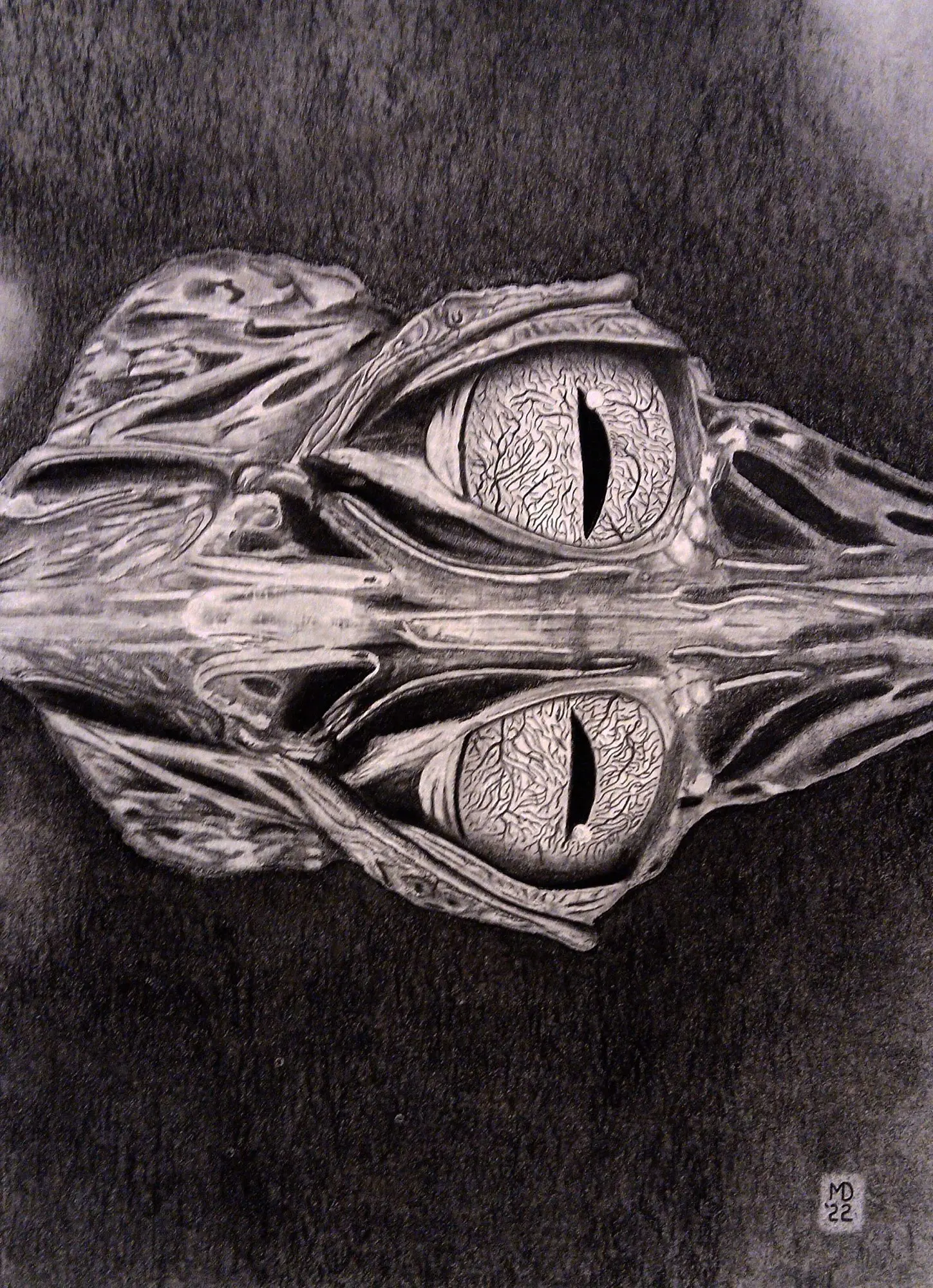
About the Spectacled Caiman Drawing
I have seen and captured many Spectacled Caimans (Caiman crocodilus) in Costa Rica, usually at night by spotting the brilliant reflection of their eyes above the water. Those searches were always a lot of fun and often became family adventures. All three of my children joined me at different times, hand-grabbing small caimans from the front of the boat for a quick photograph before releasing them.
“Small,” of course, is a relative term when dealing with crocodilians. A young caiman that can be lifted easily from the water is still an armored, muscular animal equipped with numerous sharp teeth. When a four-footer begins twisting and thrashing in the bottom of a small boat, an otherwise peaceful tropical night can become exciting in a hurry.
Spectacled Caimans are among the most widespread crocodilians in the New World. They occur from southern Mexico through much of Central and South America and occupy marshes, ponds, quiet rivers, flooded forests, reservoirs, canals, and other slow-moving waters. Their ability to tolerate disturbed and artificial habitats has helped them remain common in many places where larger crocodilians have declined.
The name “spectacled” refers to the raised bony ridge between the eyes, which resembles the bridge of a pair of eyeglasses. Their eyes and nostrils sit high on the skull, allowing the animal to remain almost completely submerged while continuing to breathe and watch everything above the surface.
At night, the eyes often become the most visible part of the animal. A reflective layer behind the retina improves vision under dim conditions and produces the orange, red, or golden eye shine seen when a flashlight sweeps across the water. During the day, a caiman may disappear into muddy water or shoreline shadows. After dark, the same animal may reveal itself instantly as two points of light.
Their eyes are also protected by a translucent nictitating membrane, or third eyelid, that moves across the surface while the animal is underwater. Together, these adaptations allow a caiman to remain almost entirely concealed while continuing to see, breathe, and monitor its surroundings.
Spectacled Caimans are opportunistic predators. Young animals feed largely on insects, crustaceans, mollusks, frogs, and small fish. Larger individuals consume bigger fish, turtles, snakes, birds, and mammals and may also scavenge. That broad diet is one reason they thrive in such a wide variety of wetlands.
They also provide considerable parental care. Females construct mound nests from vegetation and soil, and heat produced by decomposition helps incubate the eggs. A female may guard the nest, respond to calls from hatchlings still inside the eggs, open the mound as they emerge, and remain near the young after they enter the water. The same jaws capable of seizing prey can be used with remarkable control around eggs and hatchlings.
Spectacled Caimans have also become established in southern Florida. Large numbers were imported through the pet trade beginning in the 1950s, and escaped or deliberately released animals eventually founded reproducing populations.
The earliest well-documented population became established around Homestead Air Reserve Base during the 1970s. Caimans occupied nearby canals, ponds, drainage systems, and water-filled limestone excavations, and reproduction was confirmed by 1980. They have since been recorded elsewhere in Miami-Dade County, along the Tamiami Trail, in Everglades restoration areas, and within more natural wetlands.
There is a genuine connection with the Turkey Point area. The original Homestead population lies only a short distance northwest of the Turkey Point Nuclear Power Plant, and caimans occur in the surrounding canals and wetlands, including the Biscayne Bay Coastal Wetlands north of the plant.
The crocodilians most famously associated with Turkey Point itself, however, are native American Crocodiles. They began using the plant’s cooling-canal system during the 1970s, and the canals became an important nesting and nursery area.
Spectacled Caimans are not restricted to the plant’s warmed water. Their establishment appears to have been aided by South Florida’s climate, extensive freshwater canals and ponds, broad diet, disturbed habitats, and repeated introductions. Genetic research indicates that Florida caimans came from more than one South American source, suggesting that the population did not originate from a single release.
Their ecological effects remain incompletely understood, but they consume native fish, amphibians, reptiles, birds, and mammals and may compete with American Alligators and American Crocodiles. Biologists continue removing caimans from wetlands and canals connected with Everglades restoration. Their secretive behavior makes them difficult to locate—which is part of the excitement in Costa Rica but a serious complication when controlling an invasive population.
In Nocturnal Reflections, I wanted to capture the instant when a concealed animal suddenly reveals its presence. Nearly the entire caiman remains submerged in darkness, betrayed only by its watchful eye, the textured surface of its head, and the mirrored image beneath the waterline.
The composition reduces the animal to its essential nocturnal presence: eye, texture, darkness, and reflection. It recreates the quiet tension of sweeping a light across tropical water, seeing a point of fire appear in the beam, and realizing that an entire crocodilian has been watching from just beneath the surface.
Nocturnal Reflections is a graphite-pencil wildlife drawing of a Spectacled Caiman (Caiman crocodilus) by Michael E. Dorcas for Tantilla Art.