
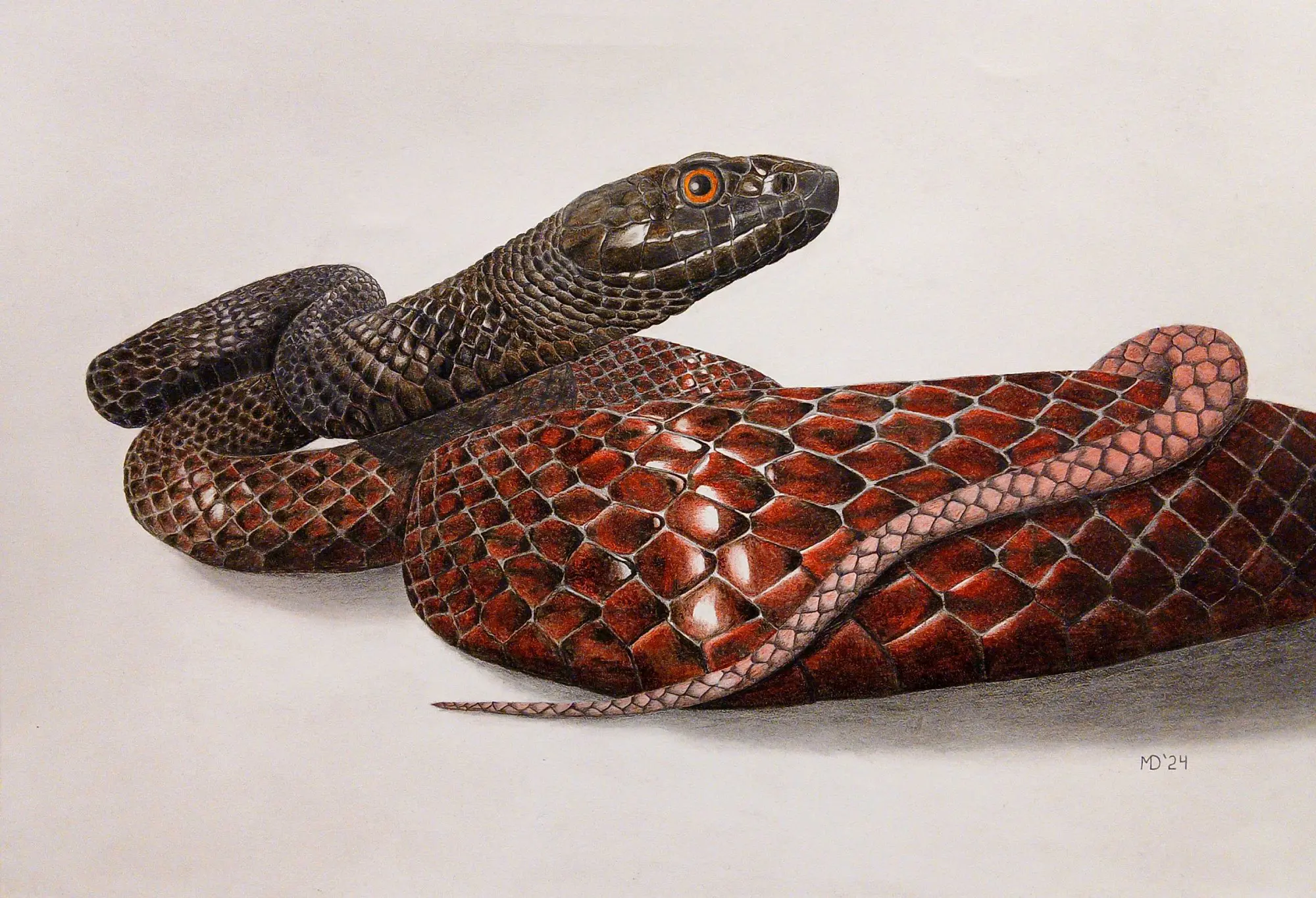
About the Coachwhip Drawing
I have captured many Coachwhips (Masticophis flagellum) over the years, usually after a considerable chase. Needless to say, many more have evaded capture. Their speed, sharp vision, sudden acceleration, and ability to make abrupt turns can leave a person lunging at empty ground while the snake disappears into grass or brush.
They are also impressively long snakes. Adults commonly reach five to six feet, and exceptional individuals exceed eight feet—the record is approximately 102 inches. Because they remain so slender even at great length, a large Coachwhip can seem almost impossibly elongated as it streams across open ground.
Coachwhips have a reputation for chasing people, but in my experience the chasing almost always occurred in the opposite direction. I chased plenty of Coachwhips; none ever chased me. Their first response to danger is usually escape, and they are exceptionally well equipped for it.
Once caught, however, they defend themselves vigorously. Most snakes direct defensive bites toward the hand or arm restraining them. Coachwhips I handled often did something much more personal: they raised their heads, stared directly into my eyes, and tried to bite me in the face. You have to respect an animal willing to make its displeasure that clear.
Coachwhips are among the most active and visually alert snakes in North America. Their large eyes and round pupils suit a life spent hunting during daylight. They often raise the head and front of the neck above surrounding vegetation—a behavior sometimes called periscoping—and scan the landscape before moving.
Their diet includes lizards, snakes, small mammals, birds, eggs, frogs, and large insects. They do not normally constrict. Instead, they seize prey with the jaws, restrain or manipulate it, and swallow it. Although usually described as active hunters, they can also wait in shade or beneath vegetation and ambush prey that approaches.
Coachwhips maintain relatively high body temperatures for snakes and support a fast, daytime lifestyle. They move frequently and expend considerably more energy than heavy-bodied ambush predators that remain motionless for long periods. During the hottest part of the day, however, they may retreat beneath vegetation or into burrows.
Radiotelemetry has revealed how much ground they can cover. In one eastern Texas study, individuals sometimes moved more than a kilometer in a day and occupied large home ranges. They also returned repeatedly to favored patches and previously used refuges, showing that their movements were not simply random wandering.
Coachwhips are associated with open, sunny habitats such as deserts, grasslands, scrub, sandhills, oak savannas, and open pine forests. Their need for large, connected areas makes them vulnerable to roads, development, and the loss of open fire-maintained habitats.
They also show extraordinary geographic variation in color. I have encountered black, red, pink, golden, and banded individuals, each reflecting a different part of the species’ broad range. Eastern animals often have dark heads and anterior bodies that gradually fade toward a pale tail, while southwestern populations may be reddish, rose-colored, brown, or nearly black.
Their common name comes from the appearance of the long, slender body and tail. The dark-edged scales can resemble the braided leather of an old-fashioned coach whip. That resemblance produced fanciful stories that the snakes could whip people with their tails, but the actual animal needs no embellishment. Its speed, awareness, and willingness to defend itself are impressive enough.
In Whiplash, I wanted to capture the intensity and restless energy of the species. The raised head, bright orange eye, and loosely gathered coils suggest a snake that is momentarily still but watching everything around it. It could turn on the afterburners and disappear—or direct its attention toward the face of anyone unwise enough to grab it.
The dark reddish-brown body and pale tail emphasize the dramatic variation in color and pattern that makes every encounter with a Coachwhip different. The pose captures the contradiction I find most compelling: a snake capable of explosive movement, shown during the brief instant when it has chosen to remain still.
Whiplash is a colored-pencil wildlife drawing of a Coachwhip (Masticophis flagellum) by Michael E. Dorcas for Tantilla Art.