
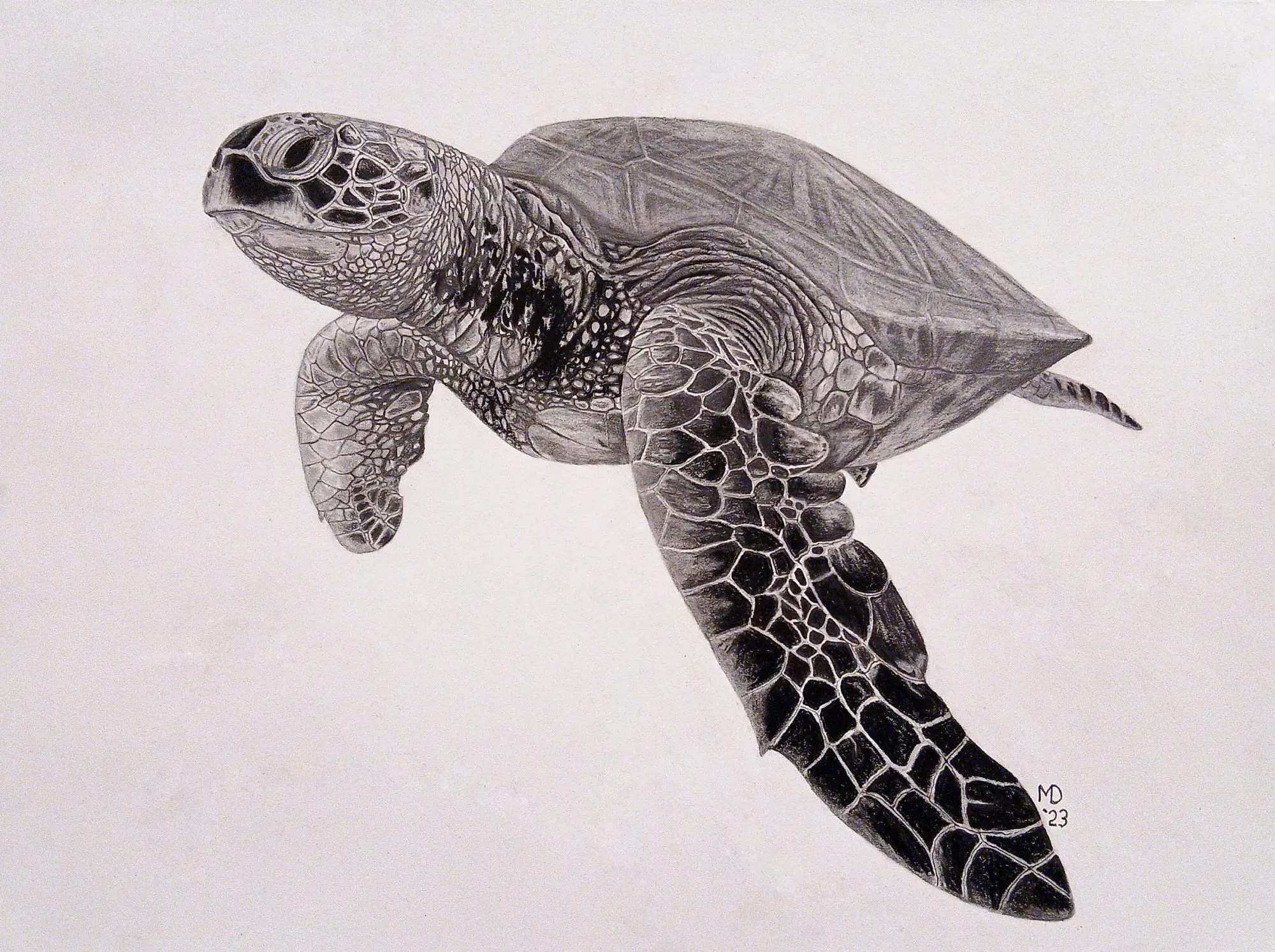
About the Green Sea Turtle Drawing
I have encountered Green Sea Turtles (Chelonia mydas) in several parts of the world, including South Carolina, Hawaii, Australia’s Great Barrier Reef, and Costa Rica. Each encounter has reinforced how naturally these large turtles move through the water. Propelled by broad front flippers, they appear less to swim than to fly, gliding and turning with a grace that seems almost effortless.
After returning from a trip to Australia with my wife, where we had snorkeled with Green Sea Turtles near Wilson Island on the southern Great Barrier Reef, I described the experience to an Australian friend. He replied that he had conducted research on Wilson Island and had watched Tiger Sharks “rip apart” Green Sea Turtles just off the beach. I was left with the slightly unsettling thought that, viewed from below, I might look rather like a sea turtle while swimming in a dark wetsuit.
Tiger Sharks are among the few predators capable of killing a large adult Green Sea Turtle. The turtle’s shell provides substantial protection, but a large shark can crush or tear through it. That danger helps explain why turtles often remain alert even while appearing calm and why shallow reefs, seagrass beds, and the open water between feeding areas can all contain hidden risks.
The name “Green Sea Turtle” does not primarily refer to the color of the shell, which may be brown, olive, gray, or mottled. It comes from the greenish fat beneath the shell, a characteristic associated with the largely plant-based diet of many adults. Green turtles are unusual among sea turtles because mature animals feed heavily on seagrasses and algae.
Their grazing can influence the structure and productivity of seagrass meadows, much as grazing mammals shape grasslands on land. By repeatedly cropping plants, turtles can help maintain areas of young, actively growing seagrass. A large turtle moving slowly across a feeding ground is therefore not simply consuming vegetation; it is participating in the ecology of the entire coastal habitat.
Their lives also encompass enormous distances. After emerging from nests and entering the sea, young turtles spend their early years in offshore waters—a period long known as the “lost years” because their whereabouts were once largely unknown. As they grow, they move into coastal feeding grounds, sometimes far from the beaches where they hatched.
Adults may migrate hundreds or thousands of miles between feeding areas and nesting beaches. After decades at sea, females commonly return to the same general region where they hatched. Their ability to locate a particular stretch of coastline after crossing immense areas of apparently featureless ocean is one of the most remarkable navigational achievements in the animal world.
Experiments indicate that Green Sea Turtles can use the Earth’s magnetic field as both a compass and a source of positional information. Subtle differences in magnetic intensity and inclination vary geographically, creating something like an invisible map. Young turtles may learn the magnetic signature of their natal region and use related cues when they eventually return as adults, although smell, currents, waves, and visual landmarks may also contribute as they approach shore.
Even before hatching, the surrounding environment has a profound influence on their lives. Green Sea Turtles have temperature-dependent sex determination: the temperature of the nest during a critical period of development influences whether hatchlings become male or female. Cooler nests produce more males, while warmer nests produce more females.
That system worked across natural variations in shade, weather, season, and beach location long before human-caused climate warming. Rising sand temperatures, however, are now producing heavily female-biased populations at some nesting sites. Research on Great Barrier Reef turtles found that juveniles originating from the warmer northern nesting beaches were overwhelmingly female, while those from the cooler southern region showed a less extreme bias. A few degrees in the sand can therefore alter the future composition of an entire population.
One of my favorite experiences was watching Green Sea Turtles come ashore to nest at Tortuguero, Costa Rica, home to the largest Green Sea Turtle nesting colony in the Western Hemisphere. A female that appears so graceful in the water becomes slow and laborious on land, hauling her body above the tide line, excavating a nest with her rear flippers, depositing her eggs, and covering them before returning to the sea.
Jaguars also patrol those beaches and prey on nesting turtles. The encounter brings together two very different ecosystems: a marine reptile that may have crossed hundreds or thousands of miles and a terrestrial predator emerging from the rainforest. A turtle that has survived sharks, fishing gear, boats, disease, and decades of ocean travel can become vulnerable during the few hours when reproduction forces her onto land.
The relationship is dramatic, but predation itself is part of the natural system. Jaguars carry turtle remains into the forest, where scavengers and decomposers redistribute marine-derived nutrients on land. The nesting beach therefore becomes a meeting place among ocean, sand, and rainforest.
In Ocean Traveler, I wanted the turtle to appear as though it were flying through the water. I deliberately left the background empty, removing the seafloor, reef, and surface so that nothing interrupts the sense of movement and suspension. The perspective of the broad flippers carries the turtle toward the viewer, while the graphite emphasizes the patterned head, streamlined shell, and intricate scales.
The title reflects more than ordinary movement through the sea. A Green Sea Turtle may pass through open ocean, coral reefs, seagrass meadows, coastal waters, and distant nesting beaches during a life measured in decades. Its body carries the history of an animal shaped not for one place, but for an immense and interconnected marine world.
Ocean Traveler is a graphite-pencil wildlife drawing of a Green Sea Turtle (Chelonia mydas) by Michael E. Dorcas for Tantilla Art.