
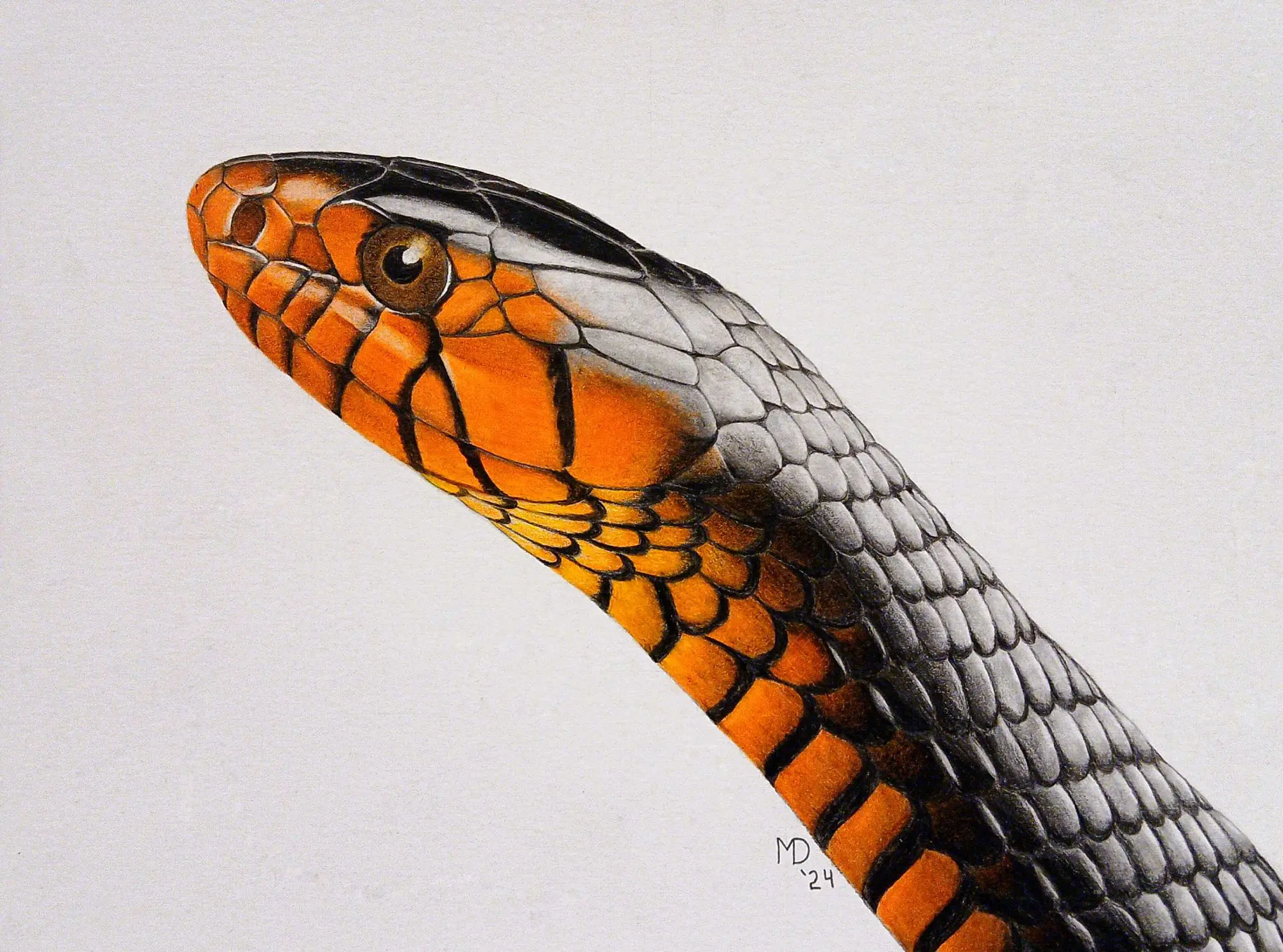
About the Eastern Indigo Snake Drawing
I have always been fascinated by Eastern Indigo Snakes (Drymarchon couperi). They are immense, powerful animals, yet individuals encountered in the field are often remarkably calm when handled. That apparent gentleness contrasts sharply with their abilities as active predators capable of overpowering rattlesnakes and many other formidable prey without using either venom or constriction.
The Eastern Indigo Snake is the longest snake native to the United States. Exceptional individuals exceed eight feet in length, with a record of approximately 8.6 feet. Their heavy bodies, large heads, and glossy scales give them an imposing presence, but in sunlight those apparently black scales reflect shades of blue, violet, and indigo. The reddish-orange chin, cheeks, and throat make some individuals even more striking.
Indigo snakes are active hunters with exceptionally broad appetites. They consume frogs, toads, fish, birds, eggs, small mammals, lizards, turtles, and other snakes—venomous species included. They do not kill by constriction. Instead, an indigo may seize its prey, press it against the ground with its powerful body, and chew until the animal is incapacitated, or simply begin swallowing it alive.
A confrontation with a rattlesnake reveals just how formidable an indigo can be. The snake may grab the rattlesnake near the head, pin it beneath its body, and chew until resistance stops. Eastern Indigo Snakes also possess a genuine physiological resistance to pit-viper venom: components in their blood serum inhibit some of the damaging effects of the venom. That does not necessarily make them completely invulnerable, but it gives them an enormous advantage when attacking prey that could kill many other predators.
Despite their power, indigo snakes seldom bite defensively. A threatened individual may hiss loudly, flatten its neck vertically, vibrate its tail against leaves, or release foul-smelling musk, but many remain remarkably composed when carefully handled. Their temperament is one reason field encounters with these enormous snakes can be so memorable.
Indigos also move through the landscape on a scale that is difficult to appreciate from a single encounter. Adult males may use home ranges covering hundreds or even thousands of acres, traveling among upland forests, wetlands, scrub, sandhills, and other habitats as seasons and prey availability change. Protecting a small patch of land is therefore rarely enough; the snakes need large, connected landscapes and safe passage between the places they use.
In the northern part of their range, Gopher Tortoise burrows provide essential refuge, particularly during winter. The burrows offer protection from temperature extremes, fire, and predators. Indigo snakes may move among numerous burrows rather than occupying only one, linking their survival closely to that of the tortoises and the longleaf-pine and sandhill communities that support them.
That relationship also exposed indigos to a particularly destructive practice. Rattlesnake hunters historically poured gasoline or other chemicals into tortoise burrows to force snakes to the surface. The fumes could injure or kill not only rattlesnakes but also indigo snakes, tortoises, frogs, insects, and many of the other animals sharing these underground refuges.
Habitat destruction and fragmentation, road mortality, illegal collection, and the loss of Gopher Tortoises contributed to the disappearance of Eastern Indigo Snakes from much of their historic range. The species was federally listed as threatened in 1978 and remains dependent on extensive habitat protection and active conservation. There are encouraging signs, however: captive-bred indigo snakes are being returned to protected landscapes in northern Florida and Alabama, and wild-born young have now been documented at a Florida release site.
In Indigo Flame, I wanted to emphasize the contrast that makes the species so visually striking. The orange face and throat appear almost luminous beside the glossy blue-black scales, while the raised head and focused eye convey alertness, strength, and quiet confidence.
The title refers not only to that brilliant orange coloration but also to the fire-maintained longleaf pine ecosystems in which indigos typically occur. Frequent fire helps sustain the open structure, ground cover, and tortoise burrows on which these snakes depend. An Eastern Indigo Snake moving through that landscape is both graceful and commanding—an immense, calm predator whose apparent gentleness conceals extraordinary strength.
Indigo Flame is a colored-pencil wildlife drawing of an Eastern Indigo Snake (Drymarchon couperi) by Michael E. Dorcas for Tantilla Art.