
I have spent many years studying Diamondback Terrapins (Malaclemys terrapin) at Kiawah Island, South Carolina. The primarily mark-recapture project was begun in 1983 by J. Whitfield “Whit” Gibbons, and I assumed responsibility for managing it around 2000. In 2016, my former student Kristen Cecala, now a professor at Sewanee, and Cris Hagen, Director of the Turtle Survival Center, began managing the project. It continues today as the longest-running study of Diamondback Terrapins in the world.
The basic field method has remained remarkably consistent. Researchers and students pull seine nets through the tidal creeks, often while struggling through deep mud, oyster shells, changing tides, and South Carolina heat. Each captured terrapin is individually marked, measured, examined, and released into the creek where it was found.
The project required an enormous amount of help. Over the years, many students, colleagues, friends, volunteers, and members of my own family—including my wife and children—joined us in the marsh. They helped pull seine nets, carry equipment, process turtles, record data, and return animals to their creeks. The work could be muddy, hot, physically demanding, and occasionally complicated by oysters, stingrays, tides, and uncooperative terrapins, but it was also genuinely a lot of fun. It gave many people the opportunity to participate meaningfully in long-term ecological research and to contribute data that became part of a scientific record extending across decades.
Over time, repeated captures turn an apparently anonymous population into a collection of known individuals. A pattern of notches along the edge of a shell may identify a female first marked decades earlier. Her growth, injuries, body condition, reproductive history, and continued survival become part of a record extending across much of her life.
One of the most remarkable aspects of a study lasting this long is its ability to connect generations. Students sometimes collected data from terrapins marked before those students were born. The scientific record passed from Whit to me, then to Kristen, Cris, and the many students, colleagues, friends, and family members who helped sustain the work. The project is therefore not simply a long dataset; it is the product of a community maintaining responsibility for the same animals and marshes across decades.
Diamondback Terrapins are North America’s only turtles specialized for life in coastal salt marshes and brackish estuaries. They move through tidal creeks, forage around oyster reefs and mud banks, and tolerate salinities that would challenge most freshwater turtles. Specialized glands help them remove excess salt, but they still seek fresh water when it becomes available, sometimes drinking rain or the temporary layer of less-salty water that forms at the surface after a storm.
Our work showed that many Kiawah terrapins remain strongly associated with particular tidal creeks. A marsh may look continuous to us, but individual turtles often use familiar tributaries and return repeatedly to the same relatively small areas. That fidelity means that the loss of terrapins from one creek may not be corrected quickly by animals simply moving in from somewhere nearby.
The value of the long-term record became especially clear when John Willson, Whit, and I examined more than two decades of captures. We documented a substantial decline in the Kiawah population along with striking demographic changes. The population contained proportionately fewer young animals, more older and larger turtles, and a greater percentage of females than it had during the early years of the study.
Those patterns were consistent with selective mortality in blue-crab traps. Males and smaller females can enter trap funnels more readily than large females. Once inside a submerged trap, they may continue feeding on bait or captured organisms, but because they must surface to breathe, they eventually drown if the trap is not retrieved in time.
The danger is not limited to actively maintained commercial traps. Recreational traps may be checked infrequently, and lost or abandoned traps can continue capturing animals. A trap sitting quietly beneath the water may kill terrapins repeatedly without anyone realizing what is happening.
This selective mortality can change a population long before it disappears completely. The continued presence of large females may create the impression that the population remains healthy, even as males and younger age classes become increasingly scarce. Because terrapins are long-lived, mature slowly, and have relatively low reproductive output, the loss of even a modest number each year can accumulate into a major decline.
Leigh Anne Harden’s research helped reveal how terrapins use the marsh when they are not in our nets. Radiotelemetry allowed her to follow individuals through their tidal environments, while temperature-sensitive equipment documented the thermal conditions they experienced. Terrapin movements and body temperatures varied with season, habitat, weather, tidal conditions, and individual behavior.
That work showed that the marsh is not one uniform environment. At different times, a terrapin may forage in flooded vegetation, move through open creeks, rest beneath undercut banks, bury in mud, or use shallow water warmed by the sun. Its surroundings change repeatedly as the tide rises and falls, exposing some areas while placing others beneath several feet of water.
Later research by C. D. Akins, C. D. Ruder, Leigh Anne, and our other collaborators expanded this work by examining the factors affecting temperature variation and habitat use in free-ranging terrapins. Together, these studies showed how behavior allows the turtles to regulate body temperature within a landscape where water depth, sunlight, air exposure, and access to different habitats are constantly changing.
Leigh Anne and her colleagues also developed a rapid survey technique based on counting terrapin heads as turtles surfaced to breathe. Traditional seine-net sampling provides individual identities, measurements, and detailed demographic data, but it requires considerable labor and suitable tidal conditions. Head-count surveys offered a faster way to assess relative abundance, compare creeks, and identify places where more intensive study might be needed.
Kristen Cecala examined another side of life in the marsh: the consequences of major injuries. Terrapins sometimes survive missing feet or limbs, deep shell damage, and wounds caused by boats, propellers, predators, or other hazards. Their ability to heal can be remarkable, but surviving an injury does not mean escaping its effects.
Kristen’s research evaluated how serious injuries affected body condition, survival, and conservation prospects. It also documented how an individual turtle can carry physical evidence of a dangerous encounter for the remainder of its life. A healed shell fracture or missing limb becomes part of the animal’s history, much like the identification marks applied by researchers.
Work by Lynea Witczak and colleagues examined how survival varied among locations and through time. Such analyses are possible only when researchers continue returning to the same creeks year after year. A capture record from one season provides a snapshot; decades of recaptures begin to reveal which animals survive, where survival differs, and how population conditions change.
M. Kern and collaborators studied how female body size and shell morphology relate to egg size and clutch size. A terrapin’s shell protects her, but it also creates a rigid opening through which every egg must pass. Reproduction therefore involves a physical relationship among maternal size, pelvic and shell structure, the number of eggs produced, and the dimensions of each egg.
Comparisons among populations showed that these relationships can differ even between relatively nearby marshes. A female’s reproductive biology is shaped not only by the general characteristics of the species but also by local conditions and the particular body forms found within a population.
Research by Rebecca McKee and Kristen Cecala addressed the crab-trap problem directly. They studied how terrapins approached and entered traps fitted with bycatch-reduction devices—small rectangular frames placed around the trap entrances. Properly sized devices allow legal-sized blue crabs to enter while excluding many terrapins.
Their behavioral experiments demonstrated that these devices substantially reduce terrapin entry. The solution is strikingly simple: a small, inexpensive modification can prevent turtles from entering a trap and drowning without eliminating its usefulness to crabbers. The devices must be appropriately sized for local crabs and terrapins, but the research showed that conservation and the fishery do not have to be opposing interests.
Long-term research is sometimes difficult to sustain because its greatest value may not become apparent for decades. No single year at Kiawah could have revealed the full demographic shift associated with crab-trap mortality. Only repeated sampling showed that the population was gradually becoming older, larger, and more dominated by females while overall captures declined.
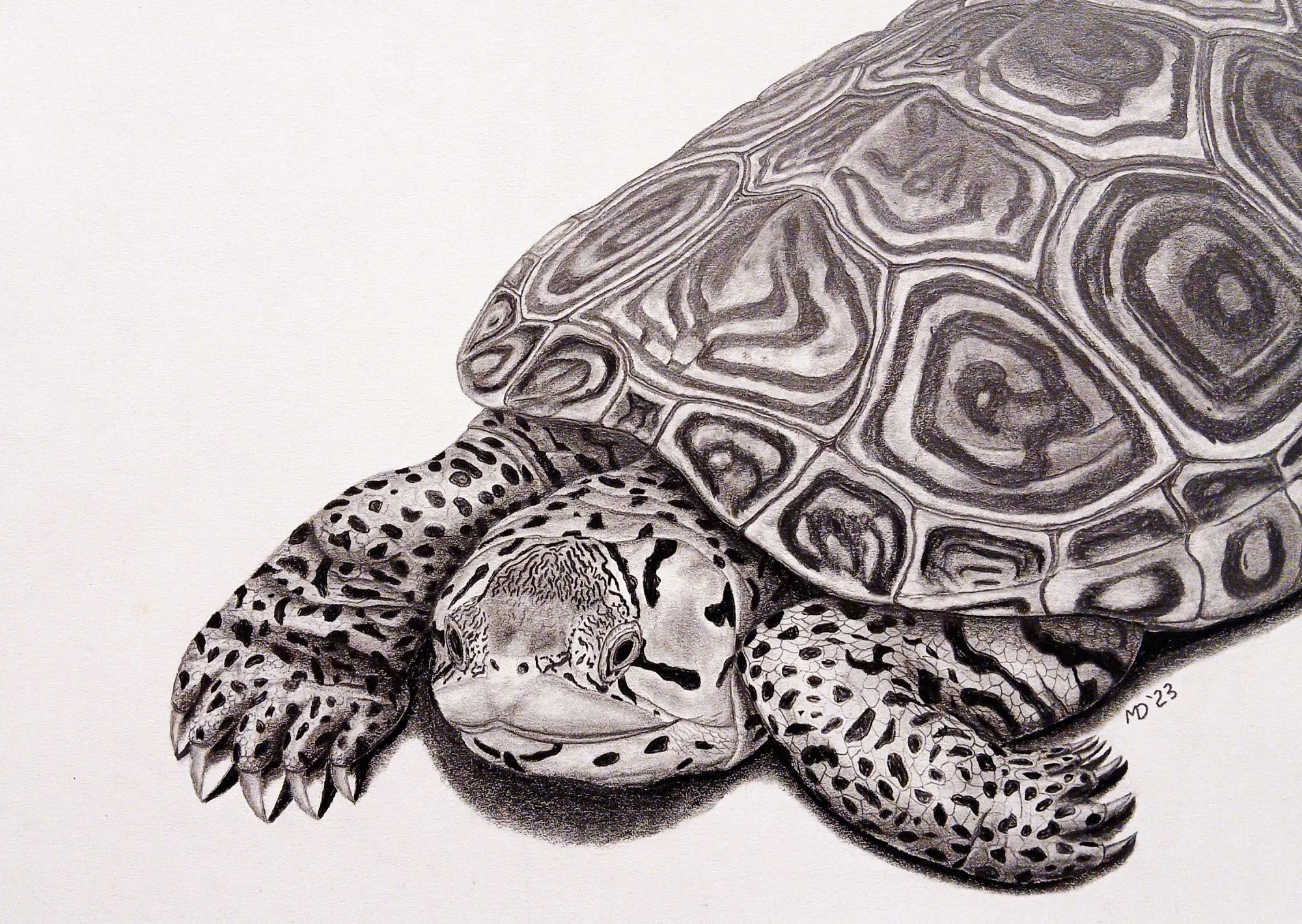
In Marsh Girl, I wanted to portray the individuality and quiet presence of a mature female. The close composition emphasizes her pale face, spotted skin, strong claws, watchful eye, and the concentric patterns of a shell shaped by years in the tidal marsh.
The title is intentionally personal. After handling and following terrapins over many years, it becomes difficult to think of them as interchangeable representatives of a species. Each mature female is an individual survivor with her own markings, injuries, familiar creek, nesting history, and place within the long record of the Kiawah marsh.
Marsh Girl is a graphite-pencil wildlife drawing of a Diamondback Terrapin (Malaclemys terrapin) by Michael E. Dorcas for Tantilla Art. Reference photograph courtesy of John D. Willson.