
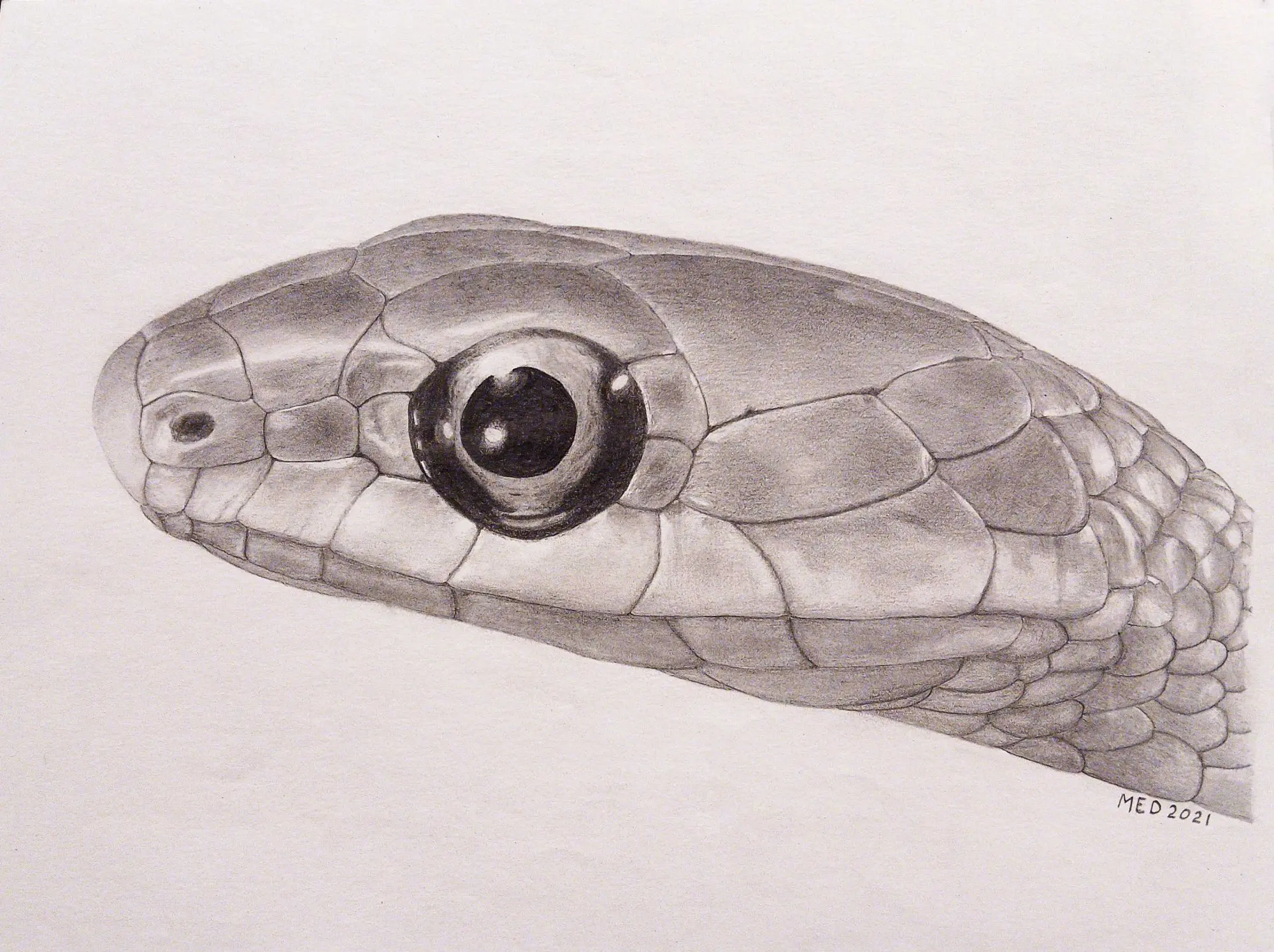
About the Rough Green Snake Drawing
Rough Green Snakes (Opheodrys aestivus) have been among my favorite snakes since childhood, and finding one is still always a treat. Their slender bodies and graceful movements seem perfectly suited to life among branches, vines, and leaves. Their color provides such effective camouflage that I have probably walked past countless individuals resting in vegetation only a few feet away without seeing them.
One of my earliest encounters occurred when I was very young – maybe 5 years old. I caught a Rough Green Snake that everted its cloaca. When I saw the pink flesh, I mistook it for a serious injury. Convinced that I was helping, I placed a bandage over it, wrapped tape around the snake to hold the bandage in place, and released it. Looking back, I can only hope the tape soon worked loose. My intentions were good; my knowledge of reptile medical care was not.
Rough Green Snakes are remarkably gentle animals. They are nonvenomous, seldom attempt to bite, and usually rely on stillness and camouflage when threatened. A snake that realizes it has been discovered may flow almost effortlessly through the vegetation, its narrow green body disappearing among stems and leaves within seconds.
Much of what we know about their ecology comes from decades of research by herpetologist Mike Plummer. His studies showed that Rough Green Snakes are not simply found in any available tree. They favor dense, highly branched vegetation, often along the margins of lakes, streams, wetlands, and forests. Networks of slender branches provide pathways for movement, places to rest, and hunting grounds filled with small invertebrates.
Unlike many snakes, they are active primarily during the day and hunt largely by sight. Caterpillars, spiders, grasshoppers, crickets, dragonflies, and related prey make up much of their diet. Even the movement of an insect’s leg or antenna can attract a snake’s attention. It approaches through the branches, slows as it nears its target, and makes a quick strike without using venom or constriction.
At night, Rough Green Snakes commonly sleep loosely coiled among shrubs and vines, often on branches overhanging creeks and other bodies of water. One of the best ways to find them is to walk these areas after dark with a flashlight and look upward for their pale white or yellowish bellies. The green back that nearly vanishes among leaves during daylight may be invisible, while the light underside stands out in the beam. Once you learn what to look for, snakes that would be almost impossible to find during the day can suddenly become surprisingly conspicuous.
Plummer’s radiotelemetry research also revealed an unexpected part of their lives. Females preparing to lay eggs descended from their usual arboreal habitat and traveled over the ground away from the shoreline. They deposited their eggs inside moist chambers within hollow living trees, and evidence suggested that some females may return to the same nesting tree in subsequent years. A snake that appears to drift casually through the greenery may therefore possess a detailed knowledge of its surroundings and remember a particular tree from one nesting season to the next.
Rough Green Snakes occasionally lay their eggs communally, with several females using the same protected location. Such nest sites can remain suitable across years, making an old hollow tree far more important to the local snake population than its outward appearance might suggest.
One of their strangest characteristics becomes visible only after death. The brilliant green coloration often fades to blue or nearly black, so a dead Rough Green Snake may look surprisingly unlike the living animal. In life, that vivid green is both one of the snake’s most beautiful features and the camouflage that makes it so difficult to find.
In Sinuous Beauty, I focused closely on the animal’s large eye, elegant profile, and carefully arranged, keeled scales. Although graphite cannot reproduce its brilliant living color, it reveals the subtle contours and textures that contribute to the snake’s delicate appearance.
The title reflects the quality that has always appealed to me most. Everything about a Rough Green Snake—from its extremely slender body to the way it moves through a network of branches—seems defined by graceful curves and effortless motion.
Sinuous Beauty is a graphite-pencil wildlife drawing of a Rough Green Snake (Opheodrys aestivus) by Michael E. Dorcas for Tantilla Art. Reference photograph courtesy of W. W. Lamar.