
About the Central American Eyelash Pitviper Drawing
I encountered many Central American Eyelash Pitvipers while conducting research near Tortuguero, Costa Rica. These small arboreal snakes were usually perched on vegetation or resting against a tree trunk, sometimes so well matched to their surroundings that we noticed them only after looking closely.
They often seemed to be simply hanging there, but their stillness had a purpose. Eyelash pitvipers are primarily ambush predators. Anchored securely by a prehensile tail, a snake may remain nearly motionless on a branch while waiting for a frog, lizard, bird, or small mammal to move within striking distance. Heat-sensitive pits between the eyes and nostrils help detect warm-blooded prey, while the tongue gathers chemical information from the surrounding environment.
Although they move most often at night, many remain in hunting posture during the day. Some position themselves near flowers visited by hummingbirds and have been documented capturing these extraordinarily quick birds. Their diet also includes treefrogs, anoles, geckos, mice, small opossums, and even bats. An animal that appears to be resting peacefully may actually be waiting with extraordinary patience for the brief instant when prey moves within range.
Juveniles have another remarkable hunting strategy. Their tail tips may be brightly colored, and a young snake can wriggle the tip like a caterpillar or worm to lure a frog or lizard closer. The moving tail directs the prey’s attention away from the snake’s head until it is close enough for a sudden strike.
One of the most extraordinary features of eyelash pitvipers is their variation in color. Around Tortuguero, we found brown, reddish, and lichen-green individuals, as well as the brilliant golden form commonly known as the Oropel. Golden snakes were especially common there, but every form was beautiful in its own way. Some seemed perfectly matched to bark or dead vegetation, while others appeared almost impossibly conspicuous until seen among yellowing leaves, flowers, or patches of sunlight.
Their taxonomy has become almost as variable as their coloration. For many years, eyelash pitvipers from southern Mexico through much of northern South America were included within the widespread species Bothriechis schlegelii. Most recent treatments recognize the widespread Central American form as Bothriechis nigroadspersus, distinct from the South American form, while the geographically restricted Bothriechis supraciliaris is also commonly recognized in southwestern Costa Rica.
A recent revision proposed dividing the complex into numerous additional species, but those finer splits remain controversial. A subsequent reanalysis concluded that the available genetic and morphological evidence did not adequately support most of them. The precise number of species therefore remains unsettled—a reminder that scientific names represent our evolving attempts to describe nature, not categories the snakes themselves are obliged to observe.
The raised scales above their eyes give the snakes their familiar name. Their exact function is uncertain, but they contribute to the broken, irregular outline of the head and may improve camouflage among leaves, bark, and moss. Together with the broad head, vertical pupils, and heat-sensitive facial pits, they create one of the most distinctive faces among tropical snakes.
Females can also store viable sperm for remarkably long periods. One Costa Rican eyelash pitviper produced young after apparently retaining sperm for nearly three years, an ability that could permit reproduction even when encounters with males are infrequent.
Despite their dramatic appearance and medically significant venom, the snakes I encountered were generally inoffensive, even when we disturbed or handled them during fieldwork. Their first defenses were usually camouflage and stillness, although any venomous snake may bite when touched, restrained, or threatened and must be treated with appropriate caution.
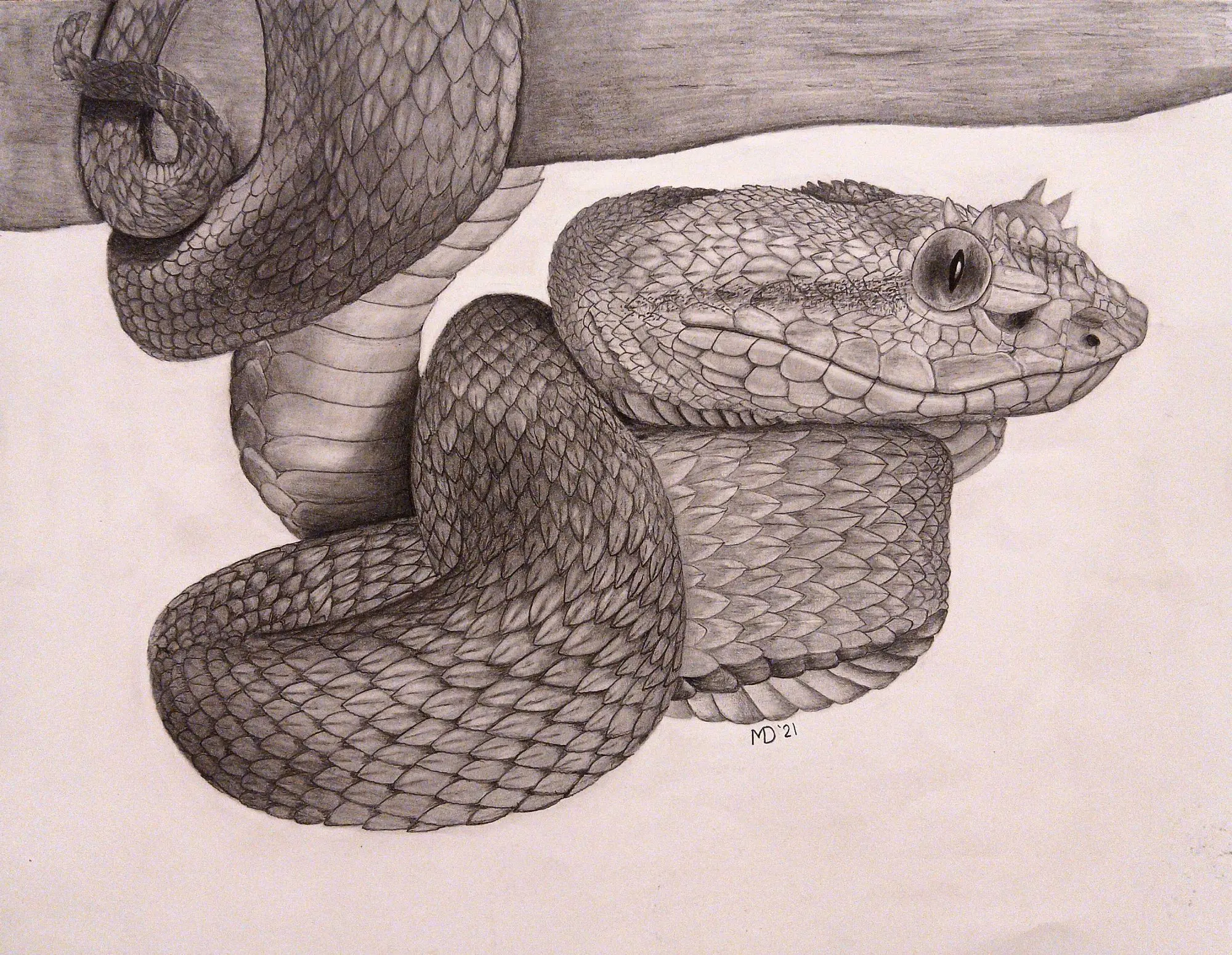
In Hanging Out, I portrayed the snake draped loosely across a branch in the elevated resting or ambush posture in which I often encountered the species. The title sounds casual, but the pose can represent both rest and intense readiness. A snake may appear completely relaxed while remaining capable of launching an extraordinarily rapid strike.
Eyelash pitvipers are famous for brilliant color, but drawing this individual in graphite allowed me to concentrate on form and texture instead. The overlapping coils and strongly keeled scales create a complex surface, while the large eye and raised scales above it draw attention to the animal’s unmistakable face.
Hanging Out is a graphite-pencil wildlife drawing of a Central American Eyelash Pitviper (Bothriechis nigroadspersus) by Michael E. Dorcas for Tantilla Art. Reference photograph courtesy of W. W. Lamar.