
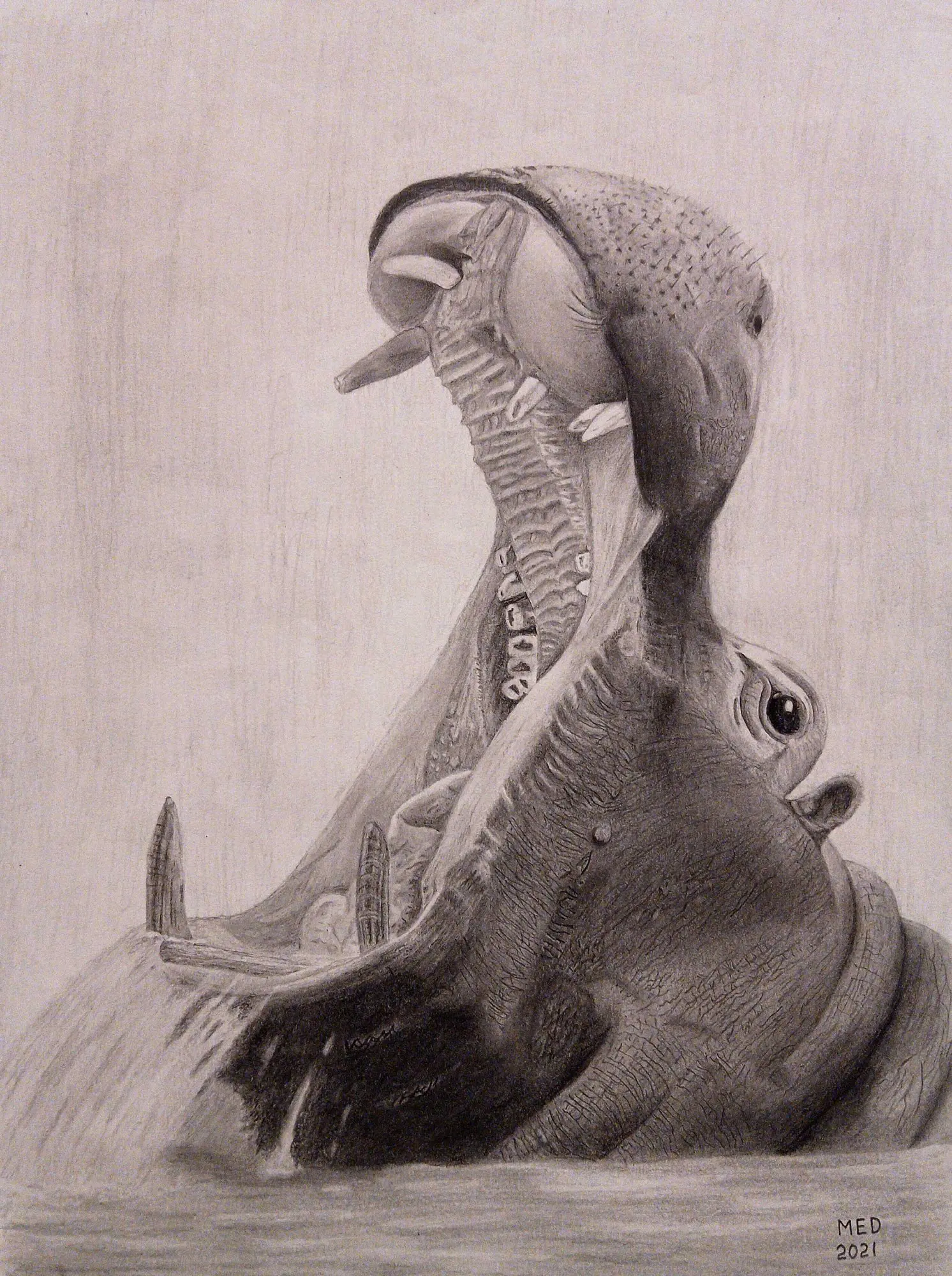
About the Hippopotamus Drawing
My earliest close familiarity with hippos came when I worked at the Fort Worth Zoo as a teenager. During the winter, I helped feed the Aldabra Giant Tortoises in a heated building adjoining the hippo enclosure. Each time I arrived carrying food for the tortoises, the hippos watched me intently through the bars, seeming almost to ask, “What about us?” Their expressions and enormous mouths could appear comical in that setting, although even then their size and power were impossible to overlook.
Seeing hippos in Africa gave me a very different appreciation of them. At Lake Naivasha in Kenya, my family and I watched a fisherman checking his nets from a tiny craft that looked scarcely more substantial than a surfboard. A hippo suddenly charged him, and all we could do was watch as he paddled desperately away. Fortunately, he managed to get moving quickly enough to escape the animal’s open jaws.
I also stayed at Elsamere (named for the lioness in the book/movie Born Free) on the shore of Lake Naivasha , where hippos regularly left the water after dark to graze around the cabins. We had to move carefully at night because unexpectedly coming between a hippo and the lake, or simply startling one at close range, could be extremely dangerous.
Common Hippopotamuses (Hippopotamus amphibius) spend much of the day in rivers, lakes, and wetlands, where the water helps protect their skin and regulate their body temperature. After dark, they commonly leave the water and follow established paths into surrounding grasslands to feed. This daily movement between aquatic resting areas and terrestrial grazing grounds frequently brings them into the same places used by people.
Hippos are strict vegetarians so they do not prey on humans. But they can respond with extraordinary force when surprised, approached too closely, separated from the water, or confronted by boats and people within the areas they use. Fishermen and others traveling in small boats can be particularly vulnerable because much of a hippo’s body may remain concealed beneath the surface until an encounter is already dangerously close. On land, people may unexpectedly meet grazing hippos along trails, around homes, or near crops after dark.
Reliable continent-wide figures for deaths caused by hippos are difficult to establish, so familiar claims about exact annual totals should be treated cautiously. The danger itself, however, is very real. Medical reports from Africa document devastating bites and crushing injuries involving severe tissue damage, broken bones, infection, amputation, permanent disability, and death. A hippo’s huge jaws and enlarged canine and incisor teeth can inflict catastrophic trauma within seconds.
Conflict is not limited to direct attacks. Hippos may enter cultivated areas at night, eating and trampling crops on which families depend. The same expansion of farming and settlement that places people closer to hippo habitat also reduces the animals’ access to secure waterways and grazing areas. Retaliatory killing may follow crop losses, injuries, or deaths, creating a conservation problem in which both people and hippos suffer. Effective conservation therefore requires more than protecting hippos alone; it must also help local communities protect their lives, crops, and livelihoods.
An adult hippo has few animals to fear. Its massive body, powerful jaws, and readiness to defend itself make it one of the most formidable animals in its environment. The wide-open mouth shown in this drawing can function as a visual display during social and territorial encounters, revealing the extraordinary teeth that make the gesture so imposing.
Open Wide was one of my earlier wildlife drawings. I concentrated on the cavernous mouth, ridged palate, heavy teeth, folded skin, and watchful eye, allowing the animal’s head to fill most of the vertical composition. The title reflects the immediate visual impression of the pose, but the drawing also captures the contrast between the hippo’s almost comic appearance and the immense power of an animal that must be treated with caution and respect.
Open Wide is a graphite-pencil wildlife drawing of a Common Hippopotamus (Hippopotamus amphibius) by Michael E. Dorcas for Tantilla Art.