
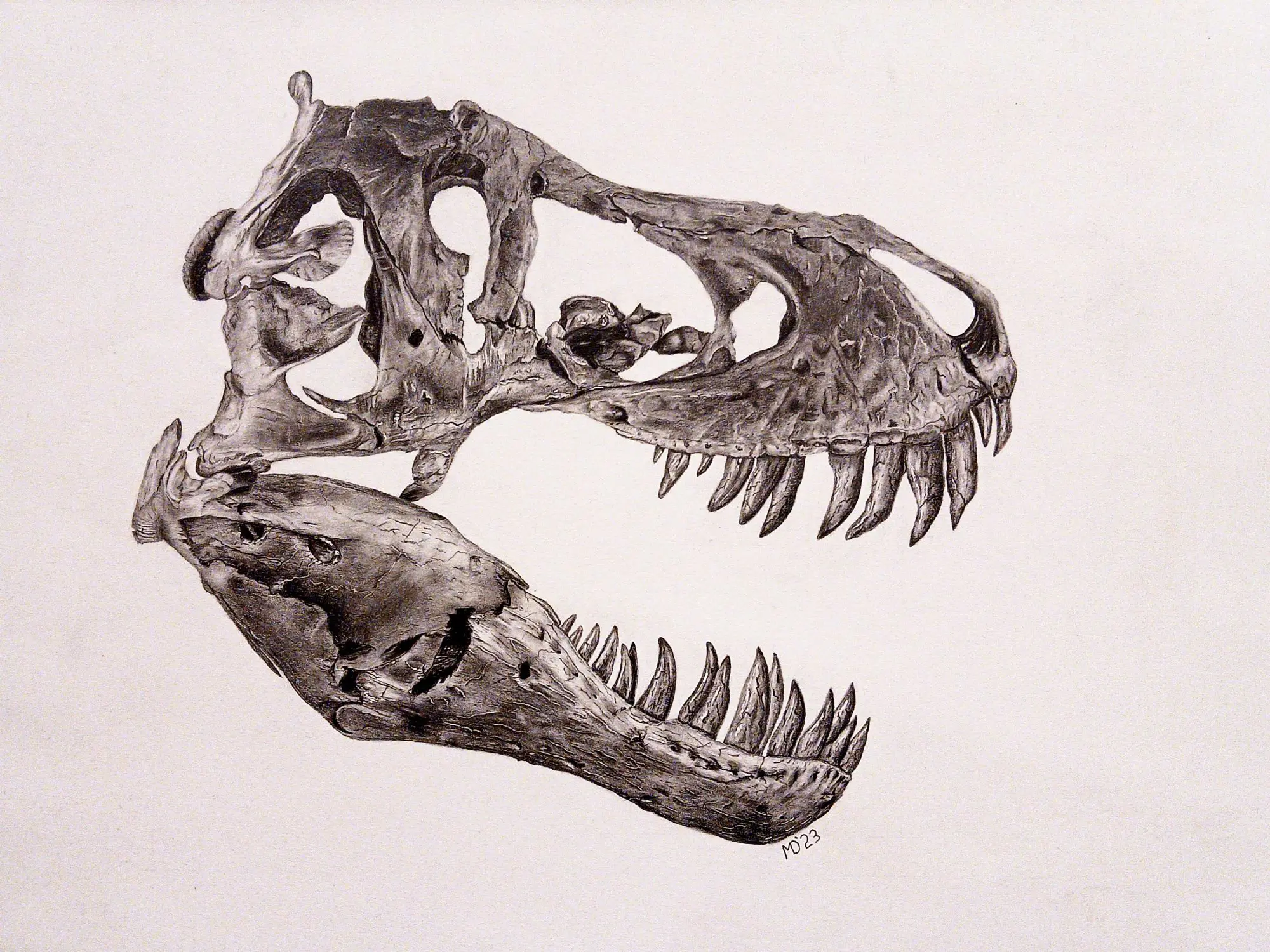
About the Tyrannosaurus rex Skull Drawing
Like many children, I was fascinated by dinosaurs. When I went to the library, the books I wanted most were the ones about the strange and often enormous animals that once inhabited the Earth. Of all the dinosaurs reconstructed in those books, few were as immediately compelling as Tyrannosaurus rex. Its immense skull, powerful jaws, and rows of heavy teeth made it the unmistakable symbol of a prehistoric predator.
The drawing also reflects my longstanding fascination with skulls. A skull is much more than the framework of an animal’s head. Its shape records where muscles attached, how the jaws operated, where sensory organs were housed, and how the animal captured and processed food. Few skulls make those functions as visually apparent as that of T. rex.
Tyrannosaurus rex lived in western North America near the end of the Late Cretaceous Period, shortly before the mass extinction that ended the age of the non-avian dinosaurs. Despite its close association with the Jurassic Park films, T. rex actually lived during the Cretaceous, tens of millions of years after the Jurassic Period had ended.
The skull was enormous but structurally complex, with large openings among heavily reinforced bones. Its deep jaws carried thick, curved, serrated teeth capable of puncturing flesh and withstanding tremendous forces. Biomechanical studies indicate that an adult T. rex could generate one of the most powerful bites known among terrestrial animals. Fossilized bite marks, damaged bones, and fragments apparently processed during feeding show that it could bite deeply into skeletal tissue and sometimes crush and consume bone.
Whether T. rex was primarily a predator or scavenger was once presented as a major controversy, but the distinction was probably never absolute. Like many large carnivores today, it likely captured living prey when opportunities arose and also took advantage of carcasses. Its powerful jaws, strong senses, great size, and ability to process bone would have made it exceptionally capable of exploiting either source of food.
As someone who has conducted a great deal of research on reptile thermal biology, I have also been interested for decades in how dinosaurs regulated their body temperatures. Were they endothermic like birds and mammals, ectothermic like most living reptiles, gigantothermic because their great size allowed them to retain heat, or physiologically somewhere between these categories?
The answer continues to be explored through evidence from bone growth, microscopic tissue structure, isotopes, eggshell chemistry, body size, respiratory anatomy, and preserved molecular products. Increasing evidence indicates that many theropod dinosaurs, such as T. rex, had metabolic rates considerably higher than those of most living reptiles, and some studies support true endothermy. Other research suggests intermediate or flexible strategies sometimes described as mesothermy or heterothermy. Dinosaurs were extraordinarily diverse, and it is unlikely that a single thermal model adequately describes every lineage, body size, life stage, and environment.
That uncertainty is part of what continues to make dinosaurs scientifically compelling. Our understanding has changed dramatically from the sluggish, tail-dragging reptiles depicted in many books of my childhood. Dinosaurs are now recognized as a remarkably diverse and evolutionarily successful radiation that included active predators, enormous herbivores, feathered species, complex social behavior, and the lineage that survives today as birds.
Popular interest has evolved along with the science. Museums, new fossil discoveries, documentaries, and films continue to reconstruct dinosaurs for each generation. T. rex remains at the center of that fascination because its anatomy is both immediately recognizable and still capable of raising questions about growth, behavior, sensory biology, metabolism, and feeding.
In Mesozoic Mayhem, I isolated the skull and lower jaw against a plain background so that the openings, sutures, ridges, broken surfaces, and individual teeth become the entire subject. The open jaws create movement and tension even though only fossilized bone remains. The title reflects both the destructive potential of the living animal’s feeding apparatus and the turbulent prehistoric world that T. rex has come to symbolize.
Mesozoic Mayhem is a graphite-pencil drawing of a Tyrannosaurus rex skull and lower jaw by Michael E. Dorcas for Tantilla Art.