
About the Painted Bunting Drawing
About the Painted Bunting Drawing
I remember the first time I saw a male Painted Bunting, although I had no idea what it was at the time. I was probably six or seven years old, riding to church with my parents along Barr Road in Beford, Texas. In those days, before the Dallas–Fort Worth area became so heavily developed, the road passed through a mixture of fields, woodland, and brushy edges. As we drove by, I saw a small, brilliantly colored bird perched on top of a bush. I asked my father whether we had little parrots living around us. He said not that he knew of, and for years the identity of that bird remained a mystery to me.
Much later, after I began birding and learned to recognize a male Painted Bunting, I immediately thought back to that childhood encounter. With a deep blue head, green back, and brilliant red underparts, an adult male is not easily confused with anything else in North America. I finally understood that the tiny “parrot” beside Barr Road had almost certainly been my first Painted Bunting.
Painted Buntings (Passerina ciris) breed in two principal regions of the United States: the south-central states, including much of Texas, and the coastal Southeast. They favor brushy fields, woodland edges, thickets, and other places with dense low vegetation. Although the males are spectacularly colored, Painted Buntings often remain partly concealed within foliage, where a male’s sweet song may reveal his presence before he is seen. They feed primarily on seeds, supplemented by insects during the breeding season.
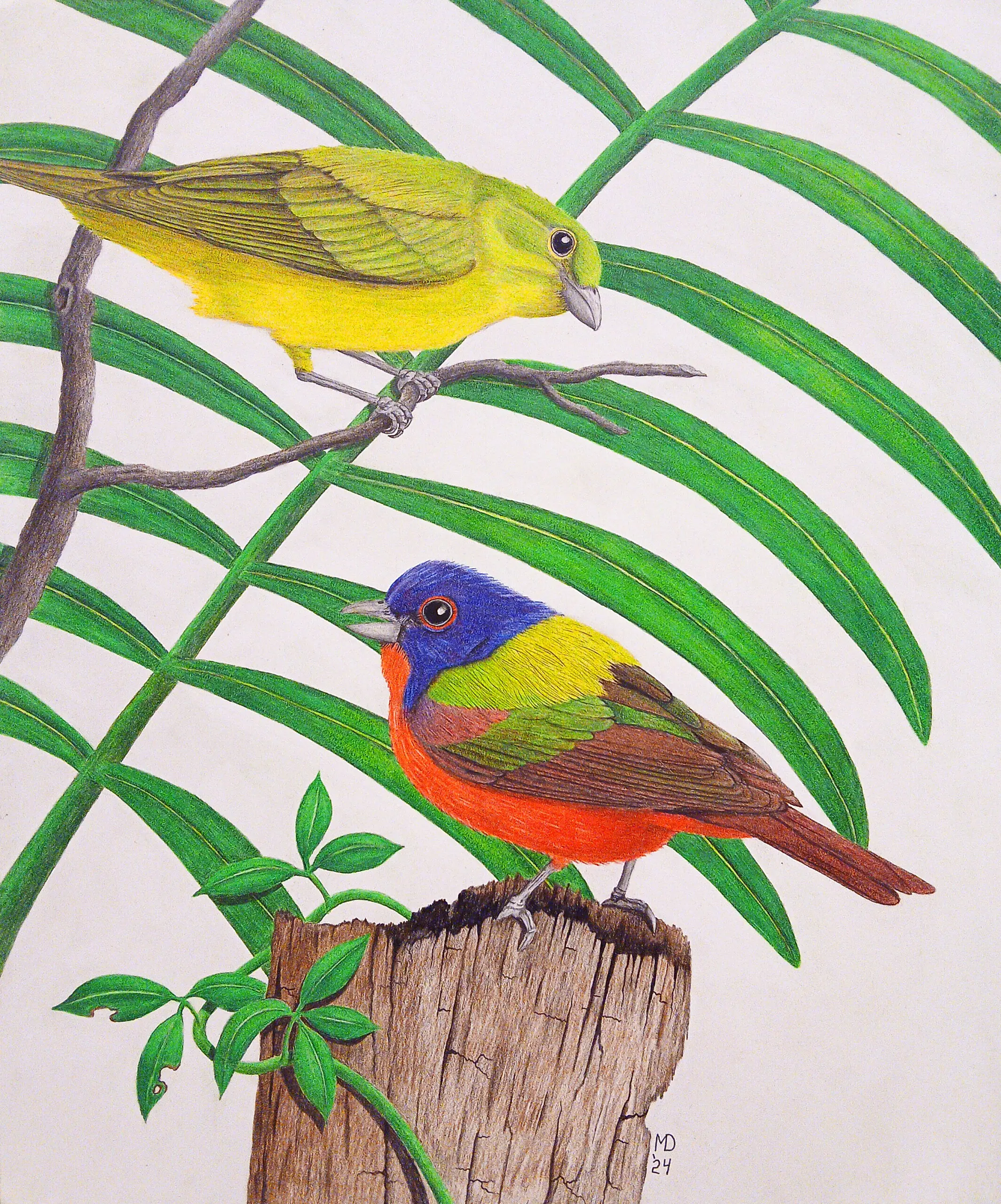
The contrast between the sexes is striking. Adult males carry an extraordinary combination of blue, green, yellow, and red, while females are clothed in subtler yellow-green plumage that blends readily into leaves and brush. The two birds therefore present very different kinds of beauty: one almost impossibly vivid, the other quiet and perfectly suited to concealment.
Since that first uncertain glimpse, I have seen and heard many Painted Buntings during summers in Texas and the Carolinas. They are still a treat every time. I continue to be amazed by how much color and beauty can be packed into such a small bird.
In Summer Pair, I portrayed a male and female among broad, arching green leaves. The brilliant male occupies the lower part of the composition, while the female watches from above in plumage that echoes the surrounding foliage. I hope the colored pencil drawing does justice to a species that has fascinated me since childhood.
Summer Pair is a colored pencil wildlife drawing of Painted Buntings (Passerina ciris) by Michael E. Dorcas for Tantilla Art.