
About the Warbler Drawing
About the Warbler Drawing
Each spring in the Southeast, I look forward to the arrival of migrating warblers and other songbirds traveling north toward their breeding grounds. Many pass through wearing their brightest breeding plumage, transforming the trees for a few weeks with flashes of yellow, orange, green, black, and chestnut. Finding them among the leaves and branches can feel like discovering little jewels in the forest.
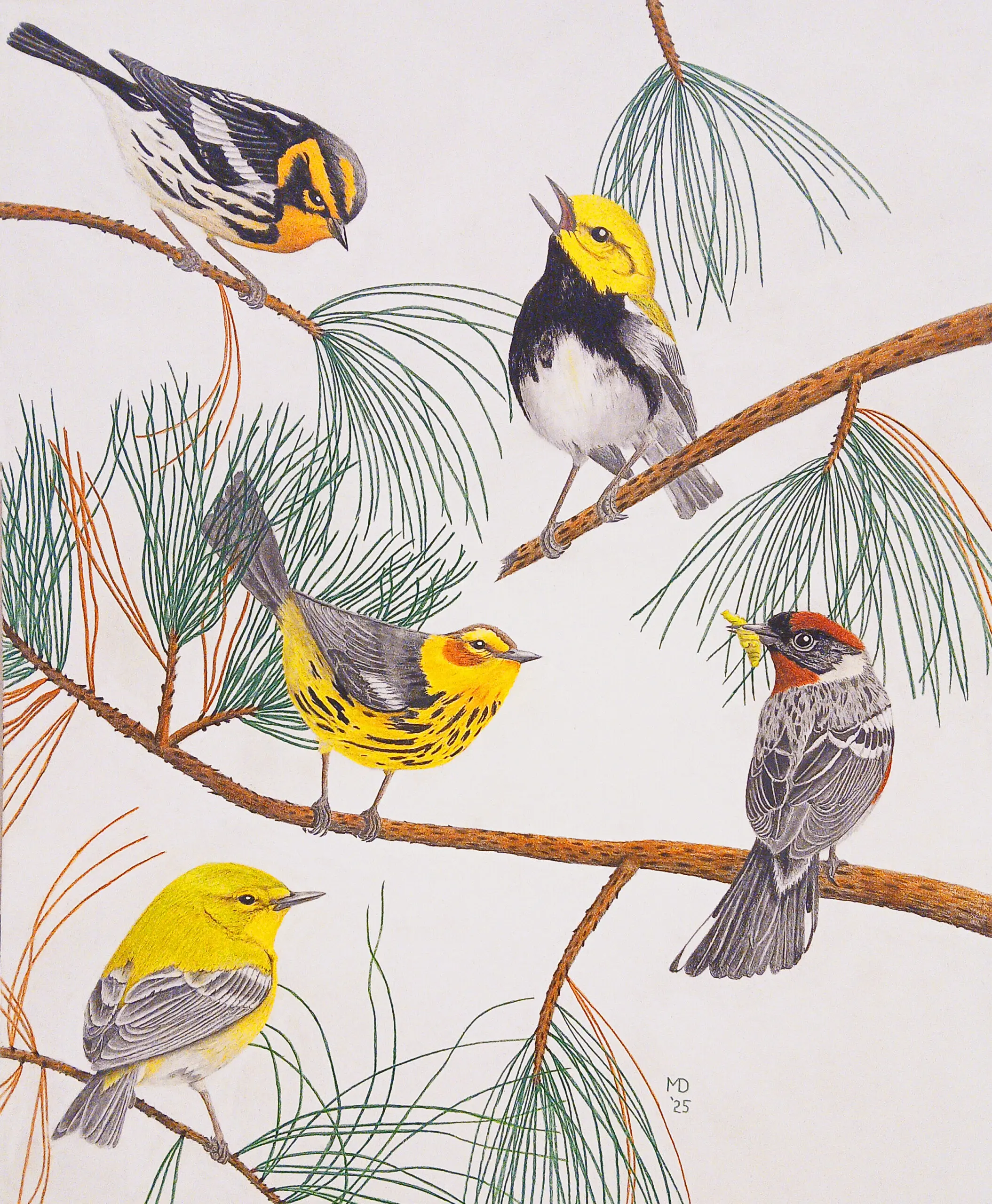
The five species portrayed in Warblers in Pines are all birds I have encountered, although with very different frequencies. I have seen Pine Warblers hundreds of times. They are familiar inhabitants of pine forests throughout much of the Southeast, and their steady musical trills are among the characteristic sounds of those woodlands. At the other extreme, Bay-breasted Warblers have been much less frequent and therefore especially memorable sightings during migration.
The drawing also includes a Black-throated Green Warbler, a Blackburnian Warbler, a Cape May Warbler, and a Bay-breasted Warbler. Male Black-throated Green Warblers have bright yellow faces, green backs, bold black throats, and dark streaking along their sides. Blackburnian Warblers are among the most striking of all North American songbirds, with brilliant orange faces and throats set against intricate black-and-white plumage. Male Cape May Warblers have yellow underparts marked with dark streaks, a distinctive chestnut cheek patch, and a yellow collar, while male Bay-breasted Warblers carry rich chestnut coloring across the crown, throat, and flanks, together with a black face and pale yellowish neck patch.
These species do not all share exactly the same breeding habitat. Pine Warblers are closely tied to pine forests, whereas Cape May and Bay-breasted Warblers breed primarily in northern spruce–fir forests. Blackburnian and Black-throated Green Warblers are often associated with coniferous or mixed forests and spend much of their time high in the canopy. During spring migration, however, all may pass through the same southeastern woodlands, sometimes appearing together in loose, mixed-species groups as they pause to feed before continuing north.
Most warblers feed heavily on insects and other small invertebrates gathered from foliage and branches. Several of the northern species portrayed here are closely linked to outbreaks of spruce budworms on their breeding grounds. Pine Warblers are unusual among warblers because they also consume substantial quantities of seeds, including pine seeds, and may occasionally visit feeders.
In Warblers in Pines, I brought these five males together among pine branches in full breeding coloration. The composition is not intended to portray a single permanent flock, but rather the excitement of spring migration, when birds that spend much of the year far apart may briefly appear in the same forests. I wanted the drawing to capture the diversity, color, and anticipation that make warbler migration one of the highlights of the year for birders.
Warblers in Pines is a colored pencil wildlife drawing of a Pine Warbler (Setophaga pinus), Black-throated Green Warbler (Setophaga virens), Blackburnian Warbler (Setophaga fusca), Cape May Warbler (Setophaga tigrina), and Bay-breasted Warbler (Setophaga castanea) by Michael E. Dorcas for Tantilla Art.