
About the Western Diamondback Rattlesnake Drawing
Western Diamondback Rattlesnakes (Crotalus atrox) have been part of my life for a very long time. I have encountered many of them over the years, particularly during fieldwork in Texas and elsewhere in the Southwest, but I still remember the first one vividly.
It was a warm New Year’s Day south of Dallas. I was climbing a rocky hillside when, as I neared the top, I suddenly found myself almost face-to-face with an enormous Western Diamondback. The snake was lying just outside what appeared to be its overwintering den, taking advantage of the winter sun. Because I was coming up the slope from below, my head was nearly level with the snake before I realized it was there.
For a while, it simply sat and watched me. Eventually it began to rattle, but what I remember most was not aggression—it was the sheer presence of the animal. It was a magnificent snake. We were conducting research at the time, so I captured it, and when measured it was 5 feet 3 inches long. I have encountered many Western Diamondbacks since then, but never another quite that large.
The place where I found that snake has changed dramatically. What was once open habitat is now largely covered by a sprawling subdivision. I cannot know with certainty what happened to the rattlesnakes that lived there, but it is difficult to imagine the population survived the transformation. That experience has stayed with me because it represents a much larger story. Across much of the Southwest, development continues to replace and fragment the habitats on which rattlesnakes and countless other native animals depend.
Western Diamondbacks also face threats that are more direct. Rattlesnake roundups continue in Texas and elsewhere, where large numbers of snakes are captured and killed, often as part of public spectacle. Others are deliberately killed whenever they are encountered simply because they are rattlesnakes. Road mortality adds yet another source of loss, particularly in landscapes where snakes must cross roads while moving between seasonal habitats, searching for mates, or dispersing.
There is no question that a large Western Diamondback deserves respect. It is a powerful venomous predator and should be given plenty of space. But respect is very different from fear or persecution. Like most wild animals, these snakes generally want to be left alone. If given the chance, they will usually try to slip away; if they cannot, they defend themselves. These snakes are important predators within Southwestern ecosystems, and they are as much a part of the natural heritage of Texas and the American Southwest as the coyotes, roadrunners, mesquite, and live oaks with which they share the landscape.
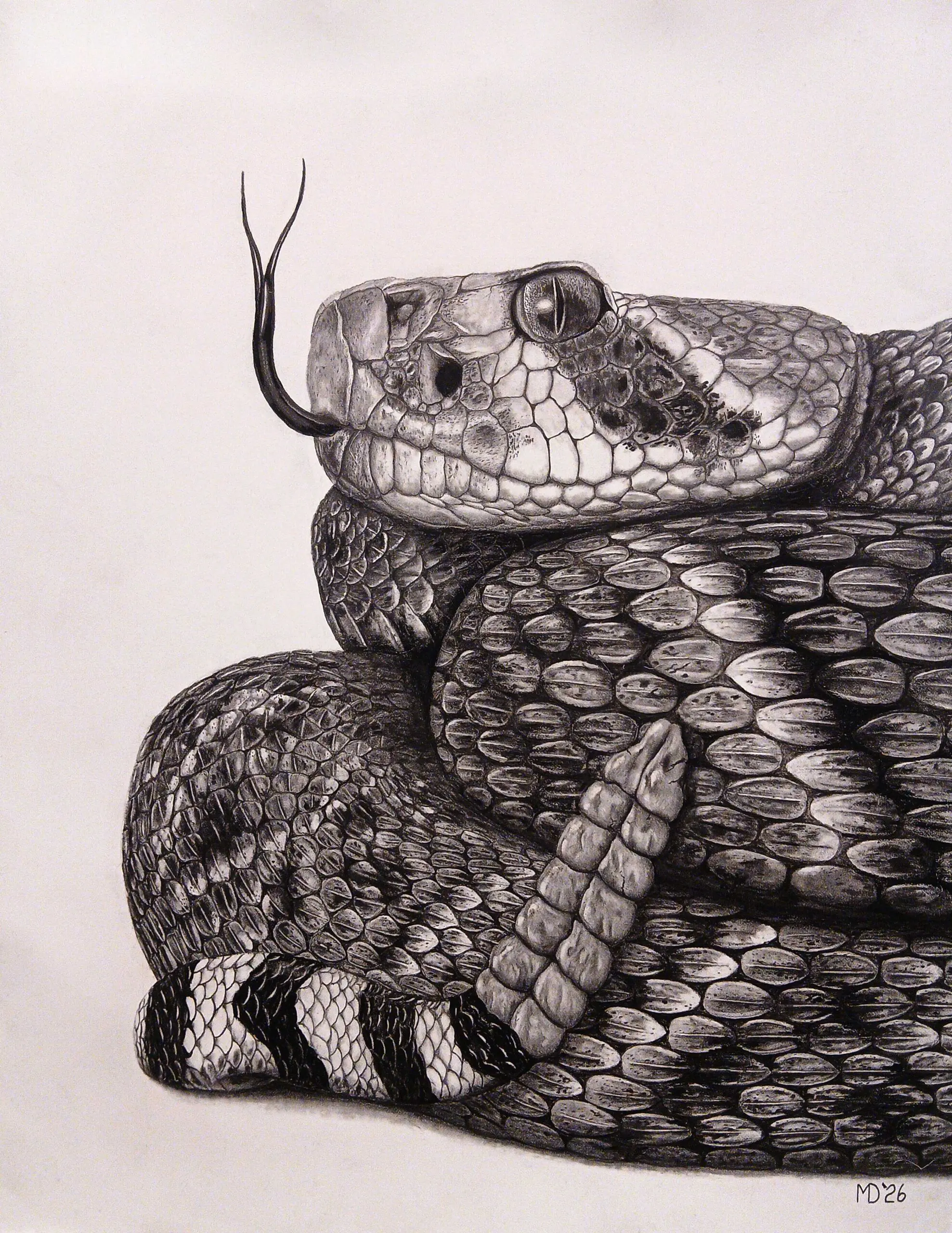
I titled this drawing ATROX because among “snake people,” that name says it all. You don’t need to say Western Diamondback Rattlesnake—just atrox. The scientific name also carries a certain force: the specific epithet comes from the Latin atrox, meaning fierce, cruel, savage, or terrible, a reference to the snake’s defensive temperament and potent venom. The name is really a misnomer. Western Diamondbacks are certainly animals to be treated with caution and respect, yet they are not malicious creatures. They are simply well-armed animals trying to survive in a world that often gives them little room. I always tell people, if you stepped on me, I’d try and bite you too!
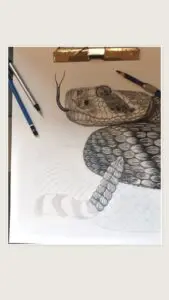
In ATROX, I wanted to convey some of that presence—the heavy head, the watchful eye, the intricate patterning, and especially the extraordinary texture created by hundreds of individual scales. Drawing those scales one by one was painstaking work, but the detail is part of what makes these animals so remarkable. The drawing is based on multiple reference photographs by my longtime friend and colleague W. W. Lamar, whose photographs have provided inspiration for many of my reptile drawings.
For me, ATROX is both a portrait of an extraordinary snake and a reminder of animals and landscapes I have known for much of my life. Western Diamondbacks are remarkably resilient animals, but their future should never be taken for granted. They deserve a place in the future of the Southwest—and the same measure of fascination, respect, and protection we extend to its other great wildlife.
ATROX is a graphite-pencil wildlife drawing of a Western Diamondback Rattlesnake (Crotalus atrox) by Michael E. Dorcas for Tantilla Art. Reference photographs courtesy of W. W. Lamar.