
About the Eastern Box Turtle Drawing
About the Eastern Box Turtle Drawing
I have encountered thousands of Eastern Box Turtles (Terrapene carolina) over the years, but finding one still feels like a small discovery. Perhaps that feeling goes back to childhood, when box turtles were among the animals that first drew me into the close observation of reptiles and amphibians.
As a boy, I kept several box turtles in a large outdoor enclosure. At the time, I was under the mistaken impression that they were strict herbivores. I once placed a few small toads in the enclosure temporarily, assuming the two kinds of animals would ignore one another. Instead, I watched in amazement as the turtles literally chased down and ate every toad within a matter of minutes. Their deliberate movements had not prepared me for the speed and determination with which they could chase living prey. Needless to say, I began providing them with a much more varied diet after that, including many different plant and animal foods and even occasional small mice.
That experience taught me something important about box turtles: their quiet, almost contemplative appearance can be misleading. They are opportunistic omnivores that eat berries and other fruits, mushrooms, earthworms, slugs, insects, carrion, and occasionally small vertebrates. A turtle feeding peacefully beneath blackberry brambles is therefore only one part of a surprisingly varied natural history.
Years later, when I was a biology professor, box turtles became the subjects of extensive research by my students, colleagues, and me. We established a long-term mark-recapture program around Davidson, North Carolina, through which turtles found by researchers and members of the community could be individually marked, measured, and documented. The program allowed us to investigate how these long-lived animals persist in a landscape increasingly divided by roads, neighborhoods, lawns, railways, and other human development.
Our research showed that box turtles can continue to live in urbanized landscapes, but their presence should not be mistaken for evidence that those landscapes are safe. Older turtles were found more frequently in heavily forested areas, while mortality was higher in developed habitats. Box turtles mature slowly and may live for many decades, so the loss of adult animals to vehicles, lawn equipment, domestic animals, collection, and other human-associated dangers can gradually deplete a population even while turtles continue to be seen occasionally.
We also studied what happens when people move box turtles away from the places where they were found. Such relocation is often well intentioned. Someone may believe that a turtle discovered in a yard, beside a road, or near construction will be safer if carried to a park or forest several miles away. Box turtles, however, normally become familiar with a relatively small home area and may attempt to return after being displaced. In our study, relocated turtles occupied much larger areas and traveled farther than resident turtles. Five of the ten relocated animals died or disappeared during the study, while none of the resident turtles did.
The practical lesson is simple but important: a box turtle should generally not be transported to an unfamiliar location. A turtle crossing a road can be helped across in the direction it was already traveling, provided that can be done safely, but it should not be taken elsewhere simply because another place looks more suitable to us. What appears to be an inviting patch of woods may be completely unfamiliar terrain to the turtle.
Railroads presented another unexpected danger. Box turtles can enter the space between railroad rails at crossings, eroded sections, or other low points, but the rails may then form walls too high for them to climb. We studied how trapped turtles responded and found that most were unable to pull themselves over the rail. An animal that has spent its life successfully navigating forests, fields, streams, and seasonal changes can thus be defeated by a narrow strip of steel only a few inches high. Once trapped, turtles may travel along the tracks searching for an exit while facing dehydration, overheating, starvation, or an approaching train.
These threats are especially troubling because each box turtle represents a considerable investment of time. The brilliantly patterned adult encountered beside a trail may have survived droughts, winters, predators, road crossings, and decades of change in the surrounding landscape. Its familiar territory may contain traditional feeding areas, shelters, overwintering sites, and routes used year after year.
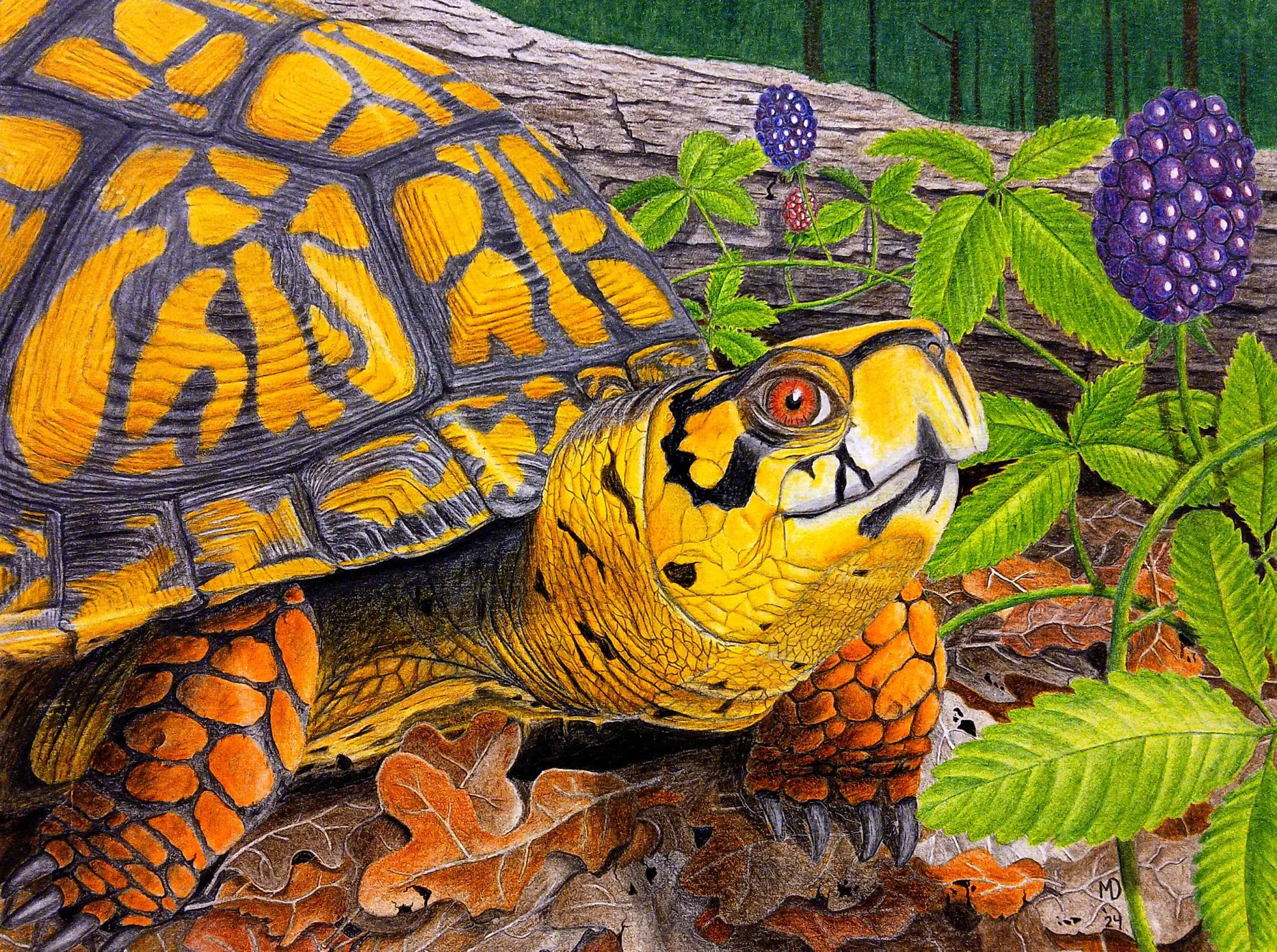
In Blackberry Season, I wanted to show that life embedded within its surroundings rather than create a simple isolated portrait. The turtle is actively feeding among ripe berries and tangled vegetation, participating in the seasonal abundance of the forest edge. Its bright shell and skin patterns echo the colors of the fruit and leaves, while the blackberry brambles help place the animal in a particular ecological moment.
The drawing brings together what has always fascinated me about box turtles: their extraordinary individual variation, their intimate connection to the landscape, and the contrast between their apparent simplicity and the complexity of their lives. Even after childhood encounters, years of scientific research, and thousands of turtles observed, each one still seems worthy of stopping, looking closely, and wondering where it has been.
Blackberry Season is a colored-pencil wildlife drawing of an Eastern Box Turtle (Terrapene carolina) by Michael E. Dorcas for Tantilla Art.