
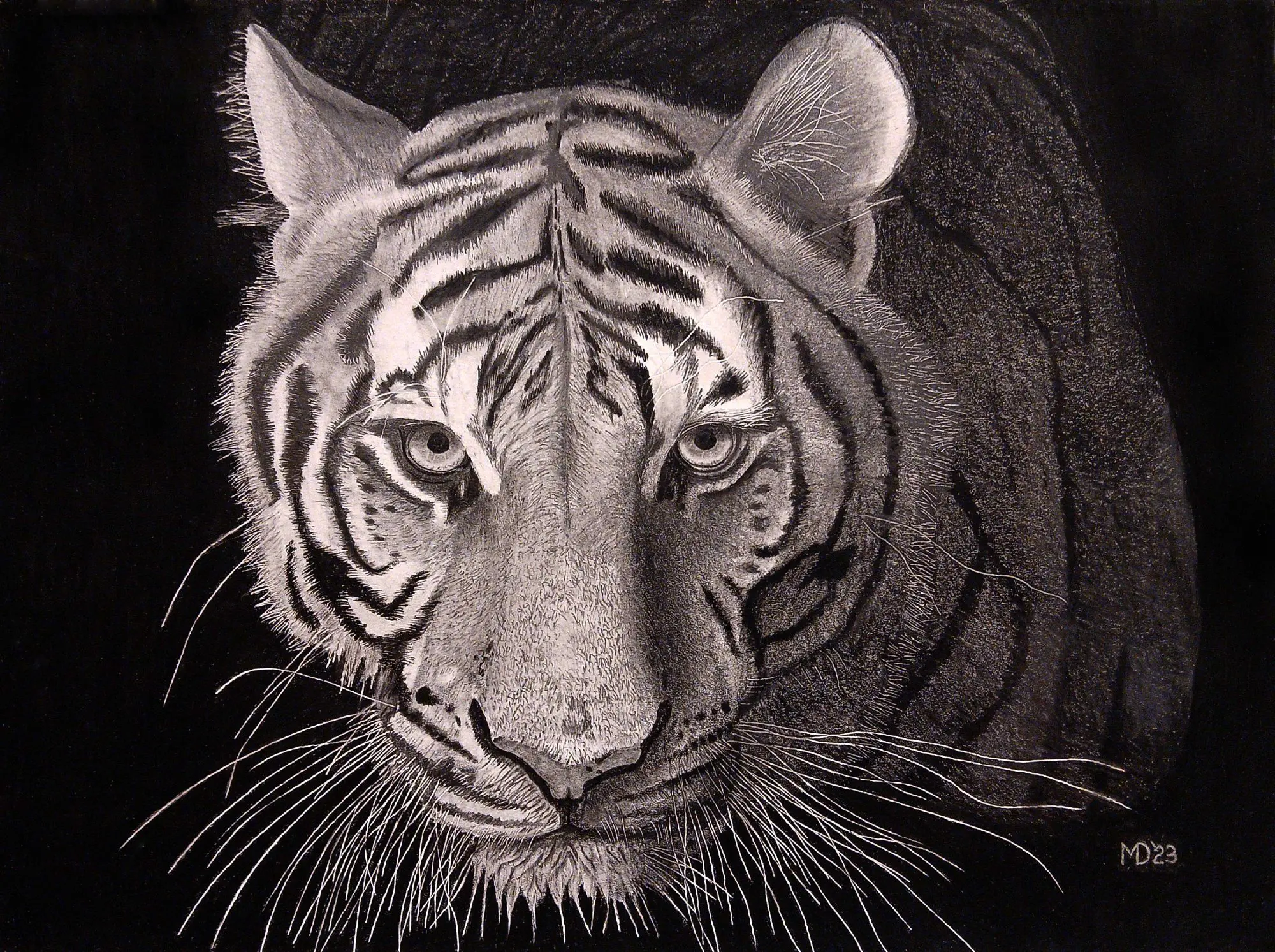
About the Bengal Tiger Drawing
I have seen lions, leopards, and other large predators in the wild, but I have never encountered a tiger. Seeing the world’s largest living cat in its natural habitat remains a “maybe one day” experience for me. Tigers have fascinated me since childhood, and the possibility of seeing one emerge silently from an Asian forest still holds a special place in my imagination.
Part of that fascination came from reading Jim Corbett’s Man-Eaters of Kumaon, which recounts his pursuit of several tigers and leopards that had begun preying on people in northern India. I later read Dane Huckelbridge’s No Beast So Fierce: The Terrifying True Story of the Champawat Tiger, the Deadliest Animal in History, an extraordinary account of the most infamous of those animals.
The Champawat Tigress reportedly killed 436 people in Nepal and India before Corbett tracked and killed her in 1907. The idea that one tiger could alter the daily lives of entire communities, leaving people afraid to work in fields, gather firewood, or travel between villages, is almost difficult to comprehend. Although that case was exceptional, it demonstrates the fear and disruption that can result when a large predator begins deliberately hunting people.
Corbett’s life also reflected the changing relationship between people and predators. He became famous for killing man-eating tigers and leopards, but he developed into an influential naturalist, writer, photographer, and advocate for protecting India’s rapidly disappearing wildlife. India’s oldest national park was eventually renamed Jim Corbett National Park in his honor and later became the first reserve included in the country’s Project Tiger initiative.
Bengal Tigers (Panthera tigris tigris) occur primarily in India, with additional populations in Nepal, Bhutan, and Bangladesh. They occupy habitats ranging from tropical forests and mangrove swamps to grasslands and the forests of the Himalayan foothills. Tigers are generally solitary, territorial predators that rely on concealment, patience, and a short explosive attack rather than prolonged pursuit.
Their striped coats allow them to disappear surprisingly well among vegetation, shadows, and broken light. Every tiger has a unique stripe pattern, providing researchers with a natural way to identify individuals in camera-trap photographs. Bengal Tigers prey primarily on deer, wild pigs, and large bovids such as gaur, although their diet varies with habitat and prey availability.
Most wild tigers avoid people, and the deliberate hunting of humans is unusual. Conflict can arise, however, where tiger habitat overlaps with villages, farms, grazing areas, and places where people enter forests to gather resources. Tigers may kill livestock or occasionally attack people, while fear and economic losses can lead to retaliatory killing. Protecting tigers therefore requires not only secure habitat and abundant wild prey but practical ways for nearby communities to live safely alongside them.
Tigers are classified as Endangered. Poaching, illegal trade, habitat destruction, fragmentation, declining prey populations, and conflict with people have eliminated them from most of their former range. Although recent conservation programs have helped some populations recover, only about 5,500 tigers are estimated to remain in the wild.
The number of captive tigers makes that total even more startling. Thousands are held in tiger-breeding facilities across East and Southeast Asia, while thousands more live in captivity in the United States. Many were bred for commercial trade, entertainment, private ownership, or poorly regulated exhibition rather than legitimate conservation. There are now substantially more tigers living behind barriers than surviving freely in the forests and grasslands of Asia.
In Night Stalker, I portrayed a Bengal Tiger emerging directly from a deep black background. Its head-on gaze, broad muzzle, flowing stripes, long whiskers, and shadowed shoulders create the impression of a powerful animal moving silently out of darkness. The title reflects the tiger’s ability to approach almost unseen and the mixture of fascination, respect, and uneasiness inspired by a predator capable of vanishing into its surroundings.
Night Stalker is a graphite wildlife drawing of a Bengal Tiger (Panthera tigris tigris) by Michael E. Dorcas for Tantilla Art.