
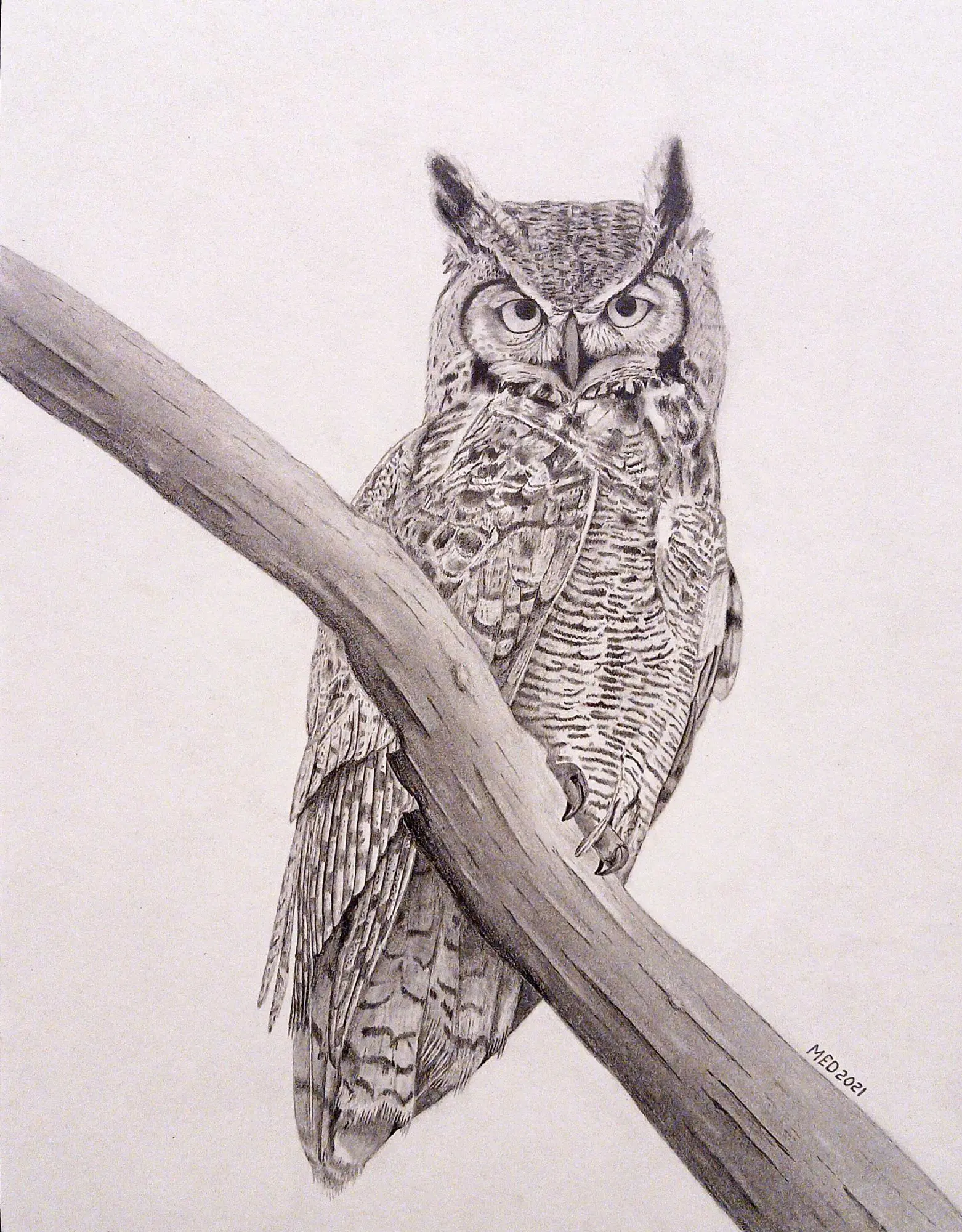
About the Great Horned Owl Drawing
Great Horned Owls (Bubo virginianus) have always impressed me as exceptionally powerful and self-possessed birds. Seeing one perched silently above the landscape is always a treat, particularly when its enormous eyes and prominent feather tufts give the impression that it is watching everything around it.
For years, we had a Chihuahua that weighed only about five pounds. Whenever I let him into the backyard after dark, I wondered whether a Great Horned Owl might carry him away. I used to say that I certainly did not want that to happen, but….. if it was going to happen, I did not want to miss seeing it. Fortunately, both the dog and my curiosity survived intact.
The concern was not entirely imaginary. Great Horned Owls are immensely powerful predators and have been documented taking very small dogs and domestic cats, although such encounters are uncommon. Their usual prey consists of wild animals, but almost anything suitably sized and available at night may attract their attention.
Great Horned Owls are among the most widespread and adaptable raptors in the Americas. They inhabit forests, wetlands, deserts, grasslands, agricultural areas, suburbs, and cities. Their diet is equally broad and includes rodents, rabbits, birds, reptiles, amphibians, insects, fish, and even other birds of prey.
Perhaps the most surprising item on that menu is the Striped Skunk. Great Horned Owls are among the few predators that regularly kill and eat them, apparently undeterred by the defensive spray that discourages most other animals. They also prey on crows, hawks, smaller owls, young Ospreys, and occasionally birds as large as geese. A Great Horned Owl is therefore not merely a predator of mice—it is capable of killing animals that are themselves formidable predators or substantially heavier than the owl.
Their extraordinarily powerful feet and talons provide the principal killing force. The owl descends silently, seizes the prey, and drives the talons inward with tremendous strength. The curved claws maintain their grip while the toes oppose one another like a living trap.
Like most owls, their approach is nearly silent because the leading edges of the flight feathers are fringed and the feather surfaces are soft. These structures reduce the turbulence and noise normally produced as air passes across a bird’s wings. Prey listening in the darkness may therefore receive almost no warning before the owl arrives.
The prominent “horns” are not horns and are not the owl’s ears. They are elongated feather tufts, often called plumicorns. The true ear openings are hidden beneath feathers on the sides of the head. Together with the broad facial discs, those concealed ears help the owl detect and locate animals moving in darkness.
Great Horned Owls are also among the earliest nesting birds of the year. Courtship and territorial calling begin during winter, and females may incubate eggs while snow still covers the ground. Rather than constructing elaborate nests of their own, pairs commonly take over abandoned nests built by hawks, crows, ravens, or squirrels. A structure created by one animal may therefore become the winter nursery of a much more powerful occupant.
In Night Watch, I portrayed the owl facing directly outward from a diagonal branch. The intense gaze, upright posture, prominent feather tufts, barred plumage, and heavy talons convey the quiet authority of a predator perfectly adapted to hunting at night.
The pose is still, but the bird does not appear relaxed or inattentive. Its fixed eyes confront the viewer, its ears remain tuned to the darkness, and its feet grip the branch with the same strength used to seize prey. The owl seems fully aware of everything occurring beyond the edge of the drawing.
The title reflects both the owl’s alert posture and its role as an unseen observer of the nocturnal landscape. Long after most people have gone indoors, the Great Horned Owl remains above the ground—listening, watching, and waiting.
Night Watch is a graphite-pencil wildlife drawing of a Great Horned Owl (Bubo virginianus) by Michael E. Dorcas for Tantilla Art.