
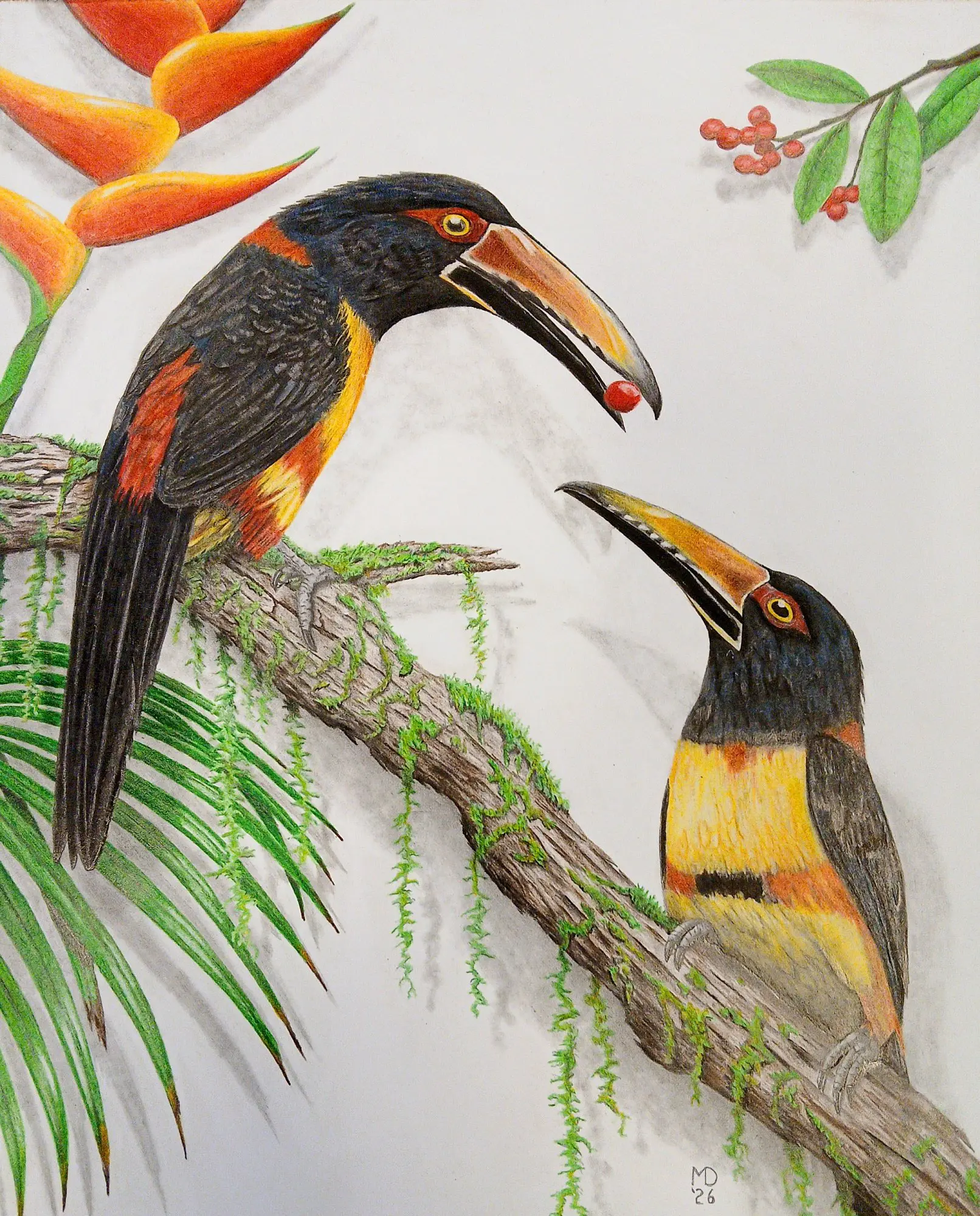
About the Collared Aracari Drawing
I first encountered Collared Aracaris during field research in Tortuguero, Costa Rica. Their beauty seemed quieter than that of some of their more flamboyant toucan relatives, but no less compelling. Their warm yellow, red, and dark plumage, patterned bills, and expressive eyes gave them a distinctive presence in the tropical forest.
Collared Aracaris (Pteroglossus torquatus) are social members of the toucan family found from southern Mexico through Central America and into northern South America. They often travel in small groups through the forest canopy and may gather together inside tree cavities to roost. Their diet consists primarily of fruit, although they also eat insects and other small animals. By swallowing fruit and later depositing or regurgitating viable seeds, they help disperse many forest plants.
They nest in natural tree cavities or holes previously excavated by woodpeckers. Both parents participate in caring for the young, and additional adult birds may sometimes help provision the nestlings. Their social behavior and close associations with one another made them especially appropriate subjects for a drawing centered on connection.
Although the Collared Aracari is currently classified as a species of Least Concern, its population is believed to be declining. The species can persist in some secondary forests, but continued deforestation and the loss of mature trees reduce the feeding, nesting, and roosting habitat on which it depends.
In Offering, I portrayed one aracari extending a berry toward another. Rather than simply illustrating two colorful birds, I used the shared offering to explore intimacy, attentiveness, and connection in the natural world. The vivid plumage, moss-covered branch, tropical vegetation, and small red berry frame a quiet interaction between the two birds.
Offering is a colored pencil wildlife drawing of Collared Aracaris (Pteroglossus torquatus) by Michael E. Dorcas for Tantilla Art.