
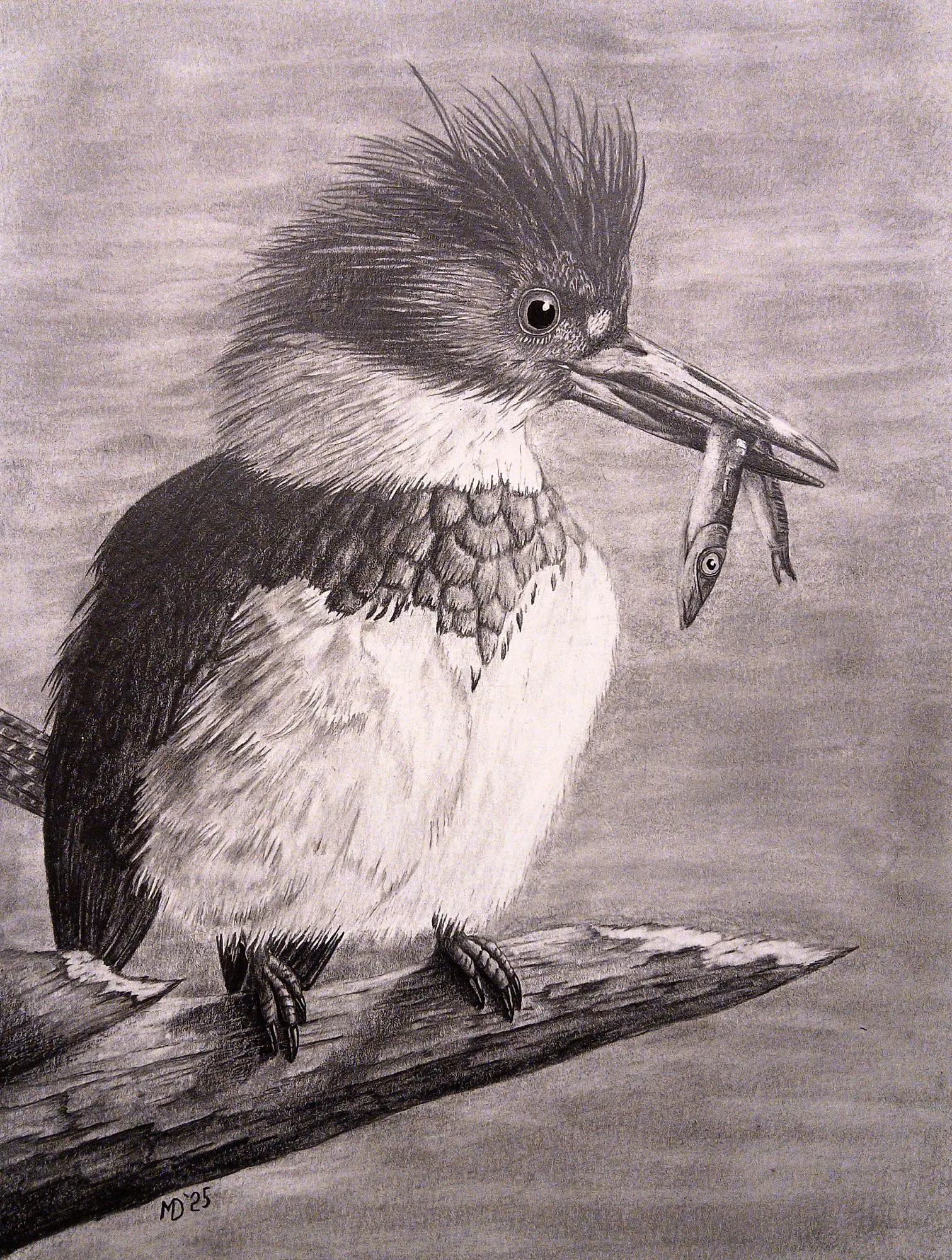
About the Belted Kingfisher Drawing
I have always enjoyed watching Belted Kingfishers along rivers, lakes, ponds, and shorelines. They often announce their presence before they are seen, flying rapidly over the water while giving their loud, unmistakable rattling call. Once located, they are frequently found perched above the water, watching intently for movement below.
Belted Kingfishers (Megaceryle alcyon) hunt primarily from exposed branches, wires, posts, and other elevated perches. When a fish comes within range, the bird dives headfirst into the water and captures it with its long, powerful bill. After returning to a perch, it may strike the fish against the branch before swallowing it headfirst. Although fish make up much of their diet, they also consume crayfish, aquatic insects, amphibians, and other small animals.
Their nesting behavior is equally distinctive. Rather than building a conventional nest, a pair excavates a long tunnel into an exposed earthen bank, often near water. The tunnel slopes upward and ends in a chamber where the eggs are laid. Both adults help excavate the burrow, incubate the eggs, and feed the young.
Belted Kingfishers are also unusual because the female is more colorful than the male. Both sexes have a blue-gray breast band, but the female has an additional rusty band across the belly. The species remains widespread and is currently considered of low conservation concern, although clean aquatic habitats, abundant prey, and suitable earthen banks remain essential to its survival.
In River Sentinel, I portrayed a Belted Kingfisher perched above the water with a freshly captured fish held in its bill. The shaggy crest, oversized head, powerful bill, compact feet, and alert eye reflect the distinctive appearance of a bird that seems constantly attentive to everything happening along its stretch of shoreline.
River Sentinel is a graphite wildlife drawing of a Belted Kingfisher (Megaceryle alcyon) by Michael E. Dorcas for Tantilla Art.