
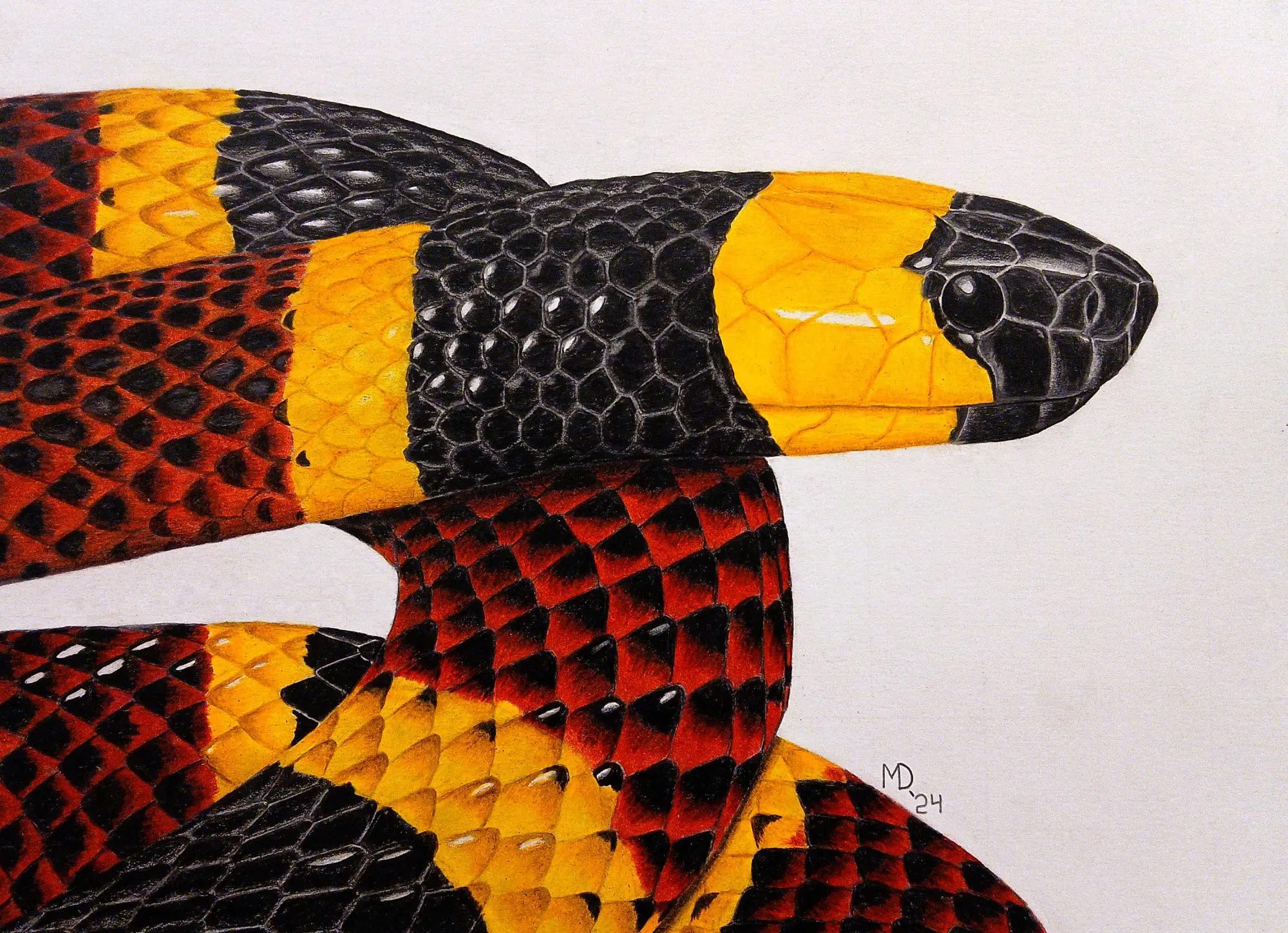
About the Texas Coral Snake Drawing
I have captured a few Texas Coral Snakes (Micrurus tener) and encountered considerably more over the years, although never very many. They are remarkably secretive snakes that spend much of their lives beneath leaf litter, inside rotting logs, underground, or otherwise hidden from view. Finding one usually means being fortunate enough to cross paths with it during one of the relatively brief periods when it is moving across the surface.
Their slender bodies, small heads, smooth scales, and brilliant bands can make them appear almost delicate. That impression changes quickly when one is restrained. Texas Coral Snakes can become surprisingly vigorous, twisting and thrashing while repeatedly attempting to bite. Of course, it is difficult to blame an animal for resisting when a much larger creature has picked it up.
Coral snakes belong to the elapid family, along with cobras and mambas. Unlike pitvipers, which possess long hinged fangs, coral snakes have small fixed fangs at the front of the mouth. A persistent myth claims that they must hang on and chew before they can inject venom. They often do maintain their grip on small prey, but they can deliver venom during a quick bite and should never be regarded as safe to handle.
Their venom acts primarily on the nervous system and can interfere with muscle control and breathing. A bite may initially produce little pain or swelling, allowing a serious envenomation to appear deceptively mild. Fortunately, bites are very uncommon and usually involve someone deliberately handling the snake. Any bite must nevertheless be treated as a medical emergency.
Texas Coral Snakes are specialized predators of other elongated animals, especially snakes and lizards. Their diet includes small earth snakes, blind snakes, young racers, watersnakes, kingsnakes, skinks, and other reptiles that can be pursued through narrow spaces beneath the ground or within leaf litter. Their venom quickly subdues prey that might otherwise twist free or bite back.
One of my most memorable encounters involved a Coral Snake that had eaten a Scarlet Snake. Scarlet Snakes are harmless, but their red, yellow, and black pattern resembles the warning coloration of coral snakes. In this case, the dangerous animal had consumed one of the harmless species that gains protection by looking somewhat like it.
That resemblance is an example of Batesian mimicry, in which a harmless animal benefits by resembling one that predators have good reason to avoid. Scarlet Snakes, Scarlet Kingsnakes, milk snakes, and several other harmless North American snakes possess variations on the same conspicuous red, yellow, and black theme.
Research by David Pfennig and his colleagues demonstrated just how strongly the success of this deception depends on geography. The researchers placed clay snake models in areas both inside and outside the range of coral snakes. Models resembling coral-snake mimics received much greater protection where real coral snakes occurred. Outside that range, predators were far more willing to attack them. The pattern works because local predators have either learned—or evolved—to treat a brightly banded snake as a potentially fatal mistake.
Their work also showed that a mimic does not necessarily need to reproduce every detail perfectly. Predators may respond to the broad visual impression of red, yellow, and black bands without carefully checking the precise order of every ring. For a fox, raccoon, hawk, or other predator, hesitation is sensible. Mistaking a harmless snake for a venomous one costs only a missed meal; making the opposite mistake could be lethal.
The coral snake benefits from making its warning difficult to ignore. When threatened, many coral snakes hide their true heads beneath their coils, curl or elevate their tails, and thrash vigorously. The sudden flashes of brilliant color and confusion between head and tail can make it difficult for a predator to determine where to attack. The pattern is therefore not simply decorative coloration—it is part of a defensive performance.
That makes coral snakes an intriguing contradiction. They possess some of the most conspicuous warning colors of any North American snake, yet they spend most of their lives concealed. The brilliant signal becomes visible mainly during those rare moments when an animal that normally depends on secrecy has been exposed.
In Scarlet Secret, I wanted to emphasize that contrast. The close composition concentrates attention on the smooth, glossy scales and vivid red, yellow, and black bands. Against the dark background, the pattern appears almost luminous—an unmistakable warning displayed by an animal that is seldom seen at all.
The title refers both to the scarlet coloration and to the hidden life of the snake itself. A Texas Coral Snake may live beneath the surface only a short distance from people who never know it is there, emerging briefly before disappearing again into the leaves, soil, and shadows.
Scarlet Secret is a colored-pencil wildlife drawing of a Texas Coral Snake (Micrurus tener) by Michael E. Dorcas for Tantilla Art. Reference photograph courtesy of W. W. Lamar.