
About the Gila Monster Drawing
I have encountered Gila Monsters (Heloderma suspectum) twice in the wild in Arizona’s Santa Rita Mountains—first a remarkably small juvenile and later a full-grown adult. Both encounters were unexpected and memorable, combining the excitement of finding an animal I had long hoped to see with deep respect for the only venomous lizard native to the United States.
Finding even two felt fortunate. Gila Monsters spend most of their lives underground in burrows, rock shelters, or other protected retreats, emerging primarily during favorable spring weather and after summer rains. At some sites, their total time above ground may amount to only a few weeks each year. An animal can therefore live nearby for decades while remaining almost completely unknown to the people who share its landscape.
Their heavy bodies and deliberate gait can make them appear slow and inefficient, but that impression is misleading. Gila Monsters are active foragers that follow chemical trails with their forked tongues while searching for nests containing bird or reptile eggs, newborn mammals, and other concentrated sources of food. A single meal may equal nearly one-third of the lizard’s body mass.
That ability to consume enormous meals is well suited to an animal whose opportunities to feed may be brief and seasonal. Excess energy is stored partly as fat in the thick tail, allowing the lizard to remain underground for long periods when conditions are too hot, cold, or dry for activity. A well-fed Gila Monster carries part of its future survival visibly behind it.
The bead-like scales are not merely decorative. Beneath many of them lie small pieces of bone called osteoderms, creating a flexible form of armor over the head and back. The contrasting black and pink, orange, or yellow pattern also functions as a warning. A predator that considers biting this slow-moving lizard is given every opportunity to reconsider.
Gila Monsters do not possess hollow fangs like venomous snakes. Venom glands lie in the lower jaw, and venom travels along grooves in enlarged teeth as the lizard bites and holds on. Their strong jaws and persistent grip can make a bite extremely painful and difficult to disengage. Bites to people are uncommon and nearly always occur when someone attempts to handle, capture, or harass the animal.
The venom is used largely in defense, but its chemistry produced one of the most surprising connections between reptile biology and human medicine. Researchers isolated a peptide called exendin-4 from Gila Monster venom. It activates the same receptor as the human hormone GLP-1 but remains active in the body much longer.
A synthetic version of exendin-4 became exenatide, one of the first GLP-1 receptor agonists approved for treating type 2 diabetes. A molecule produced by a rarely seen desert lizard thus helped open an important path in modern metabolic medicine. It is an extraordinary reminder that conserving an animal also preserves biological adaptations whose value we may not yet understand.
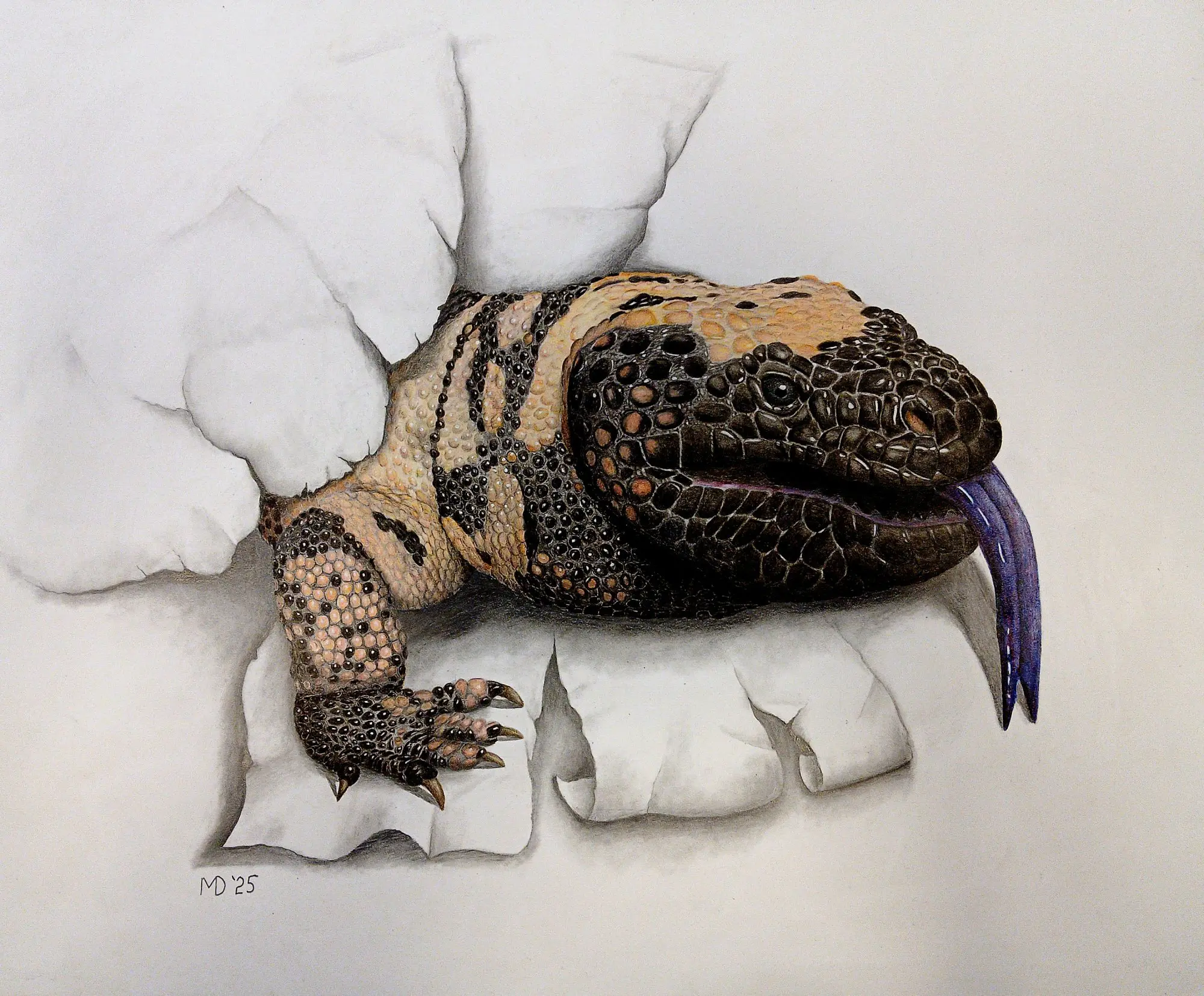
In Breaking Through, I wanted to recreate the surprise and immediacy of my encounters. The Gila Monster appears to push through the surface of the paper, bringing its bead-like scales, powerful claws, dark face, and blue-purple tongue directly toward the viewer. The illusion allowed me to combine a detailed wildlife portrait with the feeling that the animal has suddenly emerged from its hidden world into ours.
The reference photograph deserves special recognition. Gila Monsters can be notoriously difficult photographic subjects. Once active, they tend to keep walking, tongue-flicking, turning, and investigating rather than pausing in a convenient pose. I am especially grateful to my friend Bill Lamar for capturing the remarkable head-on image—and for whatever patience and frustration were required before the lizard finally cooperated.
The title reflects both the composition and the natural history of the species. A Gila Monster spends much of its existence concealed beneath the desert surface, then appears briefly and unexpectedly. In the drawing, it does more than emerge from a burrow or shelter—it seems to break through the boundary between the image and the viewer.
Breaking Through is a colored-pencil wildlife drawing of a Gila Monster (Heloderma suspectum) by Michael E. Dorcas for Tantilla Art. Reference photograph courtesy of W. W. Lamar.