
About the Green Tree Python Drawing
Since childhood, I have been fascinated by Green Tree Pythons (Morelia viridis) and Emerald Tree Boas (Corallus caninus). Although they belong to different snake lineages and evolved on opposite sides of the world, both developed remarkably similar adaptations for life among branches: green adult coloration, broad angular heads, slender necks, prehensile tails, and the characteristic posture of looping their bodies over a horizontal perch.
They remain one of my favorite examples of convergent evolution—different evolutionary histories producing similar solutions to the same ecological challenges. A Green Tree Python from New Guinea and an Emerald Tree Boa from South America can appear closely related, yet their resemblance developed independently through life in tropical forests.
For several years, I kept a captive-bred Green Tree Python in my office. He was a beautiful and generally gentle snake, usually resting in the compact, symmetrical coils typical of the species. I still had to pay attention when reaching toward him, however, because an approaching hand could occasionally be mistaken for a mouse. A warm object moving within striking range can activate a feeding response long before the snake pauses to consider whether that object is attached to the person who feeds it.
Green Tree Pythons are remarkably well constructed for arboreal ambush. Their muscular bodies and prehensile tails hold them securely on narrow branches, while the head rests near the center of the coils. From that position, the snake can launch the front of its body outward, seize an approaching animal, and pull it back toward the perch without losing its grip.
Heat-sensitive pits along the lips help locate warm-bodied prey in dim light. Their mouths also contain numerous long, recurved teeth capable of penetrating feathers or fur and preventing a struggling animal from pulling free. The snake may appear almost ornamental while resting on a branch, but every part of the body is prepared for a sudden and highly accurate strike.
The familiar name Green Tree Python describes most adults but completely fails to prepare someone for the appearance of the young. Hatchlings may be brilliant lemon yellow or shades of brick red, orange, or maroon. Both forms eventually undergo a dramatic transformation and become predominantly green.
For many years, the juvenile colors seemed almost too conspicuous to make ecological sense. A bright-yellow snake appears, at least to human eyes, as though it should be visible from across the forest. Field research, however, showed that the colors are closely associated with changes in habitat and behavior as the snakes grow.
Young Green Tree Pythons tend to use lower vegetation, forest edges, and more open or disturbed habitats. Against sunlit leaves, yellowing vegetation, reddish stems, patches of light, and the complex colors near the forest floor, yellow and red juveniles are less conspicuous than they initially appear. Adults move into different vegetation where green becomes the more effective camouflage.
Researchers tested this not only through human vision but also through models of how the snakes and their bird predators perceive color. The results showed that the yellow or red juvenile and green adult stages each blend effectively into the backgrounds used during that part of life. What seems to us like a spectacular decorative transformation is actually connected to changing habitat, hunting behavior, body size, and vulnerability to predators.
The transition can be surprisingly rapid. In a studied Australian population, yellow juveniles generally began changing at roughly one year of age and at a body length of a little more than half a meter. The transformation sometimes unfolded within only five to ten days.
It is not simply a new color revealed when the snake sheds its skin. Pigments and light-reflecting structures within the skin itself change, producing a shifting mosaic of yellow, green, blue, black, and white. For a brief period, an individual may appear to contain both its juvenile and adult selves at once.
The two color stages may also correspond with changes in the animals they hunt. Juveniles feed largely on small lizards and other prey available near the ground and in low vegetation. As the pythons grow, small mammals become increasingly important, and the snakes can hunt from larger branches and different positions within the forest.
Despite their extraordinary appearance, young Green Tree Pythons must avoid many dangers. Visually hunting birds, monitors, and other predators can capture them, and even larger snakes may pose a risk. Their small size allows them to use thin branches and dense vegetation inaccessible to heavier predators, while their coloration and stillness make them difficult to detect.
That stillness can be deceptive. A juvenile may remain coiled in the same position for long periods, appearing almost asleep. In reality, its eyes, tongue, heat-sensitive pits, and body posture keep it continually connected to the surrounding environment. The snake is conserving energy while waiting for the exact moment when movement becomes worthwhile.
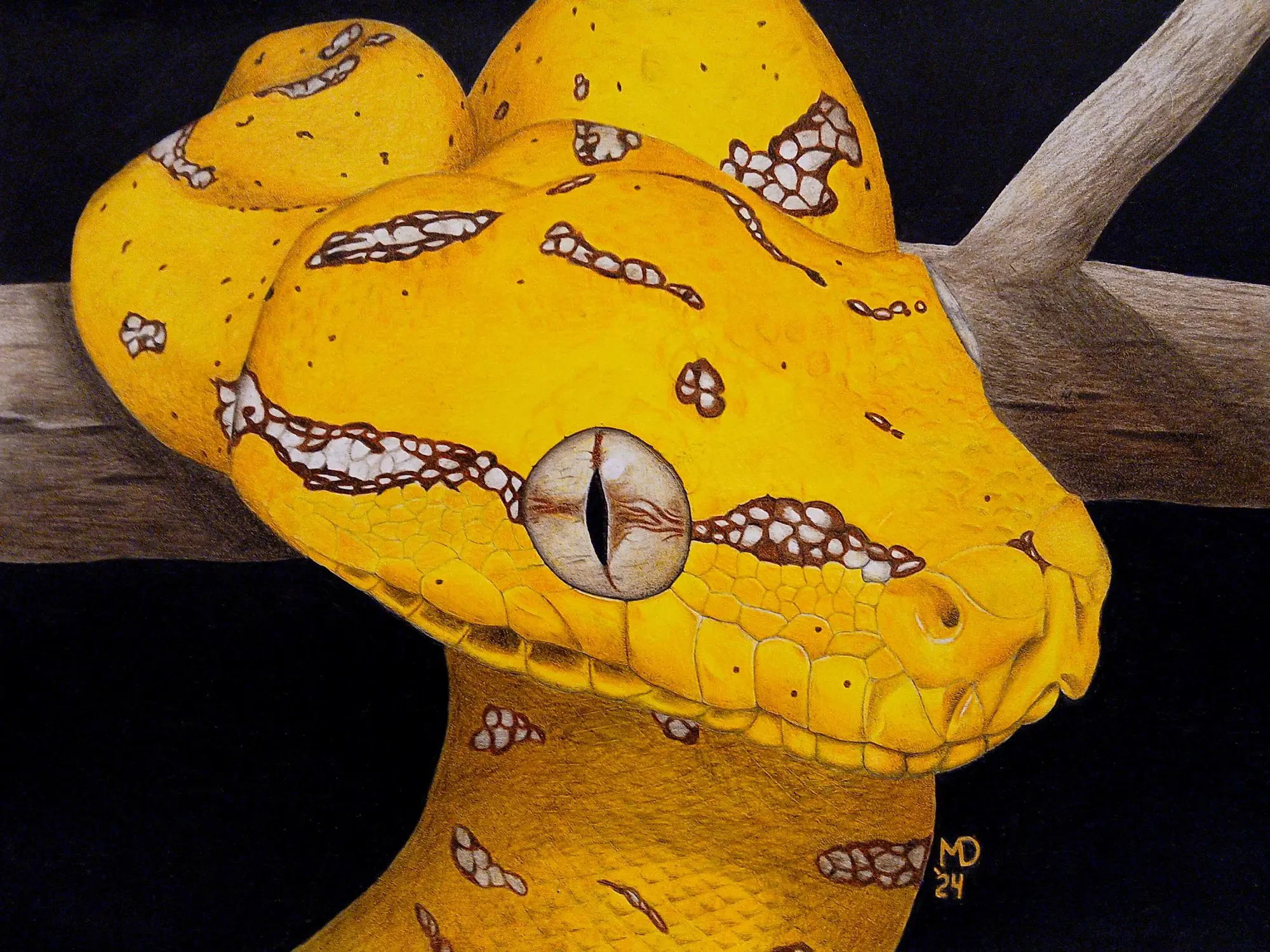
In Canopy Gold, I wanted to capture the remarkable beauty of this temporary stage—the intense yellow body, intricate white and reddish markings, large watchful eye, and secure coils wrapped around the branch. Unlike the green adult shown in Aru Emerald, this snake has not yet completed the transformation that will change both its appearance and its place within the forest.
The dark background isolates the animal and makes its golden coloration appear almost luminous. The close composition emphasizes the tightly folded body and the contrast between visual delicacy and predatory readiness. The snake seems calm and beautifully composed, but it is also alert, anchored, and prepared to strike.
The title refers to a color that will not last. The brilliant gold belongs to one chapter of the python’s life—a juvenile identity that will eventually disappear beneath green. The drawing preserves that brief transformation before the canopy claims the animal in another form.
Canopy Gold is a colored-pencil wildlife drawing of a juvenile Green Tree Python (Morelia viridis) by Michael E. Dorcas for Tantilla Art. Reference photograph courtesy of W. W. Lamar.