
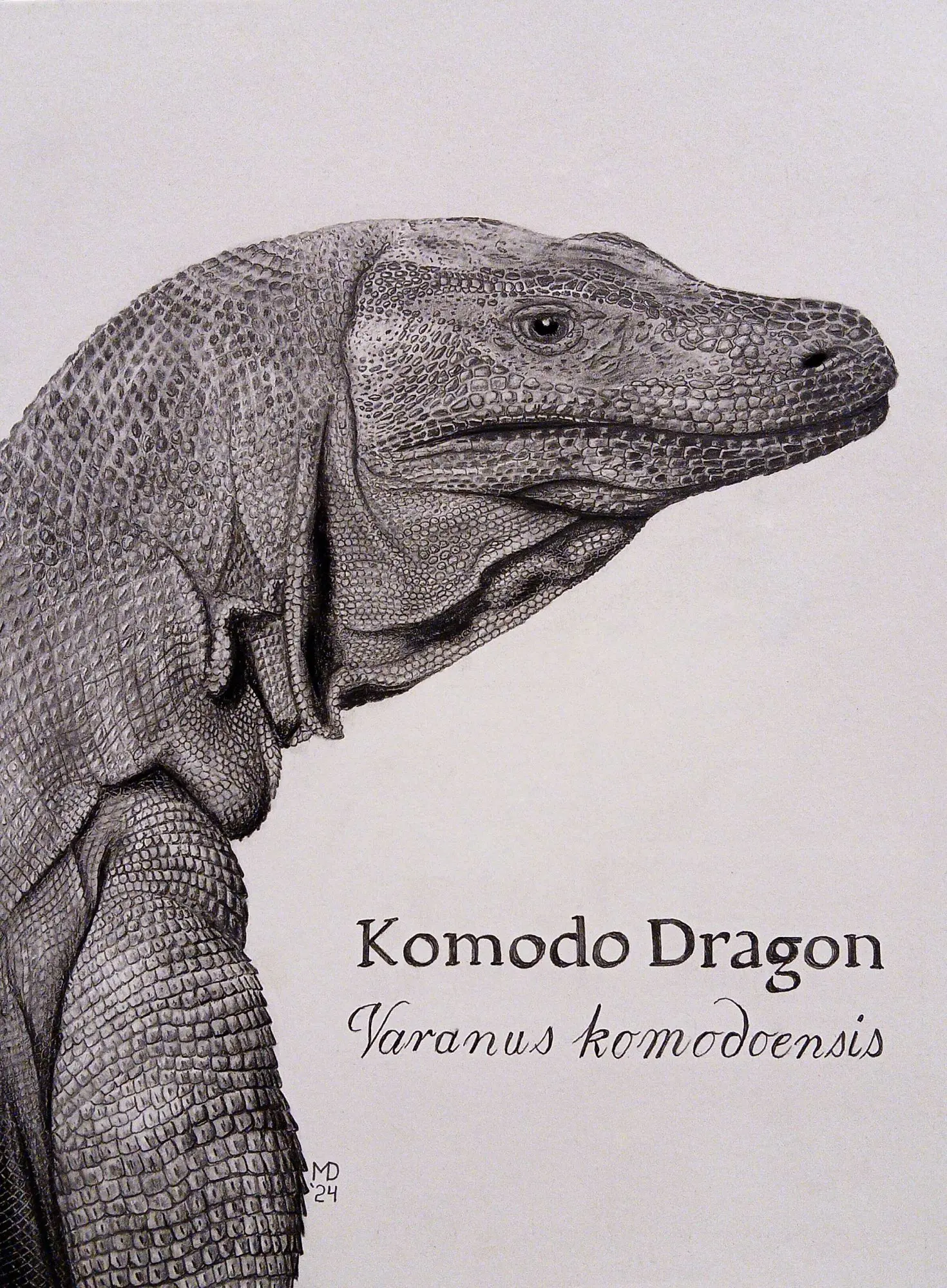
About the Komodo Dragon Drawing
I had read about Komodo Dragons (Varanus komodoensis) for most of my life and had seen several subadults in zoos, but I never imagined that I would have the opportunity to observe them in the wild. In 2015, I visited Komodo and then Rinca the following day, encountering these remarkable lizards in the island landscapes where they evolved.
Seeing them there made their size, alertness, and intelligence feel very different from anything I had experienced observing them in captivity. An adult male can approach ten feet in length, and even when resting, a dragon possesses an unmistakable physical presence. Its head remains alert, the long forked tongue continually samples the air, and the heavy body can shift from apparent stillness to sudden acceleration with surprising speed.
The potential danger was not abstract. One of the rangers showed me the scars and damage on his leg from an encounter with a dragon he had not seen while walking to the lavatory at night. The animal bit deeply into his calf, and he spent several weeks in the hospital with a serious infection. He ultimately lost much of the gastrocnemius and soleus muscles in that leg. Seeing the lasting consequences of a single bite made it impossible to regard the dragons as merely impressive tourist attractions.
Komodo Dragon attacks on people are rare, but they can be devastating and occasionally fatal. The most recent widely documented human death occurred in 2009, when a man named Muhamad Anwar was attacked after entering Komodo National Park to gather fruit. He suffered extensive bites and died from blood loss. Two years earlier, a young boy on Komodo Island was killed after going into vegetation near his village.
Such attacks do not mean that dragons routinely hunt people. Thousands of residents, researchers, rangers, and visitors have lived or traveled among them without being attacked. Most dragons avoid close contact when they can. Nevertheless, they are large predators capable of treating a person as either a threat or potential prey, especially when surprised at close range, defending food, or habituated to human activity.
A dragon’s bite is particularly destructive. Its teeth are long, recurved, and finely serrated, functioning less like the crushing teeth of a crocodile than like a row of cutting blades. The skull does not generate an exceptionally powerful clamping force, but strong neck muscles allow the animal to bite, pull backward, and shake from side to side, opening deep wounds through skin, muscle, blood vessels, nerves, and tendons.
For many years, the dragons’ effectiveness as predators was attributed largely to unusually dangerous bacteria in their mouths. Infection can certainly follow a contaminated bite—as the ranger’s experience demonstrated—but the old idea that dragons deliberately kill prey through “septic saliva” is no longer considered an adequate explanation.
Research has shown that Komodo Dragons possess venom glands in the lower jaw. Compounds in the venom can reduce blood pressure, interfere with clotting, and promote continued bleeding. The dragon’s killing system therefore combines cutting teeth, powerful pulling movements, massive tissue damage, blood loss, shock, and venom. Infection remains a possible medical complication, but it is not a slow biological weapon on which the animal must depend.
Much of the foundation for our understanding of these animals came from Walter Auffenberg of the Florida State Museum, now the Florida Museum of Natural History. Beginning in 1969, Auffenberg and his family spent approximately thirteen months living on Komodo while he conducted the first intensive field study of the species.
Before that work, Komodo Dragons were surrounded by stories and exaggeration but had received relatively little systematic observation. Auffenberg followed individuals, examined their movements and habitats, watched them hunt and scavenge, documented their reproduction and social behavior, and observed interactions around carcasses. His 1981 book, The Behavioral Ecology of the Komodo Monitor, became the classic account of the species and helped establish the foundation for modern research and conservation.
His observations revealed animals far more complex than the image of a sluggish giant lizard waiting beside a carcass. Dragons can actively search for food, follow scent trails over long distances, wait in ambush beside game paths, and attack deer, pigs, and other animals approaching closely.
Their social lives can be equally dramatic. Several dragons may gather around a carcass, where size and dominance determine access to food. Large adults may attack and eat smaller dragons. Young animals reduce that danger by spending much of their early lives in trees, where their lighter bodies and climbing ability provide some protection from the cannibalistic adults below.
The dragons also share an extraordinary evolutionary history with humans. Komodo Dragons still survive in fragmented populations on Flores as well as on Komodo, Rinca, and several smaller islands. Fossil evidence shows that they were present on Flores during the same broad period as Homo floresiensis, the small-bodied hominin sometimes called “hobbits” known from that island.
We cannot know exactly how the two species interacted, and there is no direct evidence that one regularly hunted the other. Nevertheless, they almost certainly occupied the same landscape. Homo floresiensis stood only about three and a half feet tall but made stone tools and hunted animals including dwarf elephants and giant rats. I found myself imagining an uneasy coexistence in which humans and dragons would each have recognized the other as a possible danger—and perhaps, under the right circumstances, an opportunity. It may not have been entirely unlike the complicated relationship between Agta people and Reticulated Pythons in the Philippines, where humans and giant reptiles are sometimes both predators and prey.
In Komodo, I wanted to emphasize the animal’s watchful intelligence and physical presence rather than portray it simply as a fearsome predator. The close profile draws attention to the alert eye, powerful head, loose folds of skin, and extraordinary detail of the scales. The expression is calm but attentive, suggesting an animal continually assessing everything around it.
I incorporated the handwritten common and scientific names directly into the drawing as a deliberate reference to the tradition of eighteenth- and nineteenth-century natural-history illustration, in which art, identification, and scientific observation were often presented together. That approach seemed especially appropriate for an animal whose modern image has been shaped both by myth and by the careful field observations of researchers such as Auffenberg.
Komodo is a graphite-pencil wildlife drawing of a Komodo Dragon (Varanus komodoensis) by Michael E. Dorcas for Tantilla Art.