
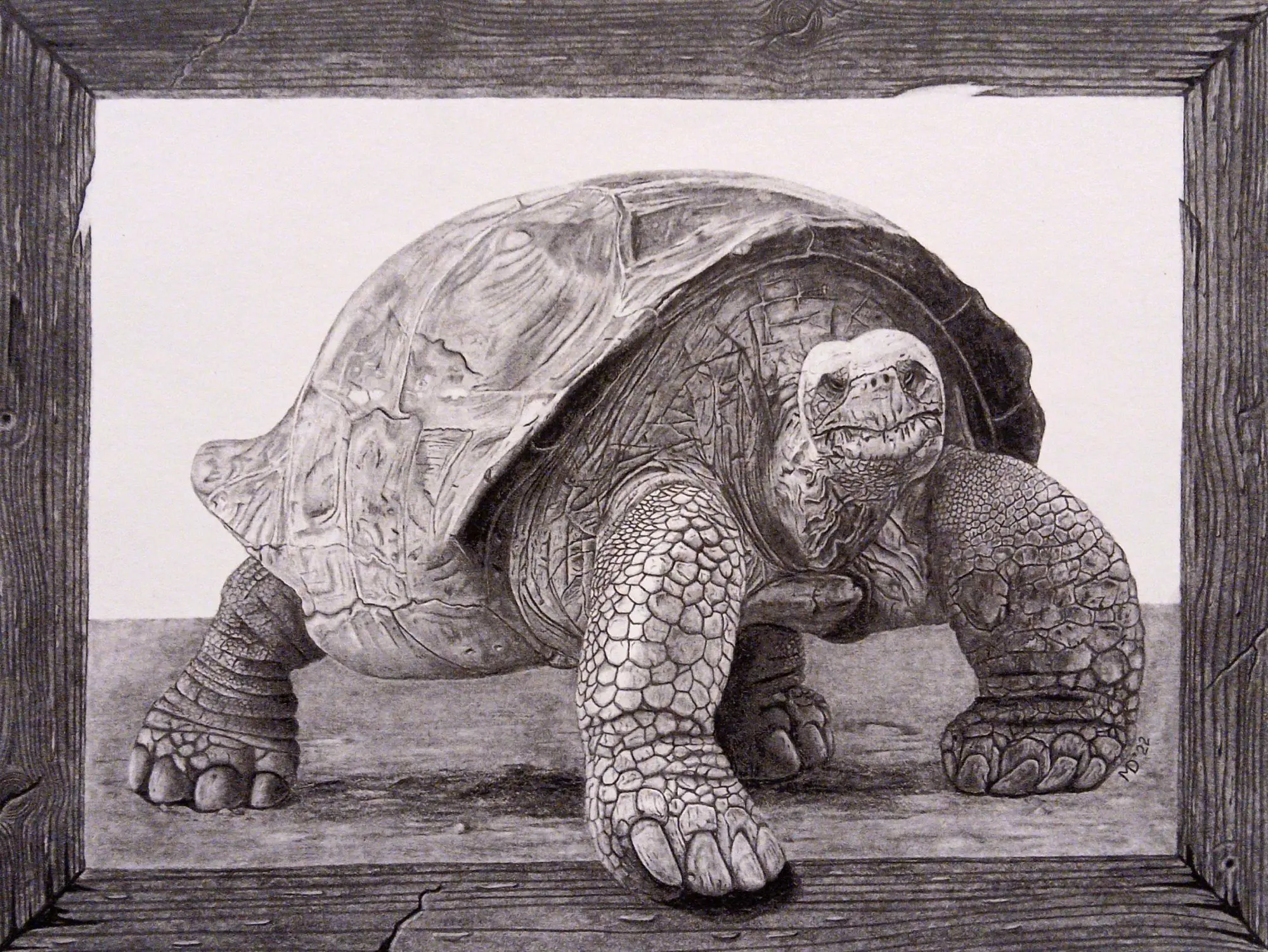
About the Galápagos Giant Tortoise Drawing
I had read about Galápagos Giant Tortoises for many years before I finally saw them in the islands themselves. At the Charles Darwin Research Station, I also saw Lonesome George, the last known Pinta Island Giant Tortoise, only two years before his death in 2012. Looking at a single living animal and knowing that an entire evolutionary lineage would disappear with him was a sobering experience.
My family had encountered Galápagos tortoises much closer to home as well. My friend Scott Pfaff, who headed the herpetology program at Riverbanks Zoo in Columbia, South Carolina, sometimes allowed my children, when they were young, to enter the giant-tortoise enclosure. They could feed the animals, sit on their immense shells, and experience at close range just how calm, solid, and seemingly timeless these animals can be.
One especially large male had an extraordinary history. I remembered Scott saying that the tortoise had come into the United States as an adult in 1929. I have not been able to verify that he was already mature at the time, but zoo records for a Riverbanks male named Abrazzo do trace back to a Texas zoo in 1929. By the time my children met him, he had therefore been in American zoos for roughly eighty years.
Abrazzo’s story continued long afterward. Riverbanks transferred him to the Philadelphia Zoo in 2020 as part of a managed breeding program. In 2025, at an estimated age of nearly one hundred, he and a similarly aged female produced 16 Western Santa Cruz Giant Tortoise hatchlings. An animal my children once sat upon eventually helped establish a new generation almost a century after his own history in captivity began.
Such longevity changes the way we think about an individual life. A Galápagos tortoise may outlive the people who care for it, the institutions that house it, and several generations of the same family. Some alive today may have hatched before automobiles, airplanes, or electric lighting became ordinary parts of human life.
The tortoises also occupy an important place in the history of biology. When Charles Darwin visited the Galápagos in 1835, local residents told him that tortoises from different islands could be recognized by the shapes of their shells. Domed tortoises generally occur on larger, wetter islands with abundant low vegetation, while saddle-backed forms have raised openings at the front of the shell that allow their longer necks to reach cactus and other elevated food in drier environments. These island differences became part of the larger pattern of variation that helped make the Galápagos central to evolutionary thought.
Unfortunately, the tortoises’ ability to survive drought and long periods without food or water also made them tragically useful to sailors and whalers. Thousands were collected from the islands and stacked alive in ships’ holds as a source of fresh meat during long voyages. Accounts of the whaling era, including Nathaniel Philbrick’s In the Heart of the Sea (excellent book by the way), describe animals enduring months of confinement before being killed for food. An extraordinary survival adaptation became the means by which humans exploited them.
Others were killed for oil, while introduced goats, pigs, rats, and other animals destroyed vegetation, competed for food, and consumed eggs and young tortoises. Several island forms became extinct. Lonesome George survived as the final known representative of the Pinta Island lineage despite decades of unsuccessful efforts to find him an appropriate mate.
Galápagos tortoises are more than unusually large and long-lived animals. They are ecosystem engineers. As they graze, browse, disperse seeds, trample vegetation, and follow familiar routes between feeding areas and water, they shape the island landscapes around them. Their disappearance changes not only the number of tortoises but also the structure and functioning of the ecosystems they once helped create.
This drawing is not intended to represent a particular island form, so I identify the animal simply as a Galápagos Giant Tortoise (Chelonoidis sp.). In Old Tortoise, Old Wood, I portrayed it stepping through a weathered wooden frame. The rough grain and cracks in the wood echo the textures of the shell, scales, and deeply folded skin.
Both the tortoise and the wood suggest age, endurance, and the passage of time, but the tortoise is not merely an emblem of the past. Animals such as Abrazzo connect distant eras: from the exploitation of wild tortoises and Darwin’s observations to modern conservation programs and hatchlings that may still be alive a century from now.
Old Tortoise, Old Wood is a graphite-pencil wildlife drawing of a Galápagos Giant Tortoise (Chelonoidis sp.) by Michael E. Dorcas for Tantilla Art.