
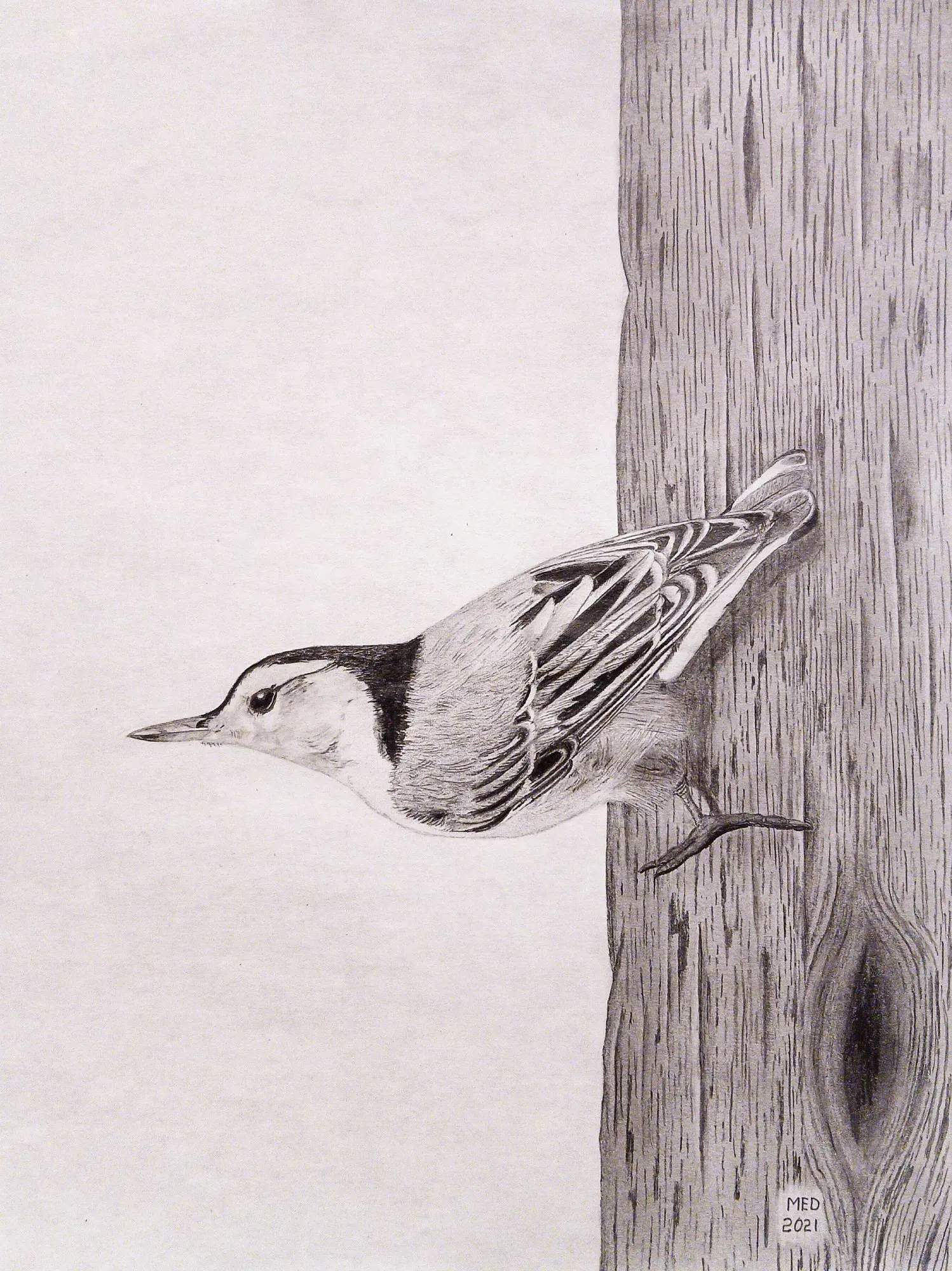
About the White-breasted Nuthatch Drawing
White-breasted Nuthatches have long been familiar visitors to my bird feeders. Despite their small size, they are energetic and distinctive birds, often announcing their arrival with a loud, nasal call before moving rapidly across a nearby trunk or branch.
What has always fascinated me most is the unusual way nuthatches move through trees. Rather than remaining upright, they travel sideways, upside down, and frequently headfirst down vertical trunks. This ability allows them to inspect bark from angles that many other birds cannot, searching crevices for insects, spiders, seeds, and other food.
White-breasted Nuthatches (Sitta carolinensis) occur across much of North America in mature forests, woodlots, parks, and neighborhoods with large trees. They readily visit feeders for sunflower seeds, peanuts, and suet. During autumn and winter, they often carry food away and hide it in bark crevices for later use. Their common name reflects another characteristic behavior: wedging a nut or seed into bark and striking it repeatedly with the bill to open it.
Pairs may remain together throughout the year and nest in natural cavities or abandoned woodpecker holes. Although they remain widespread and common, their dependence on mature trees and nesting cavities makes the preservation of wooded habitat important.
In Vertical Vagrant, I portrayed a White-breasted Nuthatch moving headfirst down a tree trunk in one of the unusual postures that makes these birds so entertaining to watch. The large vertical trunk and surrounding open space emphasize the bird’s small size, agility, and seemingly effortless ability to move across a surface that appears nearly impossible to navigate.
Vertical Vagrant is a graphite wildlife drawing of a White-breasted Nuthatch (Sitta carolinensis) by Michael E. Dorcas for Tantilla Art.