
During a 2012 trip to South Africa with my friend and colleague Whit Gibbons, we spent several days at Dinokeng Game Reserve in Gauteng, visiting colleagues and tracking Puff Adders before continuing to Kruger National Park and several of the private game reserves bordering the park.
At one of those reserves, we were fortunate enough to encounter African Wild Dogs (Lycaon pictus), also commonly called Painted Dogs, on two occasions. The first sighting was anything but restful. A pack was hunting impala, moving with such coordination that it seemed less like a collection of individual animals than a single living organism. Each dog appeared to understand its role as the pack spread across the landscape, their white-tipped tails flashing through the vegetation.
African Wild Dogs are among the most intensely social members of the dog family. Packs are extended family groups, usually centered on a dominant breeding pair, with other adults helping to guard, feed, and care for the pups. They travel over enormous areas and depend on cooperation not only while hunting, but also when defending kills, raising young, and supporting injured or weakened pack members. Because so much of their success depends on collective effort, the loss of even a few animals can threaten the stability and survival of an entire pack.
Three Spotted Hyenas and approximately ten White-backed Vultures followed wherever the pack went, apparently waiting for an opportunity to take advantage of a kill. The dogs eventually drove the impala into thicker woodland, beyond where our vehicle could follow, so we never saw the outcome. I have always liked to think that the pack ate well that day.
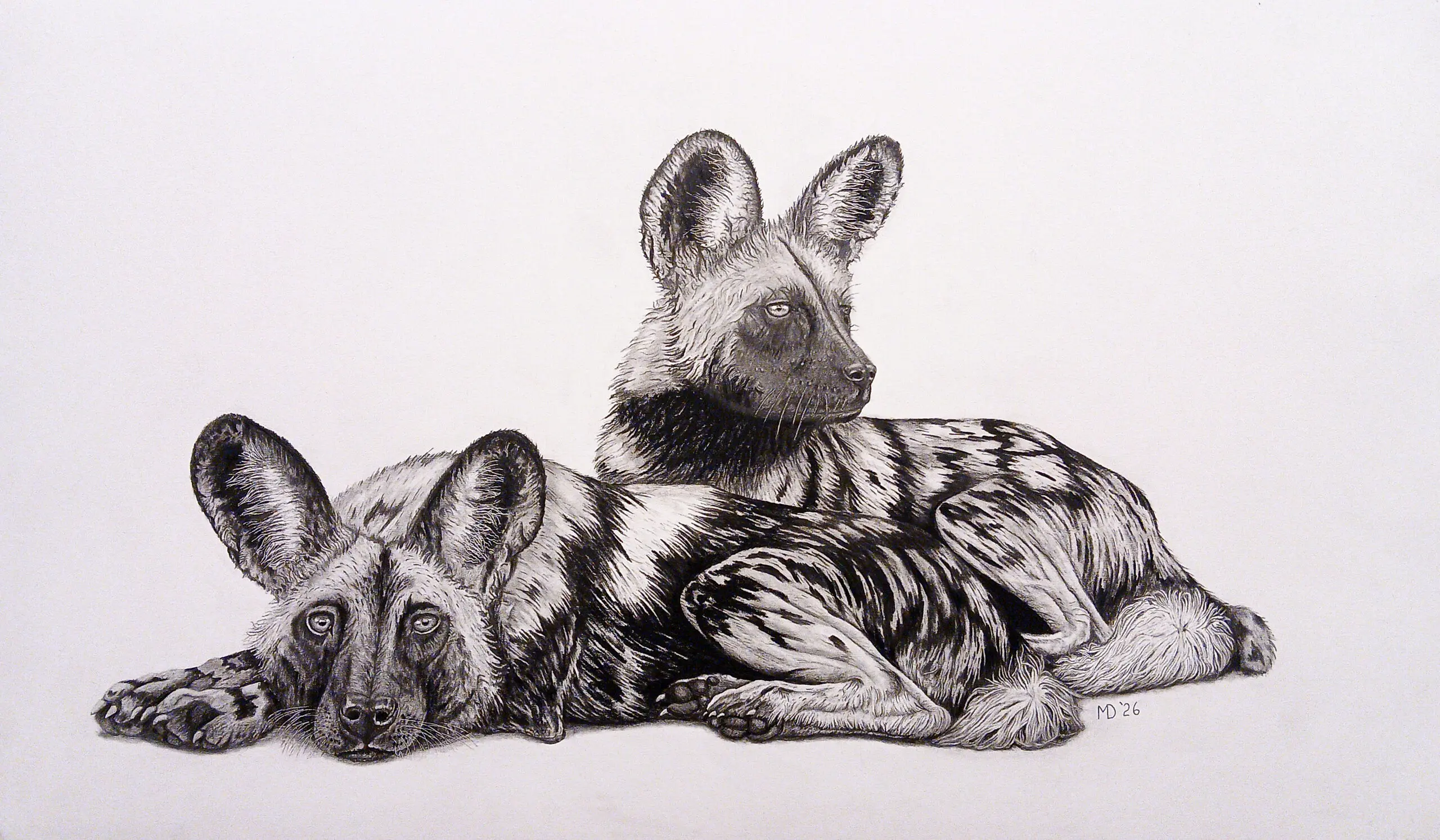
The following day, we encountered a much quieter scene. The pack was resting beneath trees in the cool shade of a dry wash. We sat nearby and watched the dogs sleep, stretch, and remain quietly attentive to one another while we ate our lunch. Perhaps they had hunted earlier that morning or were still satisfied from the previous day. Whatever the reason, the contrast was striking: animals capable of extraordinary speed and coordinated action resting together in complete peace.
No two African Wild Dogs have exactly the same pattern of black, brown, white, and gold across their coats—a characteristic that gives rise to the name Painted Dog. Once widespread across much of sub-Saharan Africa, the species is now classified as Endangered and survives primarily in fragmented populations in eastern and southern Africa. Its continued decline is driven by habitat loss and fragmentation, conflict with people, road mortality, accidental capture in snares, and infectious diseases transmitted by domestic dogs. Their need for extensive, connected landscapes makes the preservation of large protected areas and wildlife corridors especially important.
Between Hunts was inspired by that second encounter—the stillness, companionship, and calm that exist between the pack’s intense periods of collective effort.