
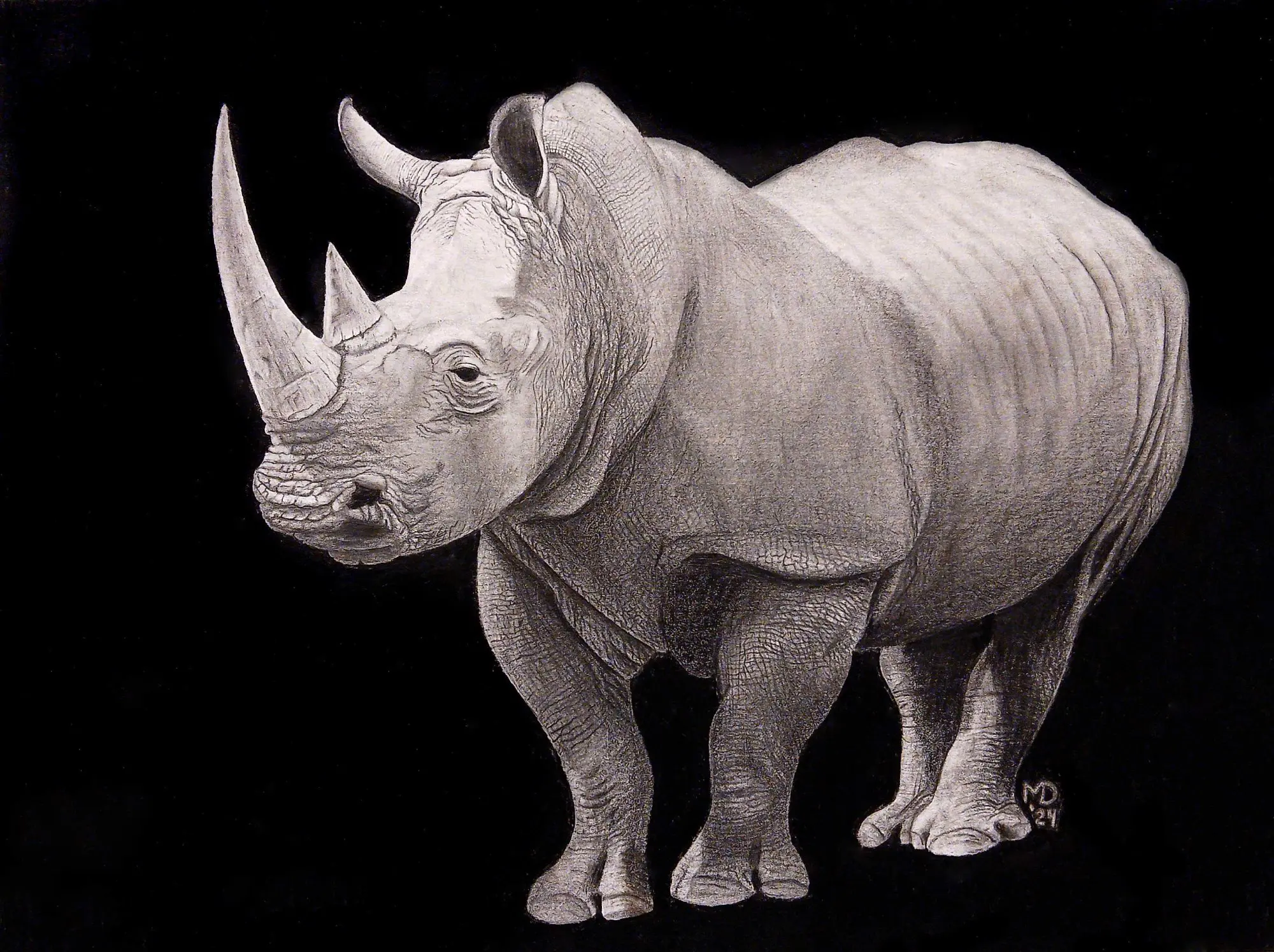
About the White Rhinoceros Drawing
Before I ever encountered a rhinoceros in the wild, I knew them only from zoos, books, and photographs. Seeing them in Africa was therefore unforgettable. I observed rhinoceroses during several visits to national parks in Kenya and Tanzania and later encountered White Rhinoceroses again in Kruger National Park in South Africa in 2012.
Nothing viewed through a zoo enclosure had fully prepared me for the presence of such an immense animal moving freely through the African landscape. White Rhinoceroses appear almost prehistoric, with massive bodies, deeply folded skin, broad heads, and two prominent horns. Yet what struck me most was the contrast between their extraordinary physical power and their profound vulnerability.
White Rhinoceroses (Ceratotherium simum) are the largest living rhinoceroses and among the largest terrestrial mammals after elephants. They are primarily grazers, using their broad, square lips to crop short grasses. Their long heads are normally carried close to the ground, and the muscular hump above the shoulders helps support the heavy skull while feeding.
Their grazing affects the structure of African grasslands. By repeatedly cropping vegetation, White Rhinoceroses help maintain areas of short grass that can also benefit smaller grazing animals. They require access to water and regularly wallow in mud, which helps them regulate body temperature and protect their skin from sunlight and biting insects.
Despite the common name, White Rhinoceroses are not white; their skin is essentially gray. A familiar explanation holds that “white” arose when English speakers misunderstood the Afrikaans word wyd, meaning “wide,” which referred to the animal’s broad mouth. Although this story is repeated widely, its linguistic history remains uncertain. The alternative name “square-lipped rhinoceros” describes the animal more accurately.
White Rhinoceroses are generally more social than Black Rhinoceroses. Females and calves may gather in small groups, while mature bulls establish territories that they mark with dung and urine. Although their eyesight is relatively limited, their hearing and sense of smell are highly developed. Their apparent calm should not be mistaken for helplessness; an alarmed rhinoceros can move with remarkable speed and force.
The Southern White Rhinoceros was reduced to fewer than 100 animals by the end of the nineteenth century. Intensive protection, carefully managed breeding populations, and translocations eventually restored the subspecies to many thousands, making its recovery one of the most important achievements in modern wildlife conservation. That success, however, remains fragile.
White Rhinoceroses continue to be killed for their horns, which are composed of keratin and have no proven medicinal value. The species remains classified as Near Threatened, and recent estimates indicate renewed population declines despite extensive protection. The Northern White Rhinoceros has been reduced to only two surviving females, providing a stark warning of how quickly even one of the world’s largest and most powerful animals can be pushed to the edge of extinction.
In Last Warrior, I placed the rhinoceros against a deep black background so that its massive form, broad muzzle, armored folds of skin, and long horns would emerge dramatically from the darkness. The title reflects the contrast that stayed with me after seeing these animals in Africa: a creature built like a living fortress, yet engaged in a struggle for survival that physical strength alone cannot win.
Last Warrior is a graphite wildlife drawing of a White Rhinoceros (Ceratotherium simum) by Michael E. Dorcas for Tantilla Art.