
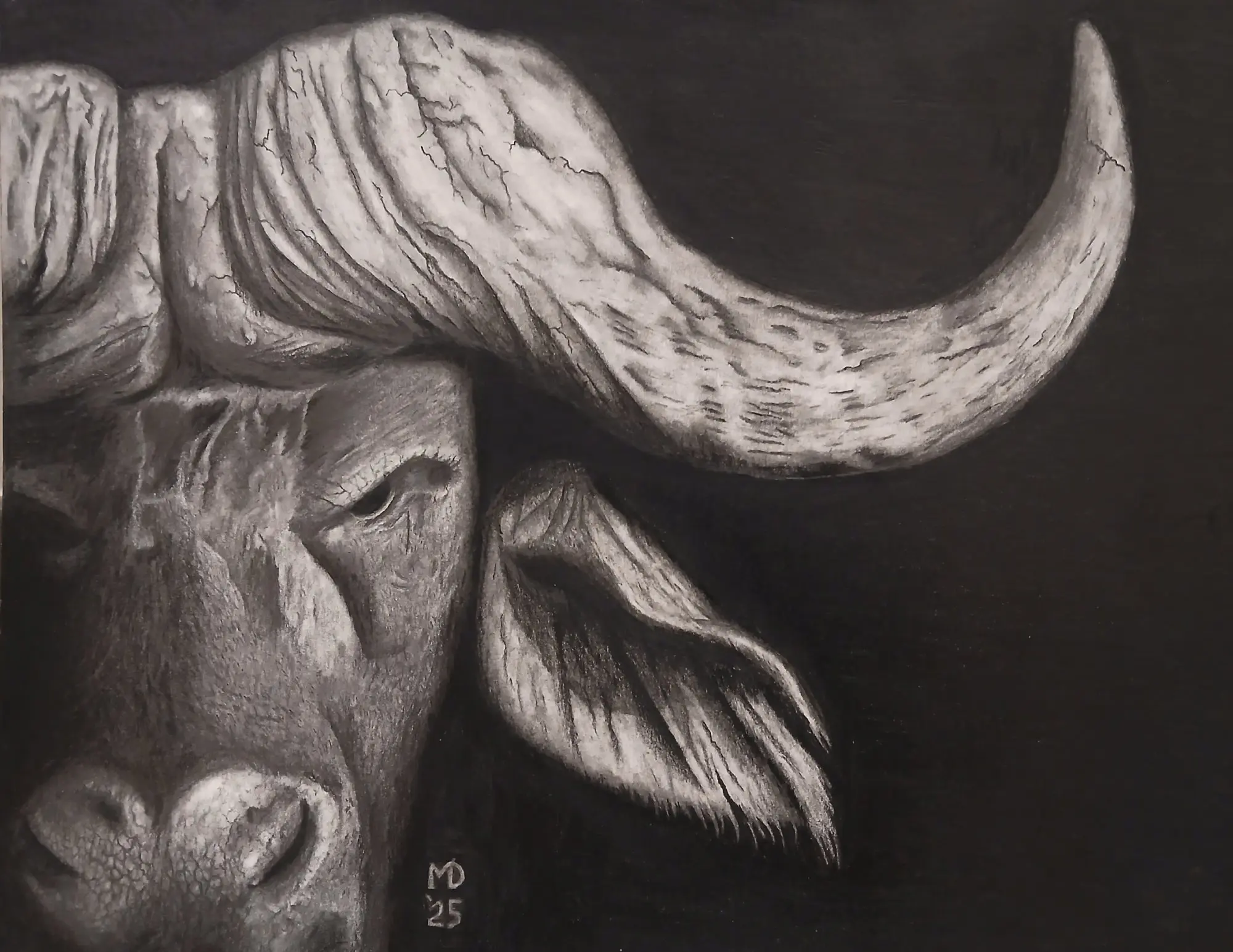
About the Cape Buffalo Drawing
I saw Cape Buffalo many times during four trips to Africa, but I first encountered them years earlier through Ernest Hemingway’s Green Hills of Africa. I read the book as a child and was fascinated by Hemingway’s descriptions of Africa’s “Big Five” and by the idea that hunting a Cape Buffalo could be even more dangerous than pursuing a lion or elephant.
At the time, I found it difficult to understand how an animal that looked, at first glance, rather like a large cow could be so formidable. Yet the image stayed with me. When I eventually saw Cape Buffalo in Africa, I immediately thought back to the animal I had pictured while reading Hemingway’s book and to the fascination those accounts had inspired.
Cape Buffalo (Syncerus caffer) are among Africa’s largest wild bovids. Mature bulls are powerfully built and can weigh well over half a ton. Their most distinctive feature is the massive horn boss that forms where the bases of the horns meet across the forehead. From that heavy shield, the horns sweep outward and then curve upward into sharp points.
Cape Buffalo commonly live in herds that may range from small groups to gatherings of hundreds of animals. Herds provide protection from predators, particularly lions, while older bulls sometimes leave the larger groups and live alone or in small bachelor groups. These solitary animals are sometimes called “dagga boys” because they frequently rest in mud or wallow in wet ground.
Buffalo are grazers and depend heavily on access to both grasslands and water. Their movements can help shape vegetation, while their grazing, dung, and role as prey connect them to many other parts of the African ecosystem. Lions are their principal natural predators, although a large adult buffalo can be exceptionally difficult and dangerous for even a group of lions to bring down.
Cape Buffalo have a longstanding reputation as one of Africa’s most dangerous large mammals, particularly when injured, threatened, or pursued. Their size, strength, sweeping horns, and willingness to defend themselves make close encounters potentially hazardous. I was content to admire them from a respectful distance and decided not to test Hemingway’s claim for myself.
Habitat alteration, hunting, disease, and competition with domestic livestock can affect Cape Buffalo populations. Diseases may also move between buffalo and cattle, making the relationship between wildlife conservation, livestock management, and nearby human communities especially complex in some parts of Africa.
In The Old Bull, I focused closely on the face, horn boss, and enormous curving horn of an aging Cape Buffalo. The tightly cropped composition, cracked horn, weathered hide, partially closed eye, and deep black background emphasize the strength, experience, and quiet but unmistakable presence of an old bull.
The Old Bull is a graphite wildlife drawing of a Cape Buffalo (Syncerus caffer) by Michael E. Dorcas for Tantilla Art.