
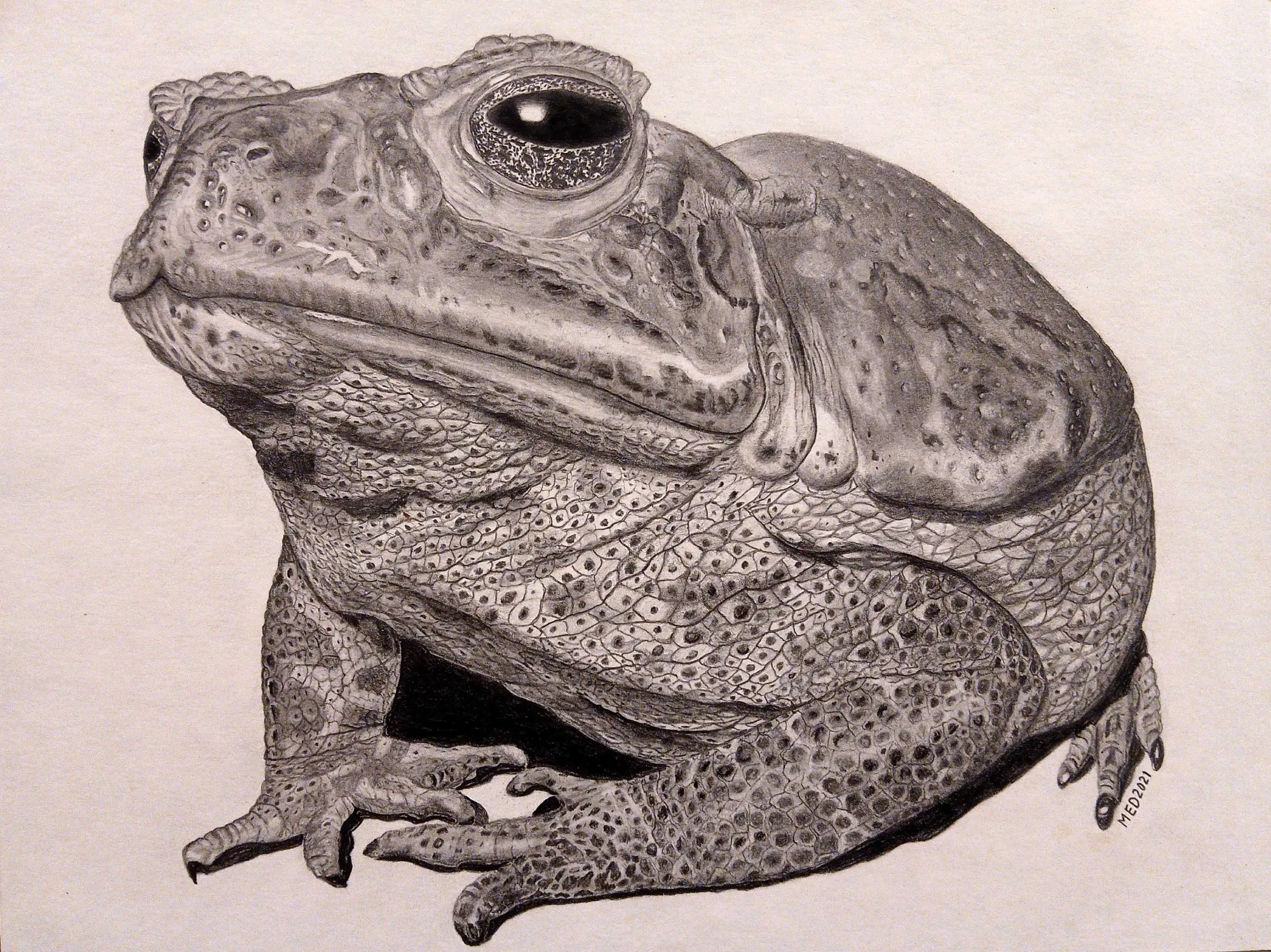
About the Giant Toad Drawing
I have encountered immense Giant Toads and their close relatives in Mexico and Central America, as well as introduced populations in southern Florida. I have also seen them in Queensland, Australia, where they are almost universally known as Cane Toads. The animal portrayed in Mama Grande was photographed by W. W. Lamar in Peru and represents the South American Giant Toad (Rhinella marina).
Large females can be particularly imposing, with broad heads, massive bodies, heavily textured skin, and enormous parotoid glands behind the eyes. Those glands contain potent defensive toxins that can be released when the toad is bitten, handled roughly, or otherwise threatened. The toxins affect the heart and nervous system and discourage many would-be predators.
Their defenses begin long before adulthood. Eggs, tadpoles, and newly transformed toadlets also contain toxic compounds, although the amount and composition change during development. A predator encountering one life stage may therefore learn to avoid the others as well.
Giant Toads are also extraordinarily productive breeders. Females deposit long strings containing thousands—and sometimes tens of thousands—of eggs in ponds, ditches, canals, and other still or slow-moving water. The tadpoles often form dense, dark schools. Combined with rapid development, broad diets, and an ability to live in disturbed environments, that reproductive capacity helps explain how introduced populations can expand so quickly.
In their native range, Giant Toads are impressive but ordinary members of tropical ecosystems. Predators there have shared a long evolutionary history with them. Some avoid the toads, some tolerate limited amounts of toxin, and others have developed behaviors that allow them to eat less dangerous portions of the animal.
In places where people introduced them, however, those same defenses can have severe ecological consequences. Cane Toads were released in Queensland in 1935 in an unsuccessful attempt to control beetles damaging sugarcane. The beetles were not controlled, but the toads survived, multiplied, and spread across much of northern Australia.
Native predators that attempt to swallow them may die from the toxins. The invasion has caused serious declines in some large monitor lizards, snakes, freshwater crocodiles, and Northern Quolls. The effects can spread through the ecosystem when the disappearance of one predator changes the abundance and behavior of other animals.
The invasion has also become an extraordinary experiment in evolution. Toads near the advancing edge developed traits associated with faster and farther movement, including proportionately longer legs. The invasion front accelerated as the descendants of the most mobile animals repeatedly became the first to colonize new territory.
Australian predators have responded as well. Some populations have evolved greater resistance to the toxins, while others have learned to avoid the toads or attack only smaller, less dangerous individuals. The encounter is therefore not a static battle between an invader and an unchanging ecosystem. Both the toads and the animals confronting them continue to change.
Seeing Cane Toads in Queensland was consequently very different from encountering Giant Toads within their native range. The same animal that belongs naturally within a South American ecosystem can become profoundly disruptive when transported into a community whose predators have no history with its chemical defenses.
In Mama Grande, I emphasized the female’s immense size and formidable presence. Her broad face, pronounced cranial ridges, enormous parotoid glands, and rough folds of skin dominate the composition, while her direct gaze gives her a calm but commanding personality.
The title reflects both her size and her presence. She is not shown fleeing, calling, or defending herself. She simply occupies the image with the solid confidence of an animal protected by one of the most effective chemical defenses among amphibians.
Mama Grande is a graphite-pencil wildlife drawing of a female South American Giant Toad (Rhinella marina) from Peru by Michael E. Dorcas for Tantilla Art. Reference photograph courtesy of W. W. Lamar.