
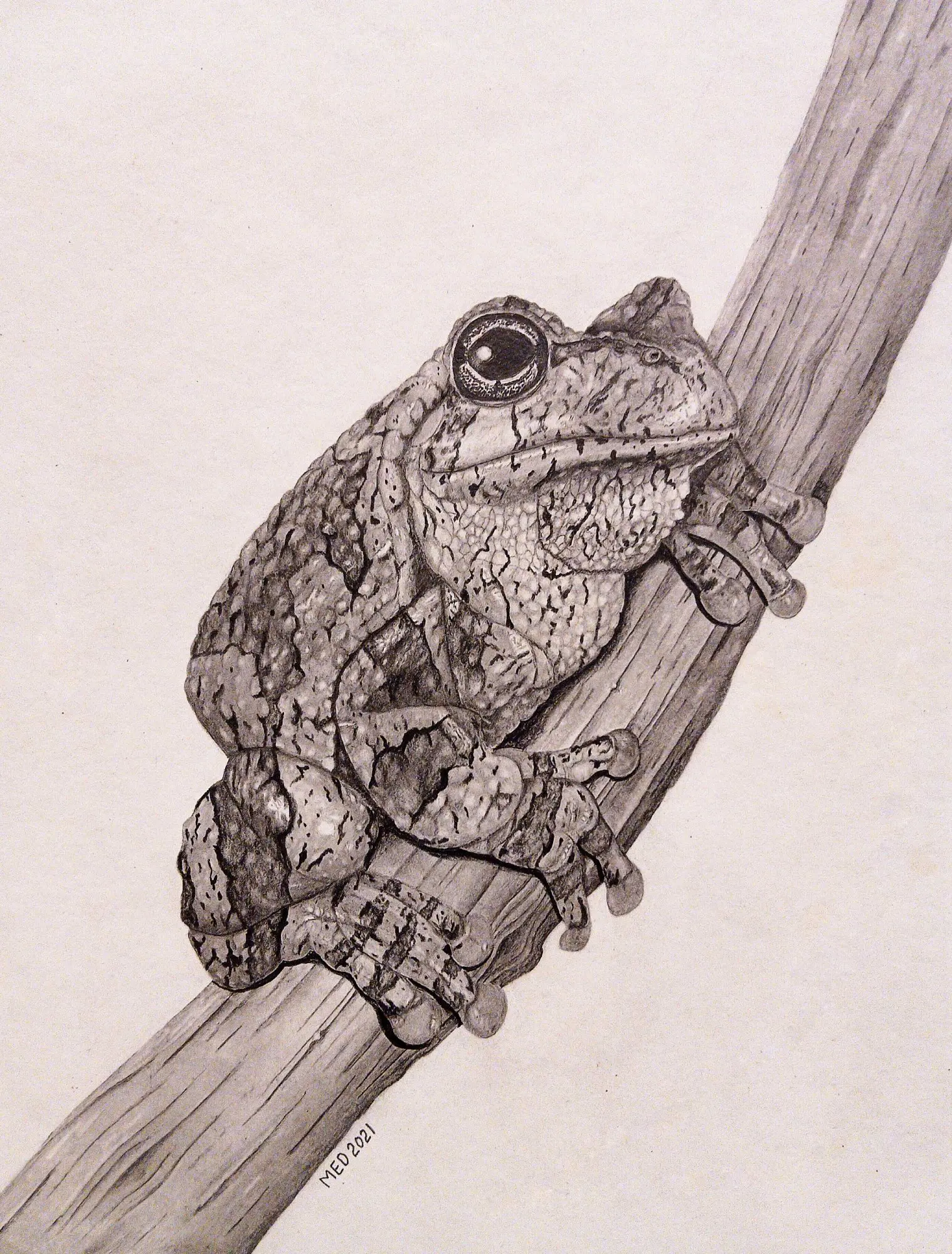
About the Cope’s Gray Treefrog Drawing
I have encountered thousands of Cope’s Gray Treefrogs (Hyla chrysoscelis) over the years, and they remain among my favorite frogs. Although their mottled coloration allows them to disappear almost completely against bark, lichen, and other natural surfaces, they are also frequently found around houses. On warm nights, they often cling to walls, doors, and windows near lights, taking advantage of the insects gathered there.
Their common name can be slightly misleading because they are not always gray. Depending on temperature, light, background, and physiological condition, an individual may shift among shades of gray, brown, and green. The change is not instantaneous, but a frog that appears dull and dark at one moment may become noticeably greener or paler later. Even when the overall color changes, the irregular pattern helps break up the outline of the body.
Hidden beneath the hind legs is another surprise: bright orange or yellow coloration that is usually concealed while the frog rests. When it leaps, the sudden flash may briefly startle or confuse a predator. A frog that appears almost indistinguishable from tree bark can therefore transform in an instant into a moving burst of color.
When I was a child, I kept two males in my bedroom. During the spring and summer, the ringing telephone would sometimes stimulate them to begin calling. Their rapid, pulsing trills could suddenly fill the room, providing an early lesson in how strongly male frogs respond to sounds resembling the calls of other frogs. The telephone apparently supplied enough of the appropriate rhythm or acoustic disturbance to convince them that another male had begun calling nearby and that they should join the competition.
A breeding chorus can become remarkably loud. Males call from trees, shrubs, or vegetation surrounding temporary ponds, flooded fields, and woodland wetlands. The trill advertises both species identity and the presence of an individual male. Females approaching a pond must locate an appropriate mate while listening through the overlapping calls of many frogs, insects, and other nighttime sounds.
Cope’s Gray Treefrogs are part of an especially interesting species complex. They are physically indistinguishable from Eastern Gray Treefrogs, Hyla versicolor, but the two differ in chromosome number and advertisement call. Cope’s Gray Treefrog is diploid, with two sets of chromosomes, whereas H. versicolor is tetraploid, possessing four sets.
Their calls provide the most practical way to distinguish them in the field. At the same temperature, Cope’s Gray Treefrog produces a faster, more rapidly pulsed trill, while the call of H. versicolor is slower and more easily heard as a series of separate pulses. Because call speed changes with temperature, the comparison must be made carefully, but females are remarkably capable of recognizing the temporal pattern of their own species.
That distinction is essential where the two occur together. A female may encounter males that look identical and call from the same general breeding habitat, yet she must select a genetically compatible mate. Differences in call structure therefore act as a reproductive boundary between species that human observers cannot reliably separate by appearance.
The close evolutionary relationship between these frogs, and the origin of the tetraploid form, have made them important subjects in studies of polyploidy, mate recognition, acoustic communication, and speciation. Genome duplication can instantly create a major reproductive divide, but the new lineage must also develop or retain signals that allow individuals with the same chromosome number to recognize one another.
Their biology is remarkable in winter as well. Cope’s Gray Treefrogs overwinter beneath leaf litter, bark, logs, or other shallow cover rather than escaping far below the frost line. During severe cold, portions of their body water can freeze. The frogs accumulate glucose, glycerol, urea, and other compounds that help protect cells from damage during freezing and thawing. An animal capable of producing a summer chorus from the bedroom wall may have survived the previous winter partly frozen beneath the leaves.
In Trill, I portrayed the frog clinging to a narrow branch, emphasizing its textured skin, large reflective eye, expanded toe pads, and the remarkable camouflage that allows these familiar frogs to remain nearly invisible. The toe pads permit it to climb bark, leaves, glass, painted walls, and other vertical surfaces, explaining why these woodland frogs so often become temporary residents of porches and windows.
The title refers to the sound that has always defined the species for me. A Cope’s Gray Treefrog may disappear visually against the surface beneath it, but once a male begins calling, the rapid trill announces his presence with an enthusiasm entirely out of proportion to his size.
Trill is a graphite-pencil wildlife drawing of a Cope’s Gray Treefrog (Hyla chrysoscelis) by Michael E. Dorcas for Tantilla Art.