
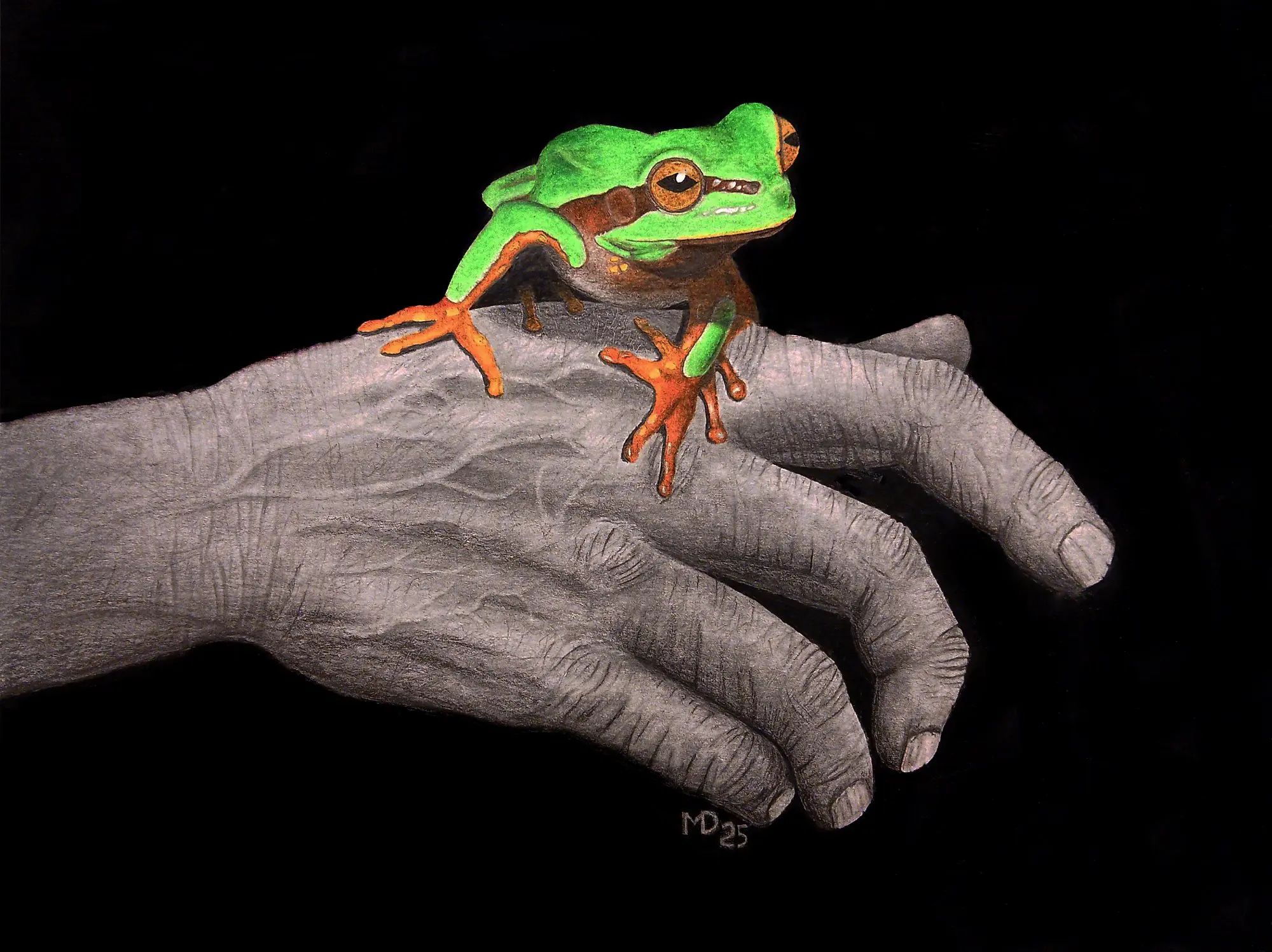
About the Pine Barrens Treefrog Drawing
I have encountered Pine Barrens Treefrogs (Hyla andersonii) only once in the wild, in the Sandhills of South Carolina. Like many secretive frogs, the animal revealed its presence first through its voice. Somewhere within the vegetation came a loud, nasal call that seemed entirely out of proportion to the size of the frog producing it.
Following frog calls through dense vegetation can be surprisingly difficult. The sound seems to move as you change position, and a calling male may be concealed only a few feet away while remaining almost impossible to see. Eventually, the search led me and my colleague to what seemed like several loud jewels hidden among the leaves—brilliant green, delicately marked, and far more colorful than anything their surroundings had prepared me to expect.
Male Pine Barrens Treefrogs call during the warmer months from shrubs, grasses, or the ground near shallow water. Their call is often described as a nasal “honk” or “quonk,” repeated several times in succession. A chorus can carry through the forest at night, announcing the presence of frogs that may remain completely hidden from view.
Pine Barrens Treefrogs have one of the strangest distributions of any eastern North American amphibian. They occur in three widely separated regions: the Pine Barrens of New Jersey, the Sandhills of North and South Carolina, and parts of the Florida Panhandle and adjacent Alabama. Vast areas separate those populations.
Modern genetic research indicates that this fragmented distribution is not simply the result of recent habitat destruction. The populations have a long evolutionary history of isolation, probably shaped by ancient climatic changes and survival in separate refuges. The frogs found in the Carolina Sandhills are therefore part of a distinctive regional lineage that has persisted through long periods of environmental change.
In South Carolina, they occupy a highly specialized landscape. Water draining through the deep sandy soils of the Sandhills emerges along lower slopes as clear, shallow seepage. These wet areas support sphagnum moss, pitcher plants, sundews, orchids, shrubs, and other vegetation associated with acidic bogs and pocosins.
The water can be far more acidic than that used by many other frogs. Pine Barrens Treefrog eggs and tadpoles are adapted to those conditions, allowing the species to breed where some potential competitors and predators are less successful. What might appear to us as an inhospitable, nutrient-poor pool is precisely the environment on which these frogs depend.
Females deposit their eggs among sphagnum and aquatic vegetation in shallow, often fishless water. The tadpoles must develop and transform before temporary pools dry or water levels fall too far. A breeding season that begins with a loud chorus can therefore succeed or fail depending on rainfall, groundwater, and the persistence of only a few inches of water.
The surrounding pine forest is equally important. Historically, these landscapes burned regularly. Fire prevented shrubs and trees from completely overtaking the seepage bogs, maintaining the open, sunny conditions needed by many of their characteristic plants and animals.
When fire is excluded, woody vegetation grows denser. That growth can shade breeding areas, alter the plant community, increase water loss through transpiration, and reduce the seepage that keeps the bog wet. Prescribed burning may therefore protect a frog that spends much of its life near water—not by burning the wetland itself indiscriminately, but by maintaining the larger fire-shaped landscape that allows the seep to exist.
Drainage, groundwater withdrawal, road construction, development, fire suppression, and changes in water chemistry can each damage these small habitats. Because suitable breeding wetlands are naturally scattered, the destruction of a single seep may eliminate an entire local population rather than merely displace the frogs to the next pond.
Their brilliant appearance seems almost inconsistent with such a secretive life. Pine Barrens Treefrogs combine vivid green backs with lavender or chocolate-colored side markings bordered in white. Hidden surfaces of the legs carry flashes of orange and yellow that may remain invisible until the frog moves.
Those colors are striking when the animal is held in the hand, yet remarkably effective among wet leaves, sphagnum, shrubs, and filtered forest light. The frog I had followed by sound seemed conspicuous only after I finally knew exactly where to look.
In On Hand, I used colored pencil for the frog while rendering my hand in graphite. The contrast isolates the animal’s vivid coloration and delicate form while preserving the personal connection of a brief field encounter. The human hand provides scale, but it also represents the moment when a disembodied call from somewhere in the darkness became an individual animal I could see closely.
The title is intentionally simple. The frog is literally resting on my hand, but the image also reflects the responsibility that comes with holding such a specialized animal. The survival of the Pine Barrens Treefrog depends on small, easily overlooked wetlands and on maintaining the water, fire, vegetation, and surrounding landscape that keep them alive.
On Hand is a colored-pencil and graphite wildlife drawing of a Pine Barrens Treefrog (Hyla andersonii) by Michael E. Dorcas for Tantilla Art.