
About the Snowy Owl Drawing
I saw a Snowy Owl only once, during the time I was working on my Ph.D. in Idaho. One winter, a bird was reported in a pasture west of Pocatello, so I headed out alone in our little Mazda 323 to look for it. The weather was terrible, with heavy snow, strong winds, and drifts crossing the road. I came over a rise and drove directly into one of those drifts, burying the car and leaving myself stranded in the middle of nowhere.
I walked about two miles back through the blowing snow until I reached a farmhouse. Through a window, I could see a man sitting at his breakfast table. He graciously let me inside, gave me coffee, and allowed me to call a tow truck. Once the driver pulled the Mazda free, I had to follow his truck back out to make sure I did not get stuck again. Driving through a blizzard in a small sedan to look for an owl was not one of my smarter decisions.
I returned two days later under much better conditions and finally found the bird. It was sitting on the ground where it was supposed to be (it had apparently read the rare bird alert and obliged me) in an open pasture about thirty yards from the road. After all the trouble, seeing that extraordinary white owl against the winter landscape made the trip worthwhile. During my five years in Idaho, I encountered an impressive variety of owls, including Great Horned, Barn, Great Gray, Northern Pygmy, Northern Saw-whet, Burrowing, Screech, Long-eared, and Short-eared Owls, but the Snowy Owl remains one of the most memorable. I got the bird.
Snowy Owls (Bubo scandiacus) breed on open Arctic tundra, where they feed heavily on lemmings and other small mammals, although they also take birds and larger prey. Unlike most owls, they frequently hunt during daylight – an essential adaptation during the nearly continuous daylight of the Arctic summer. Their movements are highly nomadic, and in some winters unusually large numbers travel south into open fields, grasslands, shorelines, and agricultural landscapes. These irruptions often follow productive breeding seasons rather than simply indicating that starving birds have been driven south.
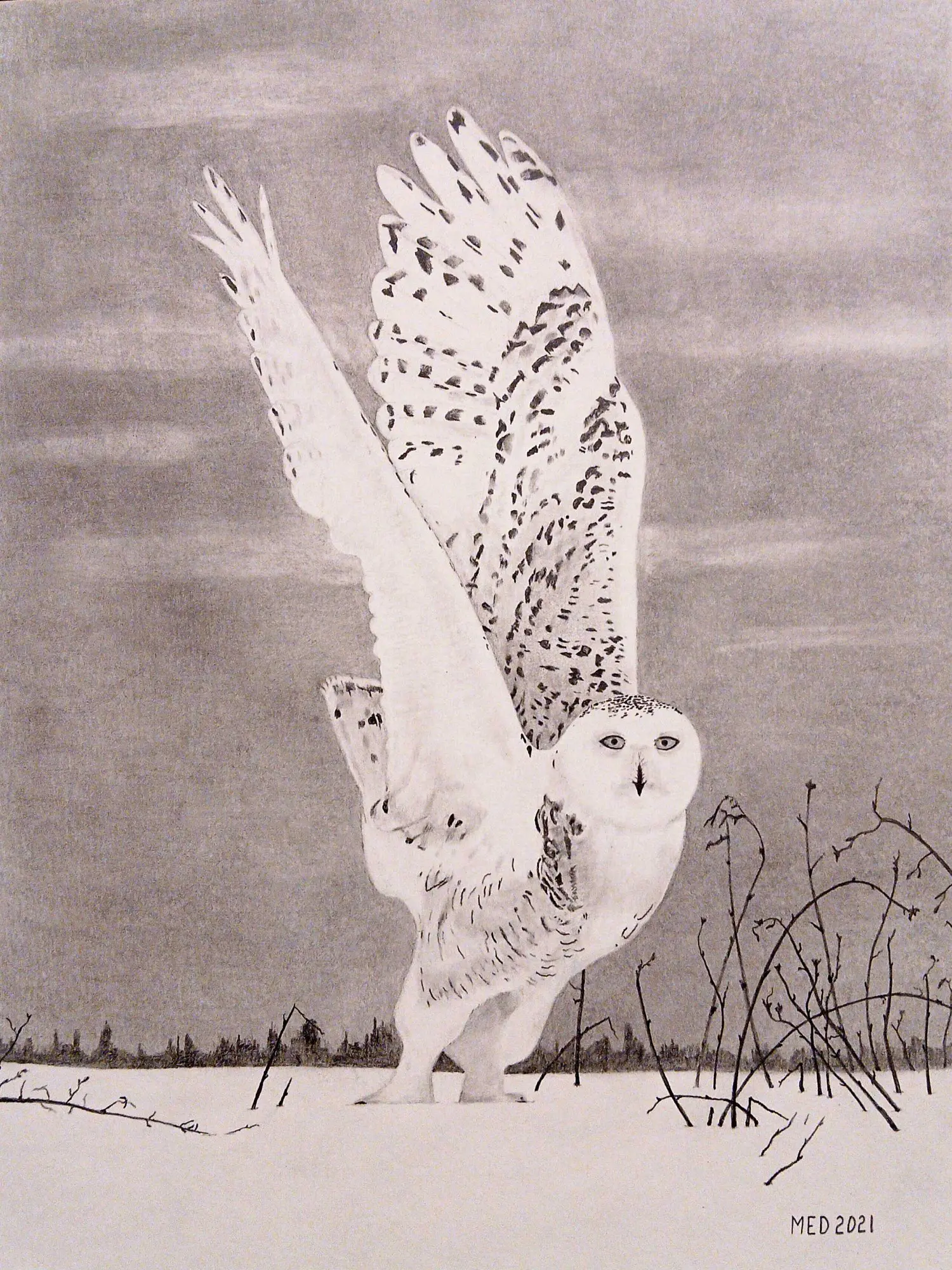
Plumage varies considerably with age and sex. Adult males generally become whiter as they mature, while females and younger birds retain more extensive dark barring and spots. The heavily marked bird in Northern Ghost could therefore represent a female or an immature individual.
Snowy Owls are difficult to count because they breed across remote Arctic regions and move unpredictably from year to year. Newer population estimates suggest that they are substantially less numerous than once believed, and the species is globally classified as Vulnerable. Climate-driven changes in Arctic ecosystems, collisions, disturbance, and other human-related causes of mortality remain important conservation concerns.
In Northern Ghost, I portrayed the owl standing in the snow with its broad wings raised as it begins to take flight. The dark markings across the otherwise white plumage emerge against the muted winter sky, while the direct gaze gives the bird a powerful and almost spectral presence. The title reflects the way a Snowy Owl can seem to materialize from an open northern landscape.
Northern Ghost is a graphite wildlife drawing of a Snowy Owl (Bubo scandiacus) by Michael E. Dorcas for Tantilla Art.